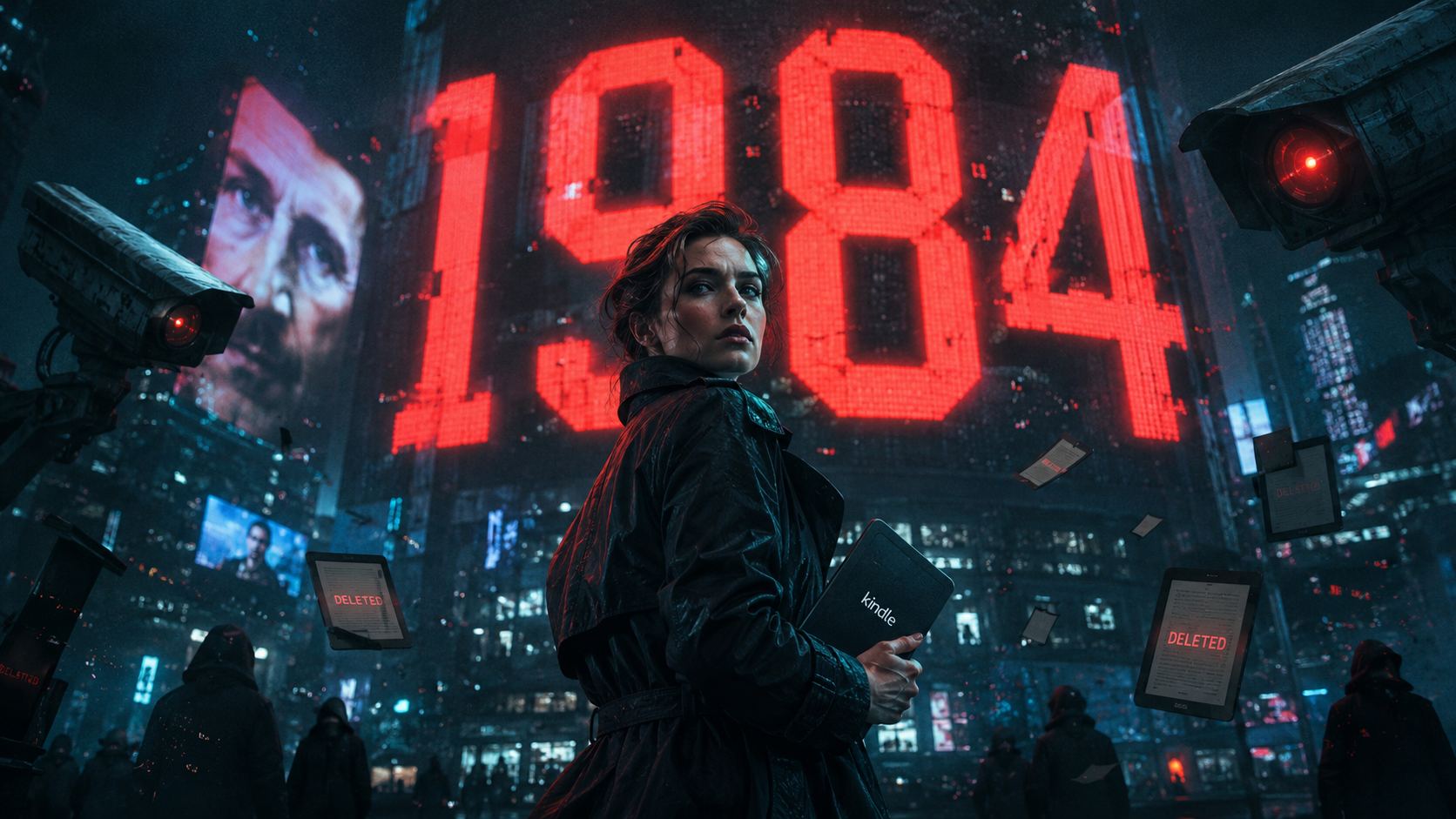
In 2009, Amazon delivered one of the most brutally ironic tech moments of the digital age: it remotely deleted copies of George Orwell’s 1984 from customers’ Kindle devices.
Not a parody. Not a Black Mirror pitch. The book famous for state-controlled truth, disappearing records, and the “memory hole” was itself vanished from people’s e-readers.
The reason was legal, not ideological: the Kindle editions had reportedly been sold by a third party that did not have the rights. But the optics were catastrophic. Amazon later apologized, offered replacements or compensation, and Jeff Bezos called the move “stupid, thoughtless and painfully out of line with our principles,” according to Reuters.
- What happened in 2009
- Why the 1984 deletion mattered
- The digital ownership problem
- Why this story still hits today
- Amazon deleting 1984: key questions
What happened in 2009
Amazon removed unauthorized Kindle editions of George Orwell’s 1984 and Animal Farm from customers’ devices after discovering that the seller did not have the legal rights to distribute them.
Customers were refunded, but that did not erase the bigger issue: books people thought they had bought simply disappeared from their devices.
For a physical book, that would be unthinkable. A bookstore cannot break into your house, take a paperback off your shelf, and leave a refund on the table. But with cloud-tethered digital goods, the rules were suddenly much stranger.
Why the 1984 deletion mattered
The symbolism was impossible to ignore.
1984 is not just any novel. It is one of the most famous warnings about surveillance, censorship, and centralized control over information. So when Amazon remotely removed it from Kindle libraries, the internet did what the internet does best: it noticed the irony instantly.
The issue was not that Amazon wanted to censor Orwell. The issue was that Amazon could erase a book after purchase.
That distinction matters. Intentions can vary. Infrastructure remains.
The Kindle removal of 1984 highlighted how ebooks differ from traditional printed books.
The digital ownership problem
The Kindle incident became a clean example of a messy modern problem: when you “buy” digital media, what do you actually own?
In many ecosystems, users are not buying a permanent object. They are buying access under a license, managed by a platform, wrapped in terms of service, and dependent on servers, accounts, and DRM.
That model powers ebooks, games, movies, apps, software, and cloud media libraries. It is convenient. It is scalable. It is also fragile.
Your library can depend on rights disputes, account status, platform policy, licensing changes, regional restrictions, or the continued existence of the service itself.
Why this story still hits today
The 2009 Kindle deletion still feels relevant because digital ownership has only become more normal since then.
Games vanish from storefronts. Movies disappear from streaming libraries. Music changes platforms. Apps get pulled. Cloud services shut down. Even purchased content can become harder to access when licenses shift or companies change strategy.
Amazon’s 1984 moment became a warning label for the platform era: digital convenience often comes with remote control baked in.
The lesson is not “ebooks are bad.” It is simpler and sharper: ownership means less when someone else still holds the delete button.
The Kindle 1984 episode became a defining moment in the history of digital media.
Amazon deleting 1984: key questions
Did Amazon really delete 1984 from Kindles?
Yes. In 2009, Amazon remotely removed unauthorized Kindle editions of George Orwell’s 1984 and Animal Farm from customers’ devices.
Why did Amazon remove the book?
The editions had reportedly been sold by a third party that did not have the rights to distribute them.
Did customers get refunds?
Yes. Amazon refunded affected customers and later offered replacement copies or compensation.
Why was the incident so ironic?
Because 1984 is a novel about surveillance, censorship, and the rewriting or destruction of information.
What is the bigger lesson?
Digital purchases often depend on platform control, licensing, and DRM. Buying access is not always the same as owning a permanent copy.