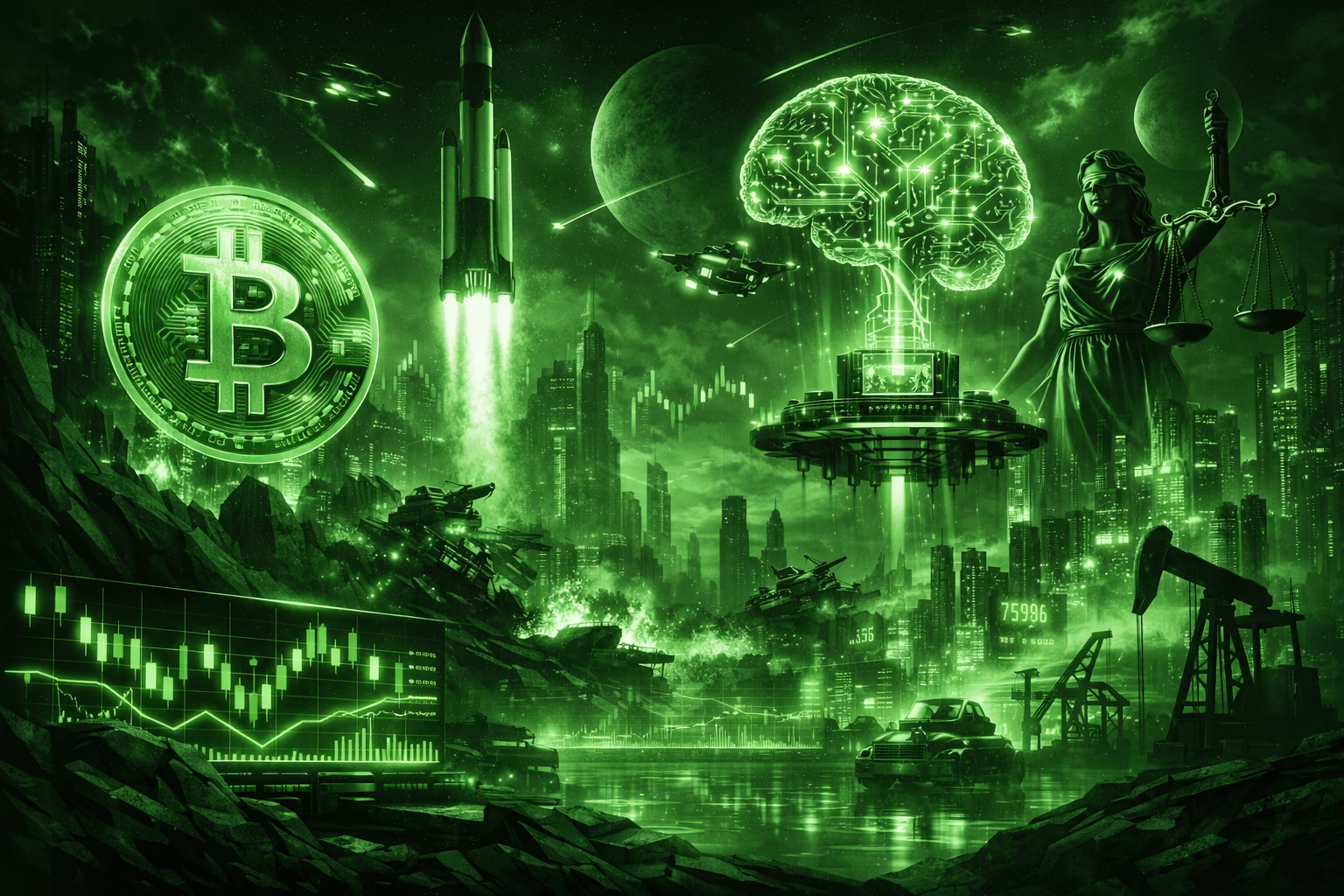
There are moments when markets cease to be mere economic mechanisms and become the stage for a grander, almost mythological narrative. What we are living through today resembles an initiation trial, a narrow passage where uncertainty, technological hope, and real-world tensions intertwine.
The old hands of finance know it well: great crashes never arrive without a ruckus. It takes a shock, sometimes two, rarely fewer. And now, three forces, like unsettling celestial bodies, seem to be converging on the horizon: slowing growth, geopolitical tremors, and the iron discipline of central banks. Nothing is decided yet, but the very atmosphere feels charged with electricity, like the air before a storm.
Table of contents
- Markets between fear and hope
- Bitcoin and the fading safe-haven narrative
- SpaceX, Meta, and the strange resilience of markets
- AI, oil, and consumer signals
- A financial era defined by uncertainty
- Market uncertainty: key questions
Markets between fear and hope
In this shifting fresco, Bitcoin, once proclaimed “digital gold”, is wavering. It no longer glimmers with the confidence of a safe haven, but pitches and rolls on a sea of fear and doubt. War looms, inflation persists, the rules of the game remain unclear, and risk appetite, like a fragile flame, struggles to stay lit.
What was meant to be a sanctuary has become a restless sea.
Yet at the heart of this uncertainty, certain promises continue to shine. SpaceX, herald of humanity’s most audacious ambitions, may soon open its doors to the markets. Staggering figures are being whispered, colossal fundraising rounds, as if the conquest of space itself is now seeking a place in investment portfolios. The infinite still beckons, even in troubled times.
Bitcoin and the fading safe-haven narrative
Bitcoin’s current hesitation says a great deal about the mood of investors. For years, it was presented as an asset capable of standing apart from traditional finance, a digital refuge in a world of monetary uncertainty.
But markets rarely preserve myths forever. When fear rises, liquidity tightens, and geopolitical risk spreads, Bitcoin often behaves less like a shelter and more like a high-volatility risk asset.
That does not erase its long-term appeal. It simply complicates the story. The idea of Bitcoin as “digital gold” remains powerful, but each period of stress forces investors to ask whether that label describes what Bitcoin is today, or what many still hope it will become.
SpaceX, Meta, and the strange resilience of markets
Closer to earth, the battles are more ordinary but no less revealing. Meta faces the courts, absorbing the blows of a justice system that is questioning the power of social networks. Yet the markets, unmoved and barely stirring, seem to look the other way, as if legal gravity weighs less than the promise of future growth.
This tension is one of the defining features of the current environment. Investors can acknowledge risk without immediately retreating from it. They can recognise regulatory pressure, legal threats, or political uncertainty, and still decide that growth, scale, and future earnings matter more.
In that sense, Meta becomes a symbol of a broader market reflex: punishment is not automatic. As long as the promise remains large enough, markets may continue to tolerate turbulence.
AI, oil, and consumer signals
And then there is technology, ever-present and untameable. ARM rises, carried by the vision of a broader, almost universal artificial intelligence. The very idea of an artificial mind capable of transforming the economy fuels imaginations and draws in capital. Amid the turmoil, innovation remains a compass.
Meanwhile, older forces continue their work. Oil, the eternal barometer of human tensions, flares at the slightest geopolitical spark. Energy companies thrive in this disorder, reminding us that some always profit from troubled times.
But perhaps it is in the simplest gestures that the deepest truth is revealed. When consumers slow down, when spending becomes more cautious, the entire economic machinery begins to breathe differently. The results of companies like Next become precious indicators, almost whispers about the state of the real world.
A financial era defined by uncertainty
This, then, is the shape of our financial era: neither brutal collapse nor triumphant ascent, but an uncertain, cautious, almost strategic progression. Investors move forward, but glance over their shoulders. They seize opportunities while keeping one hand on the safety net.
This is not a collapse, nor a golden age. It is an in-between, an unstable territory where every decision carries more weight, where every signal is scrutinised.
The game goes on, but the level has changed. And those who venture into it must now balance boldness with vigilance, like explorers walking a narrow ridge between sky and abyss.
Market uncertainty: key questions
Why are markets so sensitive to uncertainty?
Markets are forward-looking. They do not only react to what is happening now, but also to what investors believe may happen next. That makes them highly sensitive to inflation, interest rates, geopolitical tensions, and corporate results.
Is Bitcoin still considered digital gold?
Bitcoin is still often described as “digital gold”, but its behaviour during periods of stress can resemble that of a volatile risk asset. Its safe-haven status remains debated.
Why does artificial intelligence still attract investors during uncertain markets?
Artificial intelligence is seen as a long-term growth driver. Even when markets become cautious, investors may continue to support companies connected to AI if they believe the technology can reshape productivity, infrastructure, and future earnings.
How do oil prices affect financial markets?
Rising oil prices can increase inflationary pressure, raise costs for businesses and consumers, and complicate the decisions of central banks. They also tend to benefit energy companies.
Why are consumer spending signals important?
Consumer spending reflects the health of the real economy. When households become more cautious, companies can feel pressure on revenue, margins, and growth expectations.
What kind of strategy can work in uncertain markets?
In uncertain markets, investors often look for resilience: strong cash flow, solid balance sheets, pricing power, and companies less dependent on easy financing or speculative growth narratives.