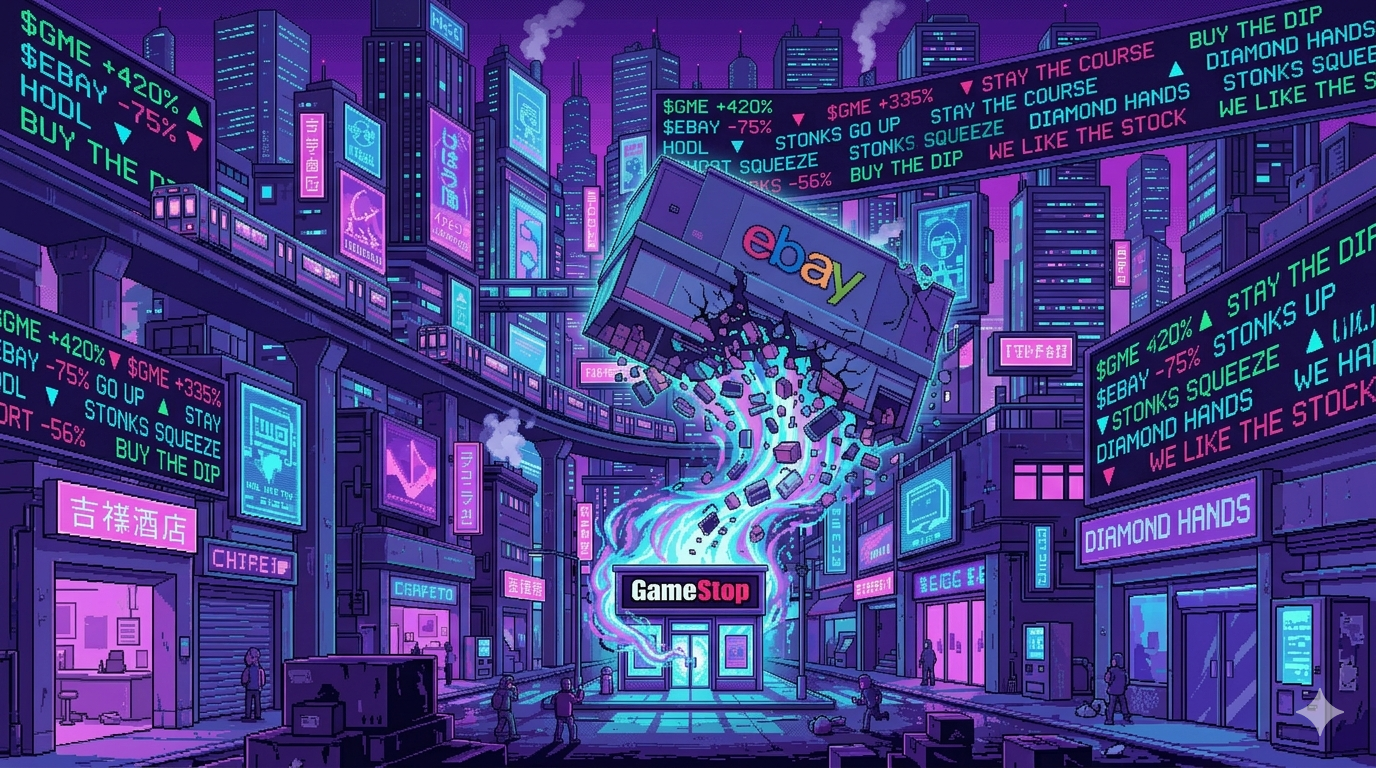
A $12 billion company just bid $55.5 billion for a business four times its size. Using meme stock currency. Without talking to the target first. In 2026.
Welcome to the Ryan Cohen cinematic universe — where the rules of corporate finance are optional and the main quest never ends.
Table of contents
- What Actually Happened
- The Backstory: Ryan Cohen’s Final Boss Run
- The Deal Structure: Numbers That Make Your Head Spin
- The Strategic Vision: Amazon Killer or Collectibles King?
- What the Experts Are Saying
- So — Genius or Glitch?
- GameStop and eBay deal: key questions
What Actually Happened
On May 3, 2026, GameStop submitted an unsolicited, non-binding proposal to acquire 100% of eBay at $125 per share — half cash, half GME stock. Total deal value: $55.5 billion. GameStop’s own market cap at the time? Just under $12 billion.
eBay confirmed receipt of the offer on Monday. Their statement noted there had been “no prior discussion or outreach” with GameStop before the offer landed. Ryan Cohen told CNBC he hadn’t spoken to eBay’s management at all. “We are just starting,” he said in what multiple outlets described as a combative interview. “For obvious reasons, eBay is a public company — there’s all kinds of perverse financial incentives from the board to the management team. So there’s only one way to approach something like this.”
Translation: he went hostile from the jump.
The Backstory: Ryan Cohen’s Final Boss Run
This didn’t come out of nowhere. Cohen has been telegraphing a massive acquisition for months. In January 2026 he told CNBC the deal would be “transformational” and “never been done before within the history of the capital markets.” He described it as “really big. Really big. Very, very, very big.”
Since February 2026, GameStop had been quietly accumulating a 5% economic stake in eBay through shares and derivatives — without a word to the market. Then on Sunday May 3, he dropped the bomb.
Cohen’s track record gives this some credibility. He built Chewy — an online pet supply retailer — and sold it to PetSmart for $3.35 billion in 2017. He then accumulated a large GameStop stake, joined the board in January 2021, and became CEO in 2023. Since then, he’s turned a money-losing retail dinosaur into a company sitting on $9.4 billion in cash — an extraordinary war chest built during the meme stock frenzy through multiple stock issuances.
The Deal Structure: Numbers That Make Your Head Spin
Here’s how GameStop claims it can fund a $55.5 billion deal:
$9.4 billion — Cash and liquid investments on balance sheet (including $368 million in Bitcoin, currently parked at Coinbase Prime via a covered-call strategy)
$20 billion — Debt financing, backed by a highly-confident letter from TD Securities
Remainder — New GME stock issuance
The math: $9.4B + $20B = $29.4B. The deal is $55.5B. That leaves a $26 billion gap to be filled with freshly printed GameStop shares. Which means eBay shareholders would be accepting a currency partially powered by Reddit sentiment and Roaring Kitty’s posting schedule. That is not standard M&A practice.
Cohen’s cost thesis is more concrete: he promises $2 billion in annualized cost cuts within 12 months of closing — slashing $1.2B from eBay’s bloated marketing budget (which spent $2.4 billion in 2025 to add just one million net active buyers), $300M from product development, and $500M from corporate overhead. He also argues eBay’s earnings could double under tighter management — pointing to GameStop’s own transformation as proof of concept.
The Strategic Vision: Amazon Killer or Collectibles King?
Cohen’s pitch has two layers. The public one: “It could be a legit competitor to Amazon.” He argues that GameStop’s ~1,600 US retail locations give eBay a national physical network for authentication, intake, fulfillment, and live commerce — a capability Amazon doesn’t have at the same scale in the secondhand market.
The more realistic one, as investor Michael Burry — who holds GME shares and once compared Cohen to Warren Buffett — pointed out in a Substack post: “Ryan’s attempt to take over eBay cannot possess the actual honest and true intent to compete with Amazon. Rather clearly, the intention must be to dominate collectibles and used goods of all ages.” Burry added he may sell some or all of his GME shares by end of week — not exactly a ringing endorsement from a famous bull.
The collectibles angle is actually coherent. GameStop already deals in secondhand gaming hardware and collectibles. eBay is the world’s largest marketplace for trading cards, vintage sneakers, rare comics, and retro electronics. The overlap is real. Whether it justifies a $55.5 billion deal is a different question.
What the Experts Are Saying
Eric Talley, Columbia Law professor: “It’s kinda like a minnow attempting to eat a whale.”
Paul Nary, Wharton School: “Economies of scale and cost cuts — that doesn’t do it for me. Maybe best case scenario they will be able to get a billion or two.” He also noted that the less related two companies are, the lower the probability any acquisition creates value.
Michael Pachter, 20-year GameStop analyst: “I thought he’d buy something for nine billion in cash, and instead he’s trying to buy something for 50-plus billion in cash and stock.”
The market’s verdict was instant: eBay +5%. GME -10%. Classic hostile bid reaction — target shareholders celebrate, acquirer shareholders run.
So — Genius or Glitch?
Here’s the honest read. The bull case is not crazy: Cohen has done this before at smaller scale, eBay is genuinely undermanaged, the collectibles overlap is real, and a physical-to-digital commerce network could be differentiated. If he pulls this off, it would be one of the most audacious corporate comebacks in modern history.
The bear case is also not crazy: the financing gap is enormous, eBay’s board has zero obligation to engage with an unsolicited hostile bid from a company a quarter its size, the GME stock component introduces a valuation variable that no investment banker can model rationally, and every serious analyst who has looked at this is skeptical.
But zoom out for a second. Whatever happens with eBay’s board — acceptance, rejection, or a drawn-out proxy war — this bid already raises a question that goes far beyond GameStop.
For decades, hostile takeovers were the exclusive playground of private equity giants, sovereign wealth funds, and trillion-dollar conglomerates. The barriers were simple: you needed institutional credibility, traditional financing, and a balance sheet that banks would respect.
GameStop just attempted to blow up that model. A company built on retail investor passion, meme energy, and a war chest accumulated through stock issuances to Reddit traders is now knocking on the door of a $46 billion internet giant. The financing letter came from TD Bank. The 5% stake was accumulated quietly over three months. The playbook is unconventional — but it’s a playbook.
The real question isn’t whether GameStop can buy eBay. It’s whether this signals something bigger: the moment retail-powered companies start playing in the same arena as institutional giants — and whether the rules of M&A will ever be the same again.
The meme stock era was supposed to be a glitch. Ryan Cohen is trying to make it a feature.
GameStop and eBay deal: key questions
What did GameStop propose to eBay?
GameStop submitted an unsolicited, non-binding proposal to acquire 100% of eBay at $125 per share, using a mix of cash and GME stock.
How much is the proposed GameStop eBay deal worth?
The proposed deal is valued at $55.5 billion.
Why is the GameStop eBay offer unusual?
The offer is unusual because GameStop’s market cap was far smaller than the proposed deal value, and the bid was made without prior discussion with eBay.
How would GameStop fund the eBay acquisition?
The proposed structure includes cash and liquid investments, debt financing, and a large new issuance of GME stock.
Why does Ryan Cohen want eBay?
The article presents two possible angles: turning eBay into a broader Amazon competitor, or more realistically, building a dominant platform for collectibles and used goods.
How did the market react to the offer?
According to the article, eBay shares rose while GME shares fell after the proposal became public.
Is this article financial advice?
No. This article is an editorial analysis of a proposed corporate deal and should not be treated as financial advice.