Hasbro just delivered the kind of quarter that usually gets Wall Street nodding: revenue up, earnings ahead of expectations, and Magic: The Gathering still printing money like a mythic rare. And yet, the stock dropped hard.
That disconnect is the story. Investors did not punish Hasbro because the quarter was weak. They punished it because the company refused to raise the bar for the rest of 2026, while also flagging operational disruption from a March cyber incident. For a company trying to convince the market it has become a sharper, higher-margin IP machine, “good quarter, cautious outlook” was not enough.
Why Hasbro stock fell
Hasbro’s Q1 2026 results were not the problem. According to the company’s official earnings release, net revenue rose 13% year over year to $1.0 billion, while adjusted diluted EPS came in at $1.47.
That was better than Wall Street expected. The problem was the next line of the story: Hasbro kept its full-year 2026 guidance unchanged.
For the market, that was the red flag. When a company beats expectations early in the year, investors often want management to show more confidence by raising guidance. Hasbro did not. Instead, it stuck with its previous outlook, pointing to macro uncertainty, cost pressure, and the lingering effects of a cybersecurity incident.
That is why the stock fell by roughly 8% after the results. The market saw strong current numbers, but not enough evidence that management was ready to promise a stronger full-year trajectory.
Magic is still Hasbro’s real engine
The star of the quarter was not a traditional toy. It was Magic: The Gathering.
Hasbro’s Wizards of the Coast and Digital Gaming segment posted 26% revenue growth in Q1 2026, led by Magic: The Gathering, which grew 36%. The company credited releases including Lorwyn Eclipsed and Teenage Mutant Ninja Turtles Universes Beyond, alongside continued strength from older products.
That matters because Magic is no longer just a nerd-culture jewel inside Hasbro. It is the company’s profit engine. The Wizards segment has higher margins than the classic toy business, and Hasbro’s strategy increasingly depends on turning its biggest franchises into repeatable, collectible, digital-friendly ecosystems.
Monopoly is still important, especially through Monopoly Go!, which contributed $41 million of revenue in the quarter. But Magic is the product line carrying the company’s growth narrative right now.
In plain English: Hasbro is becoming less “toy shelf” and more “franchise economy.” Magic is the best proof that the model can work.
The cyber incident made investors nervous
The other issue was operational. Hasbro disclosed that unauthorized network access identified in March disrupted parts of the business. The company said it believes the access has been contained, but the impact is not fully invisible to the numbers.
Hasbro expects $40 million to $60 million of Consumer Products revenue to shift out of Q2 and into the second half of the year. It also expects around $20 million in one-time costs related to the incident, including legal, remediation, and other expenses.
That does not mean the revenue is lost. But for investors, timing matters. A revenue shift from Q2 to later in the year adds uncertainty around execution, especially in a business where seasonal launches, retail inventory, and franchise timing can make or break momentum.
It also undercuts the clean version of the bull case: Magic is booming, cost cuts are working, and Hasbro is getting sharper. The cyber incident adds mess. Wall Street hates mess.
What Hasbro is betting on next
Outside Magic, Hasbro needs its other franchises to prove they can deliver more than nostalgia. The most interesting bet is Dungeons & Dragons.
Hasbro’s 2026 Toy Fair materials highlight Dungeons & Dragons Questers, a collectible action figure line designed to bring younger fans into the D&D universe through storytelling-led play. The company is also pushing Dungeons & Dragons Fizban’s Fortune, a premium collectible dice line built around oversized D20s.
That strategy makes sense. D&D is not just a tabletop brand anymore. It is a licensing platform, a gaming universe, a collector ecosystem, and a gateway into Hasbro’s higher-value fan economy.
Then there is KPop Demon Hunters, Netflix’s animated hit that has become a major consumer-products opportunity. Hasbro has announced products including Furby Furblets, electronic light sticks, Nerf role-play gear, and Monopoly editions tied to the franchise.
This is exactly the kind of licensing Hasbro wants: pop-culture IP with built-in fandom, collectible potential, and cross-generational appeal. It is not guaranteed to become the next Frozen-style merchandising monster, but it gives Hasbro a fresh swing outside its legacy brands.
The market takeaway
Hasbro’s sell-off was not a simple “bad earnings” reaction. It was a confidence check.
The company showed that Magic: The Gathering remains a monster, Wizards is still the crown jewel, and cost discipline is helping profitability. But it also reminded investors that the traditional toy business is still exposed to operational hiccups, consumer softness, tariffs, freight costs, and launch timing.
The stock was punished because the quarter was strong enough to raise expectations, but management’s guidance was cautious enough to disappoint them.
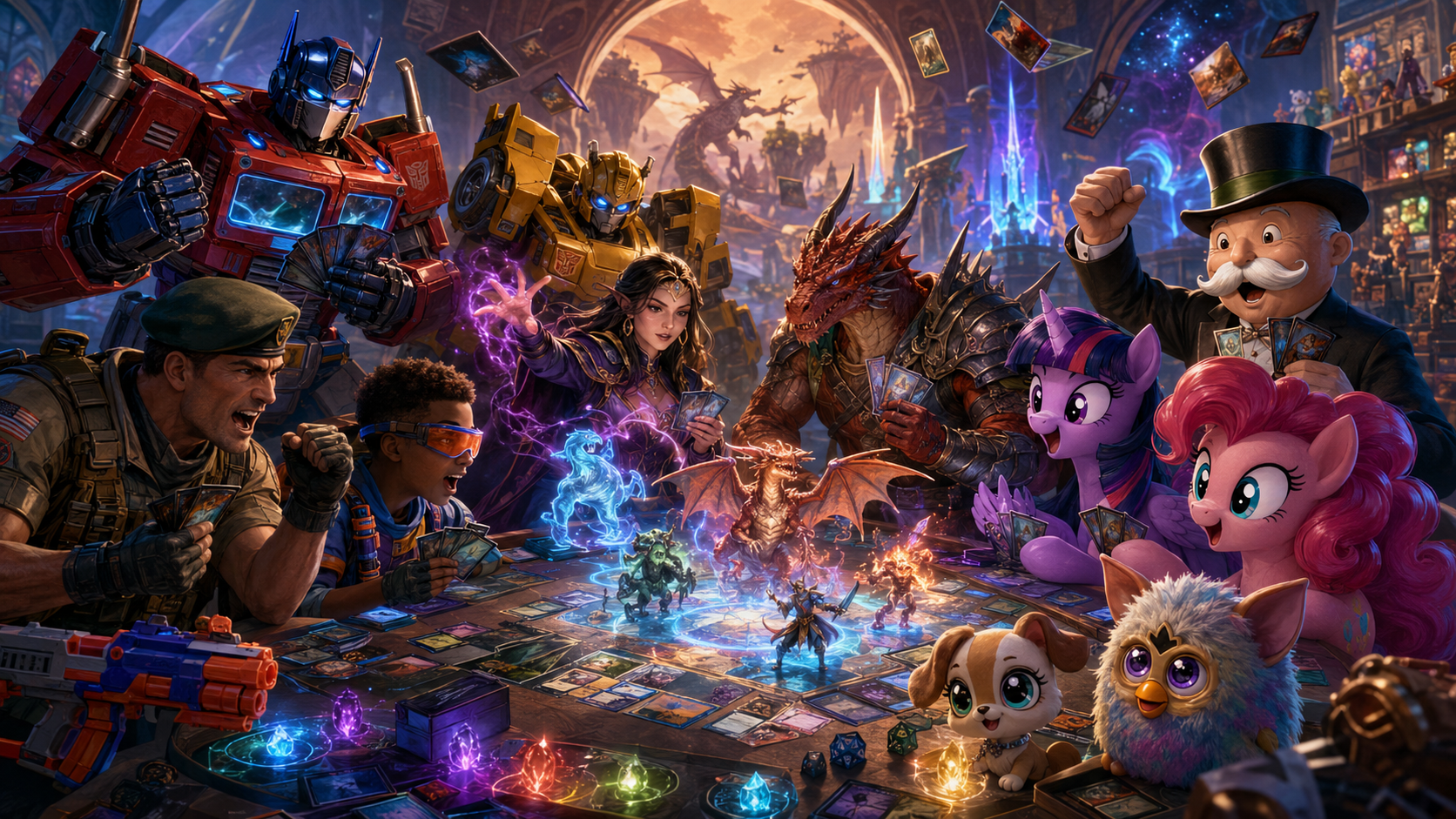
That makes Hasbro a fascinating company right now: part toy maker, part gaming company, part IP licensing machine. The future looks less like board-game aisles and more like a battle for fandom wallets. Magic is winning that battle today. D&D, KPop Demon Hunters, Monopoly, Transformers, and Star Wars-linked products now have to prove they can help carry the next campaign.
Hasbro stock: key questions
Why did Hasbro stock fall after Q1 2026 results?
Hasbro beat expectations, but investors were disappointed that the company did not raise its full-year guidance. A cyber incident and delayed Consumer Products revenue also added uncertainty.
What is Hasbro’s strongest product right now?
Magic: The Gathering is currently Hasbro’s clearest growth engine. In Q1 2026, Magic revenue rose 36%, driving strong performance in the Wizards of the Coast and Digital Gaming segment.
Is Monopoly still important for Hasbro?
Yes. Monopoly remains a major franchise, especially through Monopoly Go!, which contributed $41 million of revenue in Q1 2026. But Magic is currently the more powerful growth story.
What is Hasbro’s next big bet outside Magic?
Dungeons & Dragons is one of the key bets, especially through D&D Questers and collectible tabletop products such as Fizban’s Fortune. Hasbro is also leaning into KPop Demon Hunters merchandise.
Did the cyber incident destroy Hasbro revenue?
Hasbro said $40 million to $60 million of Consumer Products revenue is expected to shift from Q2 into the second half of 2026. That suggests timing disruption rather than confirmed lost revenue, though costs and execution risk remain concerns.
Is this financial advice?
No. This article is for information and analysis only. It is not financial advice, and investors should do their own research before buying or selling any stock.