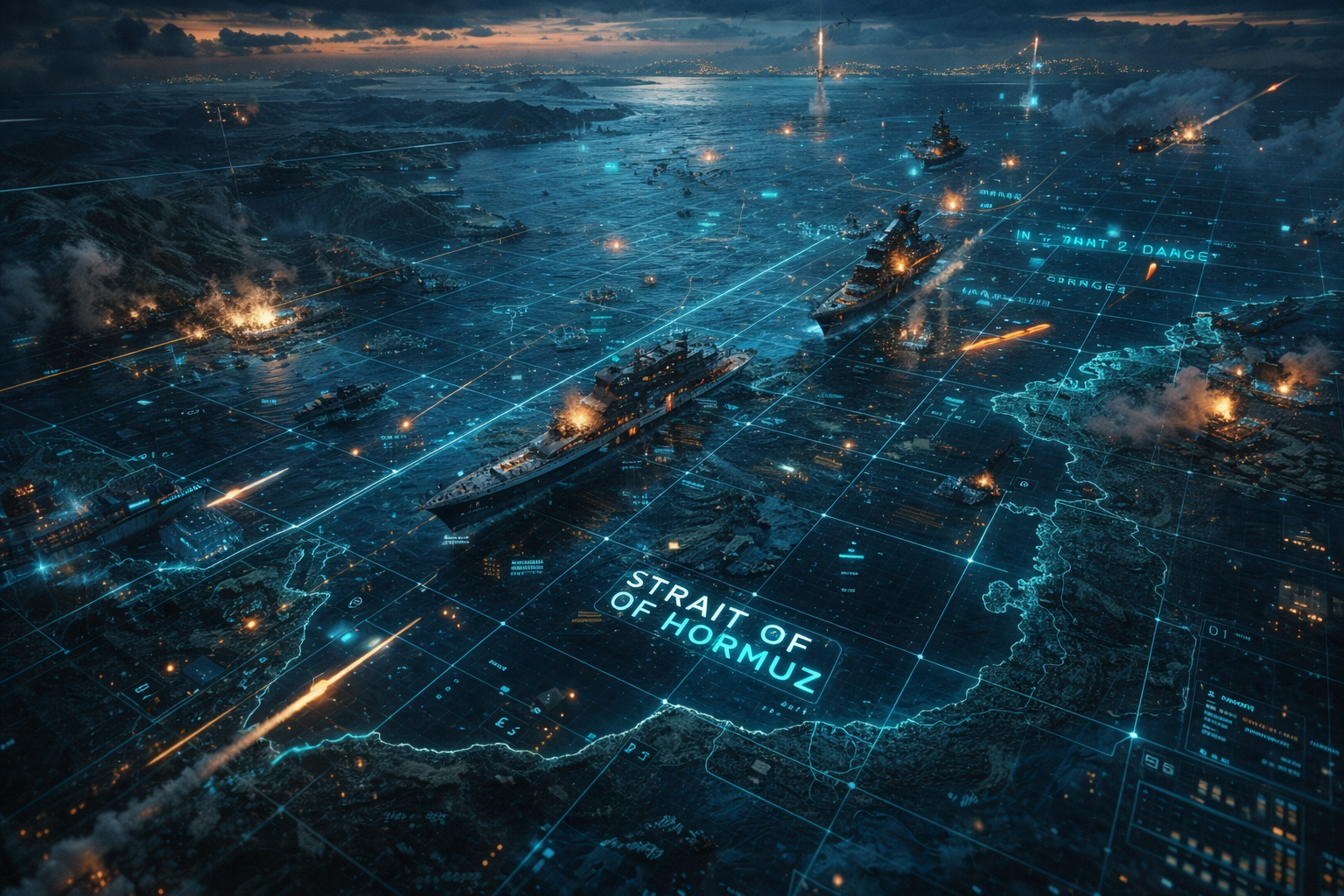
It’s easy to believe that markets today exist somewhere in the cloud.
Charts update in real time. Trades execute in milliseconds. AI scans sentiment across social media. Everything feels abstract, weightless, almost detached from reality. Open an app and you are plugged into a global system that seems to run entirely on code, data, and narratives.
But every now and then, reality hits back.
Hard.
The Strait of Hormuz is one of those reminders.
Table of contents
- The oil chokepoint markets cannot ignore
- When physical risk hits digital markets
- Inflation is logistics
- Why the story moves so fast
- Markets are infrastructure, not just data
- Strait of Hormuz: key questions
The oil chokepoint markets cannot ignore
This narrow stretch of water, sitting between Iran and Oman, does not look like much on a map. Yet it is one of the most critical energy chokepoints on the planet.
According to the U.S. Energy Information Administration, flows through the Strait of Hormuz in 2024 and the first quarter of 2025 represented more than one-quarter of global seaborne oil trade and about one-fifth of global oil and petroleum product consumption.
Tankers pass through it every day, carrying the fuel that powers economies, industries, airlines, shipping networks, and entire countries.
And it is completely physical.
When physical risk hits digital markets
When tensions rise in the region, markets react instantly. Oil spikes. Airline stocks wobble. Energy companies surge. Headlines talk about risk, supply, disruption.
But what is actually happening is far more tangible.
Ships might not pass. Routes might close. Supply chains might break.
No algorithm can reroute a tanker stuck at sea. No sentiment tool can reopen a blocked maritime corridor. This is the part we tend to forget.
We have built an entire layer of digital abstraction on top of markets. We talk about AI trends, momentum, narratives, flows, and real-time sentiment. All of that matters. But underneath it all, the system still depends on real-world infrastructure: ports, pipelines, shipping lanes, geography.
The digital layer is fast.
The physical layer is not.
And when the two collide, the physical always wins.
Inflation is logistics
That is why events like a disruption in Hormuz ripple across the entire system. Not simply because traders panic, but because something fundamental is at risk.
If oil cannot move, energy prices rise. If energy prices rise, transportation becomes more expensive. If transportation becomes more expensive, everything else follows.
Inflation is not just a number on an economic dashboard.
It is logistics.
It is the cost of moving goods, powering factories, heating buildings, flying planes, and keeping global trade alive. When a key route like Hormuz becomes uncertain, markets are not reacting to an abstract fear. They are repricing the possibility that the real economy may become harder and more expensive to run.
Why the story moves so fast
What makes this even more interesting is how quickly markets translate physical risk into digital reactions.
Within seconds, sentiment shifts. Narratives emerge. “Crisis.” “Supply shock.” “Geopolitical risk.” The story spreads, amplified across platforms, feeding into trading decisions worldwide.
This connects directly to the new generation of tools that track market sentiment in real time, from AI investing assistants to social data platforms. As explored in our article on Tori, eToro’s AI assistant, modern investors increasingly rely on systems that turn online signals into something readable, actionable, and fast.
But the story is only powerful because the underlying threat is real.
That is the paradox of modern markets.
We operate in a hyper-digital environment, yet we are still anchored to physical constraints. The illusion of speed and control breaks the moment something in the real world stops moving.
Markets are infrastructure, not just data
A blocked strait. A damaged pipeline. A delayed shipment. These are not abstract risks. They are system-level events.
They remind us of something essential: markets are not just data. They are infrastructure. They are energy. They are geography.
So yes, we can track sentiment in real time, build AI-driven portfolios, and react faster than ever before. But none of that changes the fact that somewhere in the world, a ship still needs to cross a narrow passage of water.
And if it cannot, everything else starts to move.
Strait of Hormuz: key questions
Where is the Strait of Hormuz?
The Strait of Hormuz is a narrow waterway between Iran and Oman. It connects the Persian Gulf with the Gulf of Oman and the Arabian Sea.
Why is the Strait of Hormuz important for oil markets?
The Strait of Hormuz is one of the world’s most important energy chokepoints. A major share of global oil and petroleum product flows passes through it, making it critical for energy markets and global trade.
How much oil passes through the Strait of Hormuz?
According to the U.S. Energy Information Administration, flows through the Strait of Hormuz in 2024 and early 2025 represented about one-fifth of global oil and petroleum product consumption.
What happens if the Strait of Hormuz is disrupted?
A disruption could affect oil shipments, push energy prices higher, increase transportation costs, and create broader pressure on inflation and supply chains.
Why do markets react so quickly to geopolitical tensions near Hormuz?
Markets react quickly because any threat to Hormuz can affect global energy supply. Traders, investors, and companies immediately reprice risk when a key physical route becomes uncertain.
Why does this matter in a digital investing world?
Modern markets move through apps, algorithms, AI tools, and sentiment feeds, but they still depend on physical infrastructure. The Strait of Hormuz shows that geography can still overpower digital speed.