
The KOSPI did not quietly recover. It walked back on stage with full lighting, perfect choreography, a cinematic teaser campaign, and the kind of chorus designed to detonate on first listen.
South Korea’s benchmark stock index has become one of the loudest market stories in the world. Reuters recently reported that the KOSPI had risen about 95% in 2026, after a 76% gain last year, with Samsung Electronics and SK Hynix driving the move and together accounting for roughly half of the index by market value.
That is not a normal rally. That is a comeback stage.
But the real question is not just why Korean stocks ripped higher. The obvious answer is AI chips. The more interesting answer is that South Korea has spent decades turning itself into a global cultural and technological brand. BTS, Squid Game, Parasite, Samsung, Hyundai, K-beauty, gaming, food, fashion, webtoons, smartphones, memory chips: these are not separate stories anymore. They are all part of the same export machine.
The KOSPI’s rally has a hard-power engine: semiconductors. It also has a soft-power aura: Hallyu, the Korean Wave.
- From Seoul to Wall Street: the comeback stage
- Samsung and SK Hynix: the idols behind the index
- Hallyu economics: when culture becomes market power
- The soft power premium
- The risk of buying the encore
- So what should connected investors watch?
- KOSPI rally: key questions
From Seoul to Wall Street: the comeback stage
Every great K-pop comeback has the same anatomy: silence, rumors, teasers, then impact. The KOSPI has followed a similar script.
For years, South Korea’s stock market was often treated by global investors as a useful but frustrating place: world-class companies, low valuations, corporate governance headaches, currency volatility, and the famous “Korea discount.” Samsung was everywhere in your life, but Korean equities were rarely the main character in global portfolios.
Then AI changed the beat.
Data centers started eating the world. Nvidia GPUs became the new oil rigs. Cloud giants kept spending. AI models needed faster memory, more bandwidth, more servers, more power, more storage, more everything. Suddenly, South Korea’s chip-heavy market looked less like an old-school export index and more like a leveraged bet on the next phase of computing.
That is how a market can go from background track to headline act. According to Reuters, SK Hynix crossed $1 trillion in market value in May 2026, joining Samsung Electronics and Micron in the trillion-dollar memory club, while the KOSPI hit record highs on the AI-driven surge.
In pop terms, this was not a slow-burn indie breakout. This was the moment the camera cuts to the crowd and everyone already knows the lyrics.
Samsung and SK Hynix: the idols behind the index
The KOSPI rally is not mysterious. It is concentrated, chip-led, and brutally tied to the AI infrastructure cycle.
Samsung Electronics and SK Hynix are the market’s headline acts because AI needs memory. Not just any memory, but high-bandwidth memory, DRAM, NAND, advanced packaging, and the broader semiconductor ecosystem that makes modern AI infrastructure possible. GPUs get the hype, but GPUs are useless if the rest of the machine cannot feed them data fast enough.
SK Hynix has become one of the world’s most important high-bandwidth memory suppliers. Samsung, meanwhile, remains a giant across memory, foundry, smartphones, displays, and consumer electronics. When investors look for non-U.S. exposure to the AI boom, Korea suddenly looks less like a niche trade and more like a critical node in the global supply chain.
But this is also the first warning sign. A rally powered by a small number of giants can look unstoppable until leadership narrows too much. Reuters reported that Samsung and SK Hynix together made up around half of the KOSPI by market capitalization during the latest surge. That gives the index huge upside when the AI memory trade is hot, but it also means the market can wobble hard if the same names reverse.
Think of it like a K-pop group where two members carry every chorus, every dance break, every variety show appearance, and every brand deal. Impressive? Absolutely. Sustainable forever? That is the question.
Hallyu economics: when culture becomes market power
The AI chip boom explains the ignition. Hallyu explains the lighting rig.
South Korea did not become globally visible overnight. It built an emotional export layer before many investors fully priced it in. K-pop made Korean language lyrics normal on global playlists. Korean dramas turned Seoul apartments, convenience stores, school uniforms, and street food into aesthetic templates. Squid Game became a global shorthand for ruthless competition. Parasite turned Korean social critique into Oscar-winning prestige. K-beauty colonized bathroom shelves. Korean food moved from niche to mainstream. Gaming and esports made Korea feel native to digital culture long before “creator economy” became a pitch deck phrase.
This does not mean BTS makes the KOSPI go up. Markets are not that cute.
Soft power works differently. It changes perception. It makes a country feel familiar before the balance sheet is even opened. It makes consumers more willing to try the product, stream the show, buy the skincare, visit the city, download the game, drive the car, or trust the hardware brand. It makes global investors pay attention when the fundamentals start to move.
Korea is no longer just an export machine. It is a cultural operating system.
That matters because attention is capital’s unofficial pre-market. Before money flows, curiosity flows. Hallyu has made Korea permanently visible to a generation that grew up with BTS choreography, Netflix subtitles, League of Legends esports, Samsung phones, Hyundai EVs, Korean barbecue, and skincare routines that look like software updates for your face.
The soft power premium
The soft power premium is not a line item in Samsung’s earnings report. It is not a magic valuation button. It is the invisible layer that helps Korean brands punch above their geographic weight.
Samsung benefits because it is already a global hardware language. SK Hynix benefits because AI investors now understand that memory is not boring plumbing; it is strategic infrastructure. Hyundai and Kia benefit from Korea’s upgraded design credibility. LG benefits from the premiumization of Korean electronics and appliances. Kakao and Naver benefit from a domestic digital culture that exports formats, platforms, webtoons, payments, and fandom behavior. Gaming companies benefit from Korea’s long-running status as a serious gaming nation. Entertainment groups benefit from fandoms that behave less like audiences and more like distributed marketing networks.
BTS is the cleanest metaphor here. The group was not just seven performers; it was coordination, discipline, production quality, fandom infrastructure, direct-to-global distribution, and relentless iteration. That is also the Korean corporate export model at its best: highly organized, intensely competitive, globally ambitious, and frighteningly good at polishing the product until it travels.
Squid Game is the darker metaphor. Markets are competitive, unforgiving, and sometimes absurd. Everyone is chasing survival, liquidity, and the next round. South Korea’s economy knows this tension well: world-class output, high pressure, fierce competition, and a constant need to move faster than larger rivals.
Parasite adds the prestige layer, but also the warning. Global recognition does not erase domestic strain. Cultural success can coexist with inequality, debt, housing stress, aging demographics, and a corporate system dominated by powerful conglomerates. The KOSPI’s glow-up is real, but Korea is not suddenly a frictionless fantasy market.
That is what makes the story interesting. The same country can sell beauty, dread, pop perfection, memory chips, EVs, horror capitalism, and phone screens to the world. The market is finally catching up to the brand.
The risk of buying the encore
A comeback stage can be legendary. The encore can still be dangerous.
The KOSPI’s near-vertical move creates obvious risks. The first is the semiconductor cycle. Memory chips have historically been cyclical: shortages create pricing power, pricing power attracts capacity, capacity eventually creates oversupply, and oversupply crushes margins. AI may make this cycle structurally stronger, but it probably does not abolish physics, competition, or capex.
The second risk is AI hype cooling. If investors decide cloud spending has run too far, if hyperscalers slow orders, or if AI revenue fails to justify infrastructure spending, chip-linked markets could reprice quickly.
The third risk is concentration. A KOSPI led by Samsung and SK Hynix is powerful, but it is not broad-based enough to make every Korean stock an AI winner. Index investors may think they are buying “Korea,” when in practice they are buying a heavy dose of memory chips with a side order of conglomerate exposure.
Then there is geopolitics. South Korea sits in one of the most strategically sensitive neighborhoods on Earth, with exposure to U.S.-China tech tensions, Taiwan-related supply-chain risk, North Korea, export controls, and currency swings. The Korean won can matter a lot for foreign investors, especially when equity gains are extreme.
Finally, there is the simplest market risk of all: profit-taking. When something doubles, early buyers get choices. Late buyers get volatility.
None of this kills the Korea story. It just stops the article from turning into blind hype. The rally has both a hard-power engine and a soft-power aura. That combination is powerful, but not invincible.
So what should connected investors watch?
The practical read is simple: do not watch the KOSPI like a tourist watching a music video. Watch it like a producer watching the full system behind the performance.
Start with Samsung and SK Hynix earnings. Their margins, guidance, capacity plans, and customer commentary will say more about the rally than any generic “Korea is hot” headline. Watch memory chip prices, especially high-bandwidth memory demand tied to AI servers. Follow AI infrastructure spending from the big cloud platforms, because Korea’s chip story is downstream from global data-center capex.
Track foreign investor flows. A market can move very differently when global capital decides it is underweight a country. Watch the Korean won, because currency moves can amplify or eat into returns. Watch valuations, not just price charts. A stock can double and still look cheap if earnings explode, but the math gets less forgiving every round higher.
Most importantly, watch whether the rally broadens. If Korea’s boom spreads beyond semiconductors into entertainment, gaming, internet platforms, autos, beauty, fashion, food, and consumer brands, the story becomes bigger than an AI memory cycle. If it stays trapped inside Samsung and SK Hynix, the KOSPI remains a spectacular but concentrated trade.
South Korea has spent decades building the rarest thing in global economics: a country brand that feels both industrial and emotional. It can sell you the chip inside the server, the phone in your hand, the show on your screen, the song in your headphones, the skincare in your bag, and the existential dread in your Netflix queue.
That is not just soft power. That is a platform.
The KOSPI went full K-pop comeback mode. The next question is whether this is a one-era smash hit, or the start of Korea’s next global album cycle.
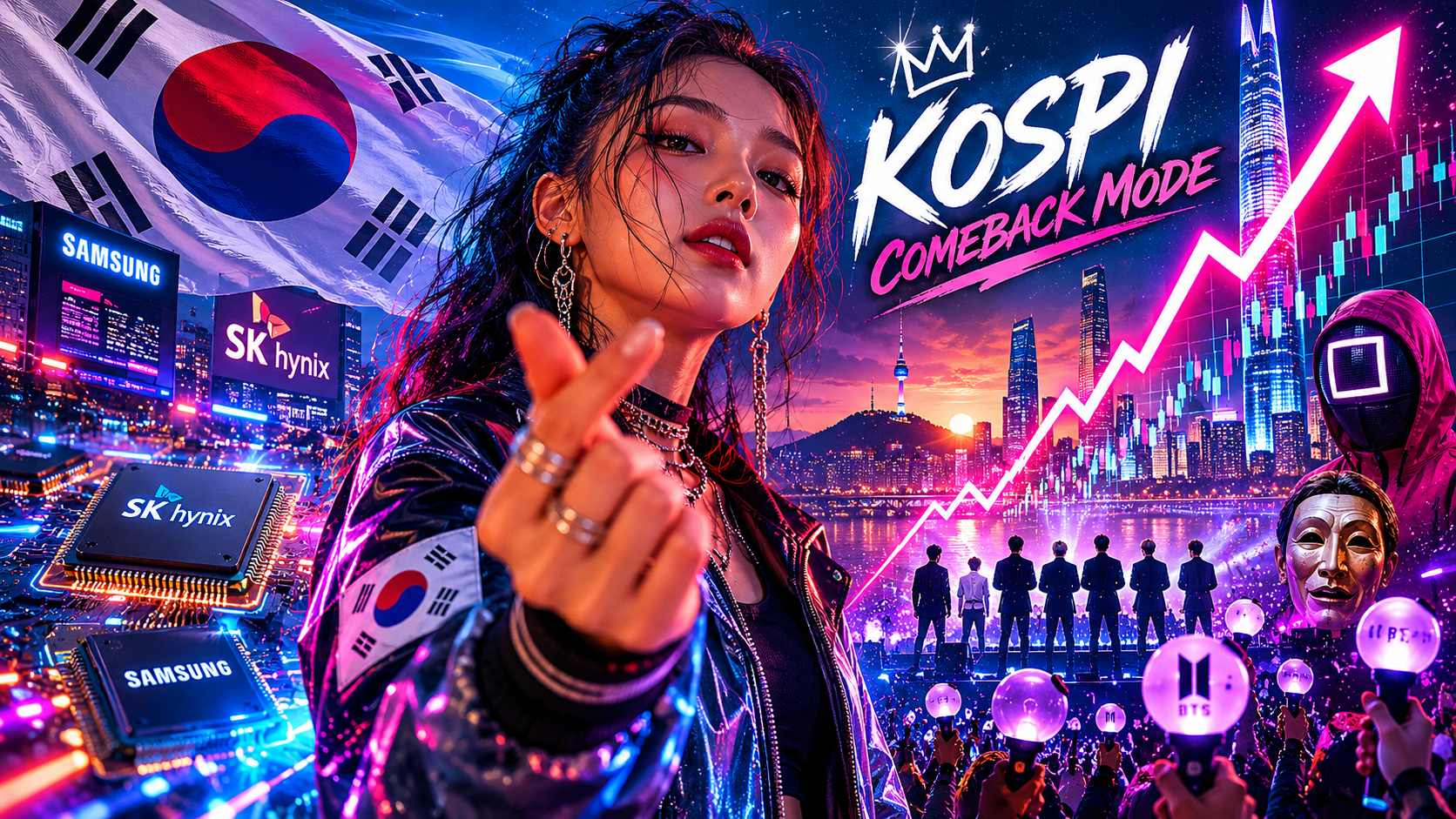
The KOSPI Went Full K-Pop Comeback Mode
KOSPI rally: key questions
Why has the KOSPI rallied so hard?
The rally has been driven mainly by AI-related demand for semiconductors, especially memory chips, with Samsung Electronics and SK Hynix playing central roles.
Is the KOSPI rally really about K-pop and Korean culture?
Not directly. K-pop and Hallyu do not mechanically push the index higher, but they help make South Korea more visible, trusted, and emotionally familiar to global consumers and investors.
Why are Samsung and SK Hynix so important?
AI infrastructure needs advanced memory chips, and both companies are major players in the global memory supply chain. Their size also means they heavily influence the KOSPI.
What are the biggest risks for the rally?
The main risks are semiconductor cyclicality, AI spending disappointment, index concentration, geopolitical tension, currency moves, valuation pressure, and profit-taking after a huge run.
Could Korean entertainment and gaming stocks benefit too?
Possibly, but they are different businesses with different earnings drivers. A broader Korea rally would need stronger performance outside semiconductors, including platforms, entertainment, gaming, autos, beauty, and consumer brands.
Is this financial advice?
No. This article is for information and analysis only. It is not financial advice, investment advice, or a recommendation to buy or sell any stock, ETF, or security.