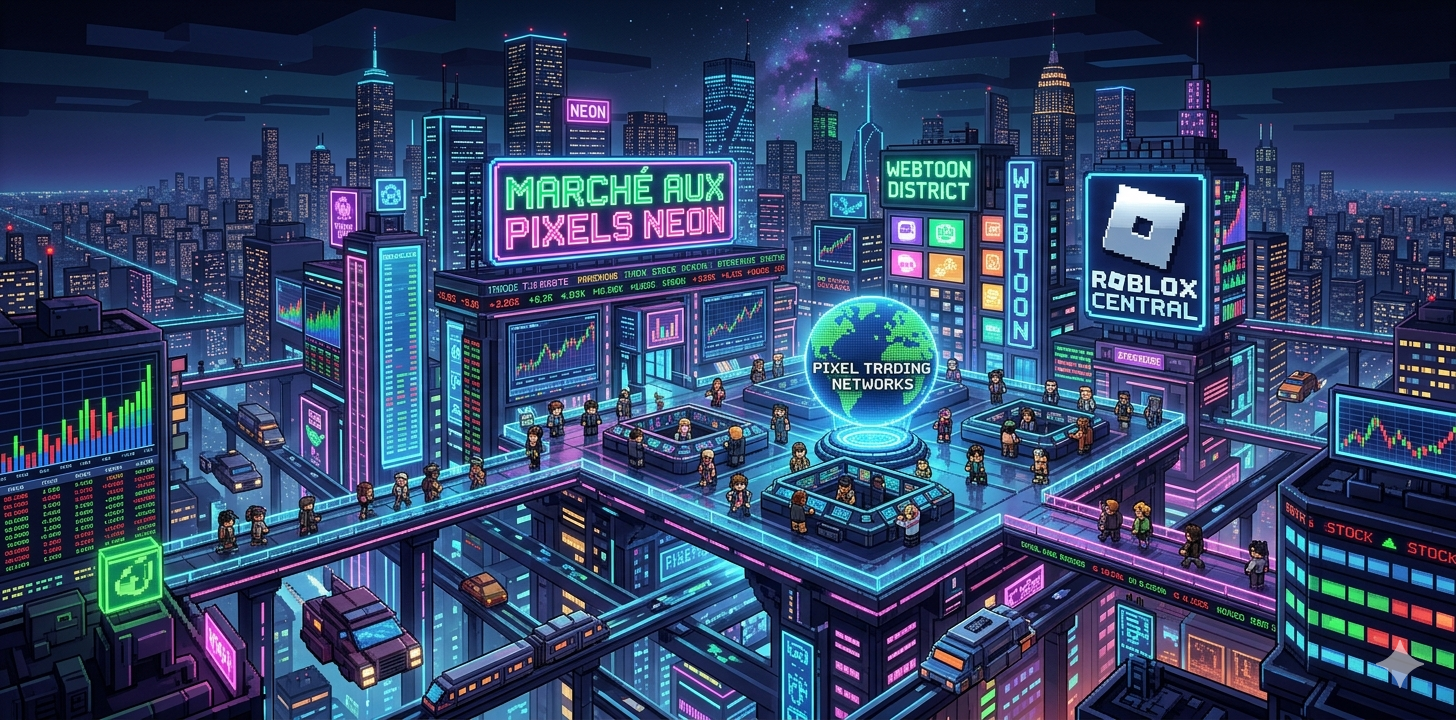
While Wall Street suits were staring at ticker symbols, a whole other financial universe was being built — one server, one scroll, one Robux at a time.
WEBTOON, Roblox, and Discord aren’t just platforms where you kill time. They’re fully operational economies, each with their own currencies, creator classes, revenue splits, and — for the savviest players — real money flowing in and out.
And in 2026, those economies are hitting numbers that would make a hedge fund manager do a double-take.
Let’s break it down, loot by loot.
Table of contents
- Roblox: The Economy Where Kids Became Millionaires
- WEBTOON: The Comics Platform That Almost Cracked It
- Discord: The Sleeper Hit About to IPO
- The Pattern: Pixels as Financial Infrastructure
- So What’s the Play?
- Pixel economy: key questions
Roblox: The Economy Where Kids Became Millionaires
The Setup
If you still think Roblox is just a game for ten-year-olds building blocky houses, you’re a few billion dollars behind. Roblox is the largest user-generated gaming platform on the planet — over 111 million daily active users as of late 2025. A proprietary virtual currency called Robux that users purchase with real money to spend inside games built by other users. And a cashout program called DevEx that converts those Robux back into actual dollars.
The result? From March 2024 to March 2025, Roblox paid out over $1 billion to creators — a 31% year-over-year increase. That’s not a rounding error. That’s a billion with a B, going to developers, designers, and studio owners, many of whom started building as teenagers.
The Numbers That Break Your Brain
The top 1,000 Roblox creators averaged $1.1 million in annual earnings in 2025. The top 10 pulled in $33.9 million combined. One single game — Grow a Garden — went viral in Q2 2025 and helped Roblox break platform and industry records in a single quarter.
The stock ($RBLX) hit an all-time high of $150.59 in July 2025, up from below $22 in mid-2022. Not bad for a company that built a $4.9 billion revenue machine on the backs of volunteer developers. Then came a 40% correction in Q4 2025 — triggered by a wave of lawsuits and short-seller reports — but even after the pullback, the platform’s fundamentals stayed intact.
The Catch (There’s Always a Catch)
Roblox keeps approximately 70% of every transaction. When a player spends $1 worth of Robux in your game, you — the developer — pocket about $0.30 in Robux, before the DevEx conversion takes another slice. The actual cash-in-hand rate? Roughly $0.0038 per Robux since the September 2025 rate increase.
It’s the classic platform economy trap: the ecosystem creates millionaires at the top, but the long tail of developers never earns enough to hit the minimum cashout threshold. When the top 100 studios bank millions while most developers earn nothing, “average” is doing a tremendous amount of work. Still — $1 billion paid out is $1 billion paid out.
WEBTOON: The Comics Platform That Almost Cracked It
The Setup
WEBTOON is the largest comics platform in the world by active users — 160 million monthly readers as of early 2026, consuming vertically-scrolled comics in over 100 countries. It went public on Nasdaq in 2024 under the ticker $WBTN. Series originally published on WEBTOON have been adapted for Netflix, Prime Video, and Crunchyroll. Content partners include Disney, Warner Bros. Animation, DC Comics, and HYBE — the K-pop giant behind BTS.
The Numbers That Sting
Full-year 2025 revenue: approximately $330 million — growing just 2.5% year-over-year. Full-year net loss: $373.4 million. Q4 2025 revenue actually declined 6.3%, dragged down by drops in paid content, advertising, and IP adaptation revenue. For 2026, management guided for flat-to-slightly-negative revenue.
The core tension: WEBTOON has a massive audience but low monetization per user. Most readers never pay. The platform relies on a subset of paying readers (Coin purchases for premium chapters) and a still-developing ad business. Converting cultural reach into financial returns has proven harder than the IPO story suggested.
The Bright Spot
In 2026, WEBTOON launched a major expansion of its Creator Programs: new monetization tools for CANVAS creators, a Creator Residency program at its LA headquarters, and expanded convention presence in Europe and Southeast Asia. The bet is that better-supported creators produce better content, which drives more paying readers. It’s the right bet. It’s just a bet on the future, not the present.
Discord: The Sleeper Hit About to IPO
The Setup
Discord started as a voice chat tool for gamers. In 2026, it’s a 260-million-user community platform that has quietly built one of the most unusual revenue models in tech — and is about to go public. In January 2026, Discord confidentially filed an S-1 with the SEC, targeting a public listing with Goldman Sachs and JPMorgan as lead underwriters. Valuation estimates range from $10 billion to $20 billion.
The Numbers That Surprise
Discord generated $561 million in revenue in 2025 — without selling user data, without an intrusive ad-based model. The bulk came from Discord Nitro, the premium subscription ($2.99 or $9.99/month). Daily engagement sits at 94 minutes per user — higher than Instagram, higher than TikTok.
Over 54% of Discord users are now non-gamers. The platform hosts coding communities, crypto trading servers, K-pop fan clubs, and AI research groups — Midjourney’s server alone has nearly 20 million members. And Discord takes only 10% of creator subscription revenue, compared to YouTube’s 30% and Twitch’s up to 50%.
The Risk
Discord’s entire value proposition is built on trust. Users stayed because it didn’t mine their data, didn’t blast them with ads, and didn’t algorithmically manipulate their feeds. Every monetization decision is a tightrope walk: go too far, and you break the thing that made the platform worth using. The IPO will sharpen that tension considerably. Public markets want growth. Growth often means ads. Ads often mean compromises. Watch this space.
The Pattern: Pixels as Financial Infrastructure
Step back and look at all three together. What you’re seeing isn’t three random platforms — it’s three versions of the same structural shift: virtual economies are becoming real economies.
Roblox has a GDP impact of $445 million to the U.S. economy in 2024 alone, supporting an estimated 22,000 full-time job equivalents globally. Discord’s server ecosystem hosts businesses, agencies, investment communities, and creative studios generating real revenue. WEBTOON’s IP pipeline feeds Netflix, Amazon, and Warner Bros. with content that drives billions in streaming revenue downstream.
The platforms are the map. The creators are the territory. In a traditional stock market, you buy a share of a company’s future earnings. In the pixel economy, you invest your time, skills, or Robux — and your return is audience, income, or influence. Same logic. Different interface.
So What’s the Play?
$RBLX — A volatile growth story with real underlying economics. The creator payout numbers are genuine, the platform stickiness is real. But legal risks, the 70% platform cut structure, and the demographic aging question make this high risk with asymmetric upside.
$WBTN — A turnaround story that hasn’t turned around yet. 160 million monthly readers is not a trivial asset, but flat revenue, a $373M net loss, and weak monetization per user make this a speculative bet on the platform eventually cracking the paid content code. Buy the story only if you believe in the story.
Discord (pre-IPO) — Not public yet — but the S-1 is filed. When it hits the market, you’re buying a community infrastructure play with the best engagement metrics in social media, a clean monetization model, and a user base that actually trusts the platform. The risk is what going public does to that trust.
The stock market used to be the place where fortunes were made from nothing. A spreadsheet, a thesis, and a brokerage account.
The pixel economy is doing the same thing — just with a different interface. You don’t need a Bloomberg terminal. You need a good game, a compelling series, or a server worth joining.
The new stock market is made of pixels. The question isn’t whether to play. It’s whether you understand the rules before you go all in.
Pixel economy: key questions
What is the pixel economy?
The pixel economy refers to digital platforms where virtual goods, creator content, communities, currencies, and user activity generate real economic value.
Why are Roblox, WEBTOON, and Discord compared in this article?
They are compared because each platform has built a creator-driven economy with users, monetization tools, revenue models, and real money flowing through digital ecosystems.
How does Roblox generate creator income?
Roblox creators earn through in-game purchases made with Robux, which can be converted into dollars through the DevEx program if they meet the platform’s requirements.
Why is WEBTOON financially challenged despite its huge audience?
WEBTOON has a massive global readership but still faces weak monetization per user, limited paid conversion, and pressure on revenue growth.
Why is Discord considered a sleeper IPO story?
Discord combines high engagement, a large user base, subscription revenue, creator monetization, and strong community trust ahead of a potential public listing.
What is the biggest risk for these digital platform economies?
The biggest risk is that platform economics often benefit top creators and the platform itself while leaving most creators with limited income.
Is this article financial advice?
No. This article is an editorial analysis of digital platforms, creator economies, and market narratives. It should not be treated as financial advice.