
A stablecoin is a crypto token designed to keep a stable value. In most cases, that means tracking the price of a traditional currency such as the US dollar or the euro.
That sounds almost boring by crypto standards, which is exactly the point. Bitcoin can move wildly. Meme coins can melt faces in both directions. A stablecoin is supposed to do the opposite: behave like a steady digital dollar, euro or other reference asset that can move on a blockchain.
Stablecoins matter because they make crypto easier to use. Traders use them to move in and out of volatile assets. DeFi protocols use them as building blocks. People use them for payments, savings, remittances, settlement and cross-border transfers. In many crypto markets, stablecoins are the quiet plumbing behind the chaos.
But “stable” is not the same as “risk-free.” A stablecoin is only as strong as its design, reserves, issuer, legal structure, redemption process and market confidence. Some are backed by cash and short-term assets. Some are backed by crypto collateral. Some rely on algorithms and incentives. Those differences are not details. They are the whole story.
This article is part of Crypto Explained, Geek’n’Destroy’s beginner-friendly guide to cryptocurrency, Bitcoin, blockchain, wallets, tokens, DeFi, NFTs and the vocabulary of Web3.
Sommaire
- What is a stablecoin?
- How stablecoins work
- The main types of stablecoins
- Fiat-backed stablecoins
- Crypto-backed stablecoins
- Algorithmic stablecoins
- What stablecoins are used for
- The risks beginners should understand
- Stablecoins and regulation
- What people often misunderstand about stablecoins
- What to Remember (FAQ)
What is a stablecoin?
A stablecoin is a crypto token designed to maintain a steady price relative to another asset. Most stablecoins aim to stay close to one unit of a fiat currency, usually one US dollar.
The idea is simple: combine the speed and programmability of crypto with the price stability of traditional money. Instead of holding a volatile token while trading or using DeFi, users can hold something that tries to behave like digital cash.
A dollar stablecoin, for example, is supposed to trade around $1. If it moves meaningfully above or below that level, people say it has lost its peg. A small movement may be temporary market noise. A serious depeg can become a full confidence crisis.
Stablecoins are usually issued on public blockchains such as Ethereum, Solana, Tron or other networks. They can be held in a crypto wallet, sent between addresses, traded on exchanges and used inside blockchain apps.
That makes them different from a PayPal balance or a bank deposit. A stablecoin can move on crypto rails, interact with smart contracts and circulate outside one company’s closed system. But it also comes with crypto-native risks that traditional users may not expect.
How stablecoins work
A stablecoin works by trying to keep market confidence that one token can be redeemed, exchanged or valued at its target price.
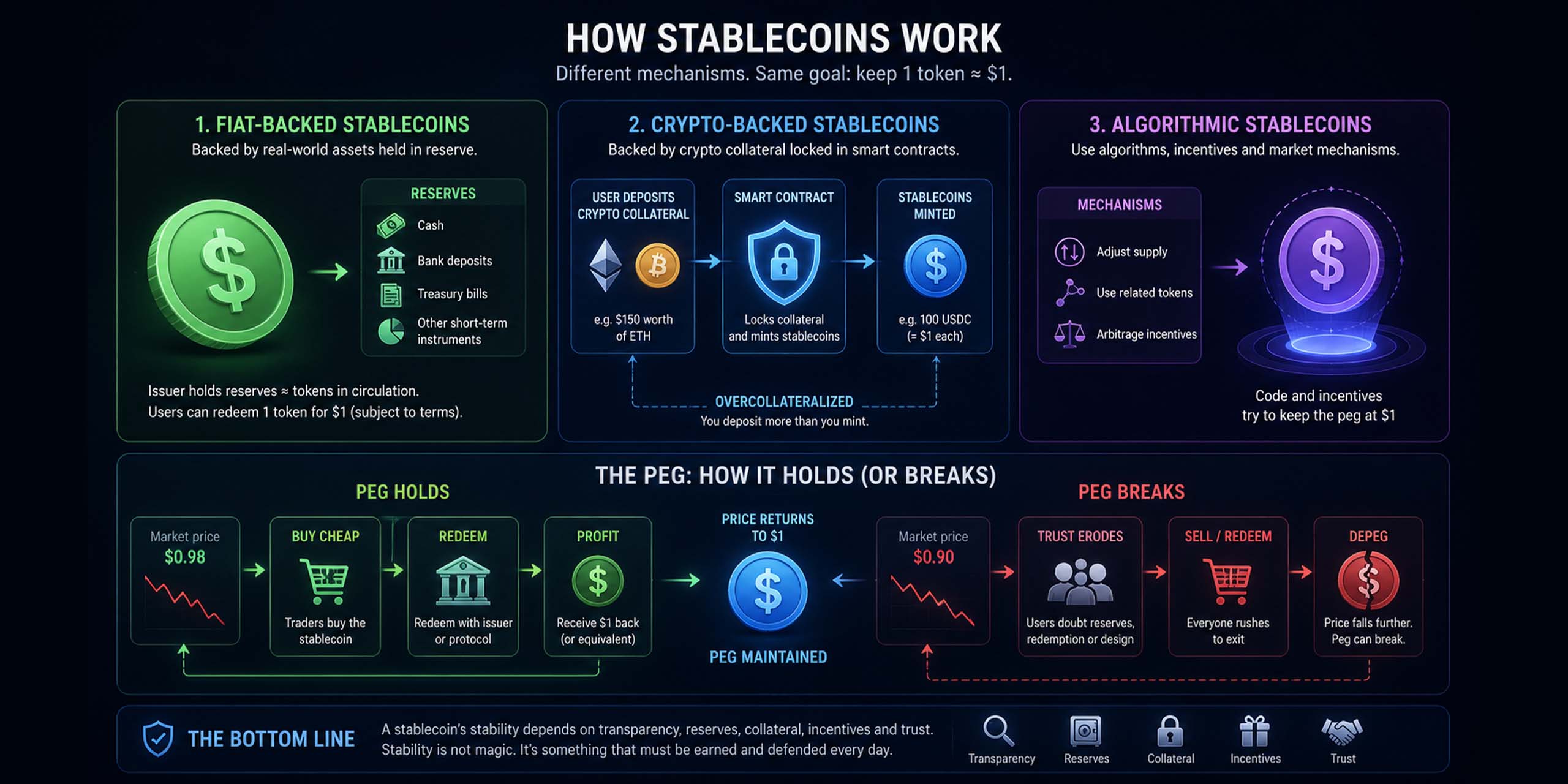
For a fiat-backed stablecoin, the issuer usually promises that tokens are backed by reserves. If one token represents one dollar, the issuer should hold assets that support that promise. Those reserves might include cash, bank deposits, Treasury bills or other short-term instruments, depending on the issuer and jurisdiction.
For a crypto-backed stablecoin, users lock crypto assets as collateral. Because crypto prices are volatile, these systems usually require overcollateralization. In plain English, a user may need to deposit more than $1 worth of crypto to mint $1 worth of stablecoin.
Algorithmic stablecoins use software, incentives and market mechanisms to try to maintain the peg. They may expand or contract supply, use related tokens, or rely on arbitrage. This design can look elegant in a diagram and terrifying during a bank-run-style panic.
The peg depends on incentives. If a stablecoin trades below $1 but users believe it can be redeemed for $1, traders may buy it cheaply and redeem it, pushing the price back up. If users stop believing in redemption, reserves or the mechanism, the peg can break fast.
That is the brutal truth behind stablecoins: stability is not a magical property. It is an outcome that must be defended every day.
The main types of stablecoins
There are three main stablecoin models: fiat-backed stablecoins, crypto-backed stablecoins and algorithmic stablecoins.
Fiat-backed stablecoins are the most intuitive. A company issues tokens and holds reserves meant to support their value. Popular dollar stablecoins often follow this broad model, though their reserve quality, disclosure and regulation can differ.
Crypto-backed stablecoins are more decentralized in spirit. Instead of trusting a company’s bank accounts, users rely on smart contracts and collateral posted on-chain. The trade-off is complexity. These systems must manage liquidation, price feeds and volatility.
Algorithmic stablecoins try to preserve value without straightforward full backing. They are the most experimental and historically the most fragile. The pitch is capital efficiency. The risk is that confidence disappears when the mechanism is tested under stress.
There are also commodity-backed stablecoins, such as tokens linked to gold or other assets, and regional stablecoins designed to track currencies beyond the US dollar. But dollar stablecoins dominate crypto because the dollar dominates global finance and trading pairs.
A stablecoin’s label is not enough. The real questions are: what backs it, who controls it, how redemption works, how transparent it is, and what happens in a panic?
Fiat-backed stablecoins
A fiat-backed stablecoin is issued by an entity that claims to hold reserves corresponding to the tokens in circulation. If there are one billion tokens designed to track one dollar each, the issuer should have reserves capable of supporting roughly one billion dollars of claims.
This model is easy to understand because it resembles familiar financial products. Users trust the issuer to manage reserves, process redemptions and maintain the peg. If the issuer is transparent, regulated and conservatively managed, the stablecoin can feel relatively straightforward.
But the details matter. Cash is not the same as risky debt. Short-term government securities are not the same as obscure commercial paper. Daily transparency is not the same as vague quarterly statements. A stablecoin can be “backed” and still raise serious questions about what that backing actually means.
Fiat-backed stablecoins also rely on traditional finance. They need banks, custodians, auditors, reserve managers and regulatory relationships. That makes them practical, but not fully independent from the financial system crypto originally tried to route around.
The upside is liquidity and usability. The downside is trust in an issuer. Fiat-backed stablecoins are not pure decentralization. They are a bridge between blockchains and old-world money.
Crypto-backed stablecoins
Crypto-backed stablecoins try to reduce reliance on a central issuer by using on-chain collateral. Users deposit crypto into smart contracts and mint stablecoins against that collateral.
Because the collateral is volatile, these systems usually require users to deposit more value than they borrow. If someone wants to mint $100 in stablecoins, they may need to lock significantly more than $100 in ETH or other accepted assets. This extra cushion helps protect the system if prices fall.
If the collateral value drops too far, the position can be liquidated. That means the system sells or transfers collateral to keep the stablecoin backed. This is how crypto-backed designs try to survive market stress.
The advantage is transparency. Collateral and positions can often be inspected on-chain. The system can be more open and programmable than a company-issued stablecoin.
The downside is complexity. These designs depend on smart contracts, price oracles, liquidation mechanisms, collateral quality and user behavior. If any of those pieces fail, the peg can come under pressure. Crypto-backed stablecoins are clever machines, but clever machines still break.
Algorithmic stablecoins
Algorithmic stablecoins attempt to maintain a peg through code and incentives rather than simple reserve backing. They often try to adjust supply or use a related token to absorb volatility.
The appeal is obvious. A stablecoin that does not need full reserves could be more capital-efficient, more decentralized and easier to scale. The problem is that stability depends heavily on confidence, and confidence can vanish faster than an algorithm can politely ask it to stay.
When market participants believe the mechanism works, arbitrage can help keep the price near the peg. When they lose faith, selling pressure can overwhelm the design. In the worst cases, the system can enter a death spiral: the stablecoin falls, the supporting token falls, confidence falls, and the mechanism becomes weaker exactly when it needs to be strongest.
This is why algorithmic stablecoins deserve extra caution. They are not automatically scams, but they are structurally fragile unless the design is exceptionally robust and battle-tested. Even then, users should ask what stands behind the peg when everyone runs for the exit at once.
In stablecoins, elegance is not enough. The real test is stress.
What stablecoins are used for
Stablecoins are heavily used in crypto trading. Instead of converting back to bank money after every trade, users can move into a stablecoin and stay inside crypto markets. That makes stablecoins a kind of settlement layer for traders.
They are also central to DeFi. Lending markets, decentralized exchanges, liquidity pools and yield strategies often rely on stablecoins because they provide a relatively steady unit of account. Without stablecoins, DeFi would be even more exposed to crypto volatility.
Stablecoins are used for payments and transfers. A person can send a dollar-denominated token across borders without waiting for bank hours or traditional correspondent banking rails. That can be useful for freelancers, remote teams, remittances and businesses that operate internationally.
They can also serve as a temporary shelter from volatility. If a user expects crypto prices to fall, moving into stablecoins may feel safer than holding volatile assets. That said, it replaces price risk with issuer, peg, custody and regulatory risk.
For builders, stablecoins are programmable money. They can be integrated into apps, smart contracts, games, marketplaces and automated financial systems. That makes them less flashy than meme coins and far more structurally important.
The risks beginners should understand
The first risk is depegging. A stablecoin can trade below its target price if confidence weakens, liquidity dries up, reserves are questioned or the mechanism fails.
The second risk is reserve quality. For fiat-backed stablecoins, users need to know what assets back the token, where they are held, how liquid they are and whether redemption is actually available. A stablecoin backed by safe, liquid assets is not the same as one backed by risky or opaque instruments.
The third risk is issuer risk. If a stablecoin depends on a company, users depend on that company’s management, banking relationships, compliance, transparency and solvency. The blockchain may be public, but the reserves may still sit in traditional institutions.
The fourth risk is smart contract risk. Stablecoins used in DeFi may interact with protocols that can be hacked, exploited or badly designed. Even a solid stablecoin can be lost in a broken app.
There is also custody risk. Holding stablecoins on an exchange means trusting that exchange. Holding them in self-custody means protecting your wallet and seed phrase. The stablecoin may target $1; your operational risk is still very real.
Finally, regulation can change market access. Stablecoin issuers may freeze addresses, restrict redemption, leave certain jurisdictions or change how they operate to comply with laws. That may be necessary for legal survival, but it also reminds users that many stablecoins are not censorship-resistant like Bitcoin aims to be.
Stablecoins and regulation
Stablecoins sit right on the fault line between crypto and traditional finance. Regulators care about them because they look money-like, move quickly, and can grow large enough to matter beyond crypto trading.
The main concerns are consumer protection, reserve quality, redemption rights, financial stability, market integrity and illicit finance. A stablecoin that promises to be worth one dollar raises an obvious question: what exactly gives users confidence that they can get one dollar back?
In the European Union, the MiCA framework created specific rules for crypto-assets, including categories such as asset-referenced tokens and e-money tokens. That matters because many stablecoins are no longer treated as vague internet money experiments. They are becoming regulated financial products.
In the United States and other markets, stablecoin regulation has also become a major policy issue. Lawmakers and central banks are trying to decide how stablecoin issuers should hold reserves, disclose information, manage redemptions and interact with the banking system.
For users, the important point is simple: regulation can make some stablecoins more transparent and reliable, but it can also reshape which tokens are available, where they can be used, and what issuers are allowed to do.
Stablecoins are not outside the financial system anymore. They are one of the places where crypto is being pulled into it.
What people often misunderstand about stablecoins
The first misunderstanding is that stablecoins cannot lose value. They can. The entire point of a stablecoin is to maintain a peg, but pegs can fail under pressure.
The second misunderstanding is that all stablecoins are the same. A fiat-backed stablecoin, a crypto-backed stablecoin and an algorithmic stablecoin have very different risk profiles. Treating them as interchangeable is lazy and dangerous.
The third misunderstanding is that a stablecoin is the same as a bank deposit. In many cases, it is not. Stablecoin holders may not have deposit insurance, the same legal protections, or a direct claim equivalent to money held in a regulated bank account.
The fourth misunderstanding is that transparency solves everything. Transparency helps, but users still need to understand what they are looking at. A reserve report, smart contract dashboard or audit-style attestation is useful only if the underlying assets and obligations make sense.
The final misunderstanding is that stablecoins are boring. They are supposed to be boring at the price level. Under the hood, they are one of the most important battlegrounds in crypto: money, regulation, banking, DeFi, payments and global dollar demand all meet here.
Stablecoins are the crypto assets designed to look calm. That is exactly why they deserve close attention.
What to Remember (FAQ)
What is a stablecoin in simple terms?
A stablecoin is a crypto token designed to keep a steady value, usually by tracking a fiat currency such as the US dollar or the euro.
How does a stablecoin stay stable?
A stablecoin stays stable through reserves, collateral, algorithms or market incentives. The exact mechanism depends on the type of stablecoin.
Are stablecoins safe?
Stablecoins can be useful, but they are not risk-free. They can face depegging, reserve problems, issuer failure, smart contract bugs, custody issues and regulatory changes.
What is the difference between a stablecoin and Bitcoin?
Bitcoin is a volatile decentralized crypto asset with a fixed supply schedule. A stablecoin is designed to track another asset, usually a traditional currency, and keep a steadier price.
What are stablecoins used for?
Stablecoins are used for trading, payments, DeFi, cross-border transfers, settlement and holding value inside crypto markets without taking direct exposure to volatile tokens.
Can a stablecoin lose its peg?
Yes. A stablecoin can lose its peg if users lose confidence, reserves are questioned, liquidity dries up, collateral falls sharply or the stabilization mechanism breaks.
Sources: Federal Reserve, Bank for International Settlements, ESMA MiCA