A token is one of the most common words in crypto, and also one of the easiest to use badly. People say “token” when they mean cryptocurrency, coin, asset, share, reward, NFT, voting right, casino chip, or sometimes just “thing with a price chart.” Helpful, obviously.
In crypto, a token is a digital asset created on a blockchain. It can represent value, access, voting power, ownership, membership, a collectible item, a claim on something else, or a function inside an app. Some tokens are useful. Some are speculative. Some are beautifully engineered. Some are just vibes wearing a ticker symbol.
The important distinction is this: a token usually exists on top of an existing blockchain, instead of being the native asset of its own blockchain. Bitcoin is the native asset of the Bitcoin network. Ether is the native asset of Ethereum. But many crypto projects issue tokens on Ethereum, Solana, BNB Chain, Polygon or other networks.
That makes tokens one of the building blocks of Web3. They are how crypto turns software into markets, communities, incentives and ownership systems. They are also how many bad ideas become tradable before they become useful.
This article is part of Crypto Explained, Geek’n’Destroy’s beginner-friendly guide to cryptocurrency, Bitcoin, blockchain, wallets, DeFi, NFTs and the vocabulary of Web3.
Sommaire
- What is a token?
- Token vs coin: what is the difference?
- How crypto tokens work
- The main types of crypto tokens
- Fungible tokens vs non-fungible tokens
- Token standards: ERC-20, ERC-721 and ERC-1155
- What tokens are used for
- The risks beginners should understand
- What people often misunderstand about tokens
- What to Remember (FAQ)
What is a token?
A token is a crypto asset issued and managed on a blockchain. It can be transferred between wallets, used inside apps, traded on exchanges, held as an investment, or connected to a specific right or function.
The word is broad because tokens are broad. A token can behave like money, but it does not have to. It can represent a stablecoin, a governance vote, an in-game item, a loyalty point, a share of protocol revenue, a membership pass, a collectible image, or access to a service.
Most tokens are controlled by smart contracts. A smart contract is code deployed on a blockchain that defines how the token works: how many exist, who owns them, how they can be transferred, whether new tokens can be created, and what special rules apply.
That is what makes tokens different from a simple database entry in a company app. A token can be part of a public, programmable blockchain environment. Other apps, wallets and marketplaces can recognize it if they support the same network and standards.
This is also why tokens spread so fast. A developer does not need to build a new blockchain from scratch to launch a token. They can deploy a contract on an existing blockchain and immediately plug into its wallets, users, exchanges and infrastructure.
Token vs coin: what is the difference?
In everyday conversation, people often use “coin” and “token” as if they mean the same thing. Technically, there is a difference.
A coin is usually the native asset of its own blockchain. Bitcoin is the coin of the Bitcoin network. Ether is the native asset used to pay fees on Ethereum. SOL is the native asset of Solana. These assets are deeply tied to how their networks operate.
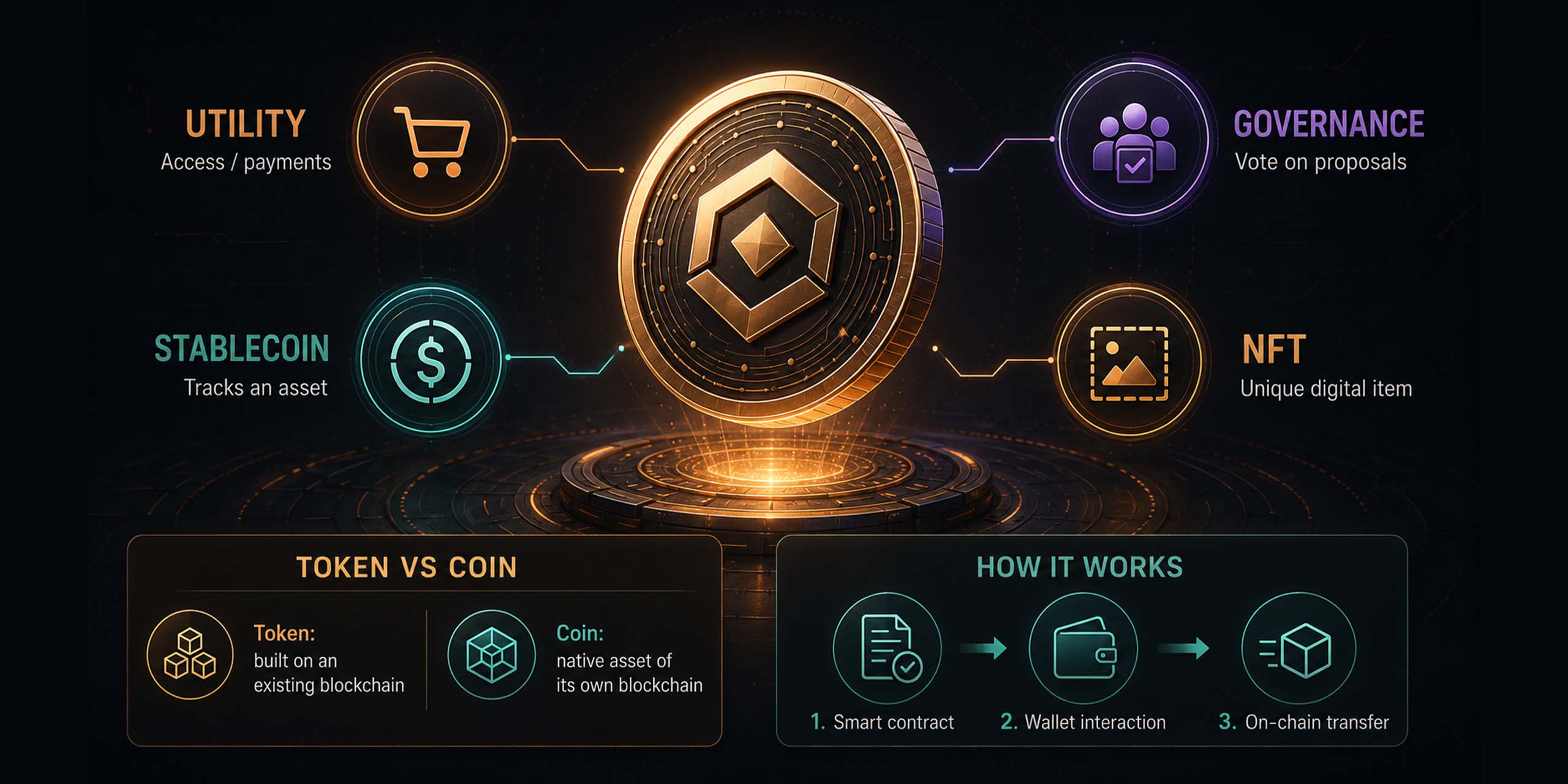
A token is usually created on an existing blockchain. For example, many tokens run on Ethereum using token standards like ERC-20 or ERC-721. They depend on Ethereum for security, transaction settlement and fees, but they have their own rules and purpose.
A simple way to put it: coins are built into the base network; tokens are built on top of a network.
This distinction is useful, but not sacred. Crypto language is messy, and different communities use terms differently. Some assets are casually called coins even when they are technically tokens. What matters most is understanding the structure behind the asset: does it have its own blockchain, or does it rely on another one?
For beginners, that question is more important than the label. It tells you what network the asset uses, which wallet supports it, what fees apply, and what risks you need to understand.
How crypto tokens work
Most crypto tokens work through smart contracts. The smart contract keeps track of balances and defines what users can do with the token.
Imagine a token contract on Ethereum. The contract records that one wallet has 100 tokens, another wallet has 50, and a liquidity pool has 10,000. When someone sends tokens, the contract updates the balances according to its rules. The transaction is then recorded on the blockchain.
Users interact with tokens through a crypto wallet. The wallet lets them view balances, sign transactions, approve spending, and connect to apps. The token itself is not sitting inside the wallet like a file. It exists as a record on the blockchain.
This is where approvals matter. In many blockchain apps, users give a smart contract permission to move a token on their behalf. That can be useful for trading on a decentralized exchange or using DeFi. It can also be dangerous if the user approves a malicious contract.
Tokens can also include rules beyond basic transfers. Some contracts allow minting, burning, freezing, voting, staking, vesting or fee mechanisms. Others are intentionally simple. The contract design matters because it decides what the token can do and what risks come with it.
A token is not just a symbol and a price. It is a set of rules, permissions and incentives written into software.
The main types of crypto tokens
There are many token categories, and they often overlap.
A utility token is designed to provide access to a product, network or service. It might be used to pay fees, unlock features, reward users or power an ecosystem. The word “utility” gets abused a lot, though. Calling a token useful does not make it useful.
A governance token gives holders some role in decision-making. In DeFi and DAOs, governance tokens may let users vote on protocol upgrades, treasury spending, fee changes or other proposals. In practice, governance power can be concentrated if a small number of wallets hold most of the supply.
A stablecoin is a token designed to track the value of another asset, usually a fiat currency like the US dollar or euro. Stablecoins are widely used for trading, payments and moving value across crypto markets.
A security token is a token that represents an investment contract or financial security, depending on how it is structured and regulated. This is a legally sensitive category, and rules vary by jurisdiction.
A non-fungible token, or NFT, represents something unique or distinguishable. NFTs are often associated with digital art and collectibles, but the broader idea can apply to tickets, memberships, game items or certificates.
Then there are meme tokens, which are driven mainly by culture, humor, community and speculation. Some become huge markets. Most fade. Their technology may be simple; their psychology is the product.
Fungible tokens vs non-fungible tokens
The difference between fungible and non-fungible tokens is one of the cleanest ideas in crypto.
A fungible token is interchangeable with another token of the same type. One USDC is meant to be worth the same as another USDC. One unit of a governance token is normally equivalent to another unit of that same token. Fungible tokens work well for money-like assets, points, shares, votes or rewards.
A non-fungible token is unique. One NFT is not automatically equal to another NFT, even if they belong to the same collection. A rare game item, a concert ticket, a membership pass and a digital artwork can all have different traits and values.
This is why ERC-20 and ERC-721 matter. ERC-20 is widely used for fungible tokens on Ethereum. ERC-721 is widely used for NFTs. ERC-1155 can support both fungible and non-fungible tokens in a more flexible multi-token system.
The fungibility question is not just technical. It changes how people use the asset. Fungible tokens are easier to trade in liquid markets. Non-fungible tokens are better for representing distinct items, but their value is usually harder to price.
A token’s format shapes its market. That is why “token” is too vague by itself. The next question should always be: what kind of token?
Token standards: ERC-20, ERC-721 and ERC-1155
A token standard is a shared technical template that tells wallets, apps and contracts how to interact with a token.
On Ethereum, the most famous token standard is ERC-20. It defines a common interface for fungible tokens. Because many wallets, exchanges and apps understand ERC-20, new tokens can plug into existing infrastructure more easily.
ERC-721 is the best-known standard for non-fungible tokens. It allows each token to have a unique identity, which is why it became central to the NFT boom.
ERC-1155 is a multi-token standard. It can handle fungible tokens, non-fungible tokens and semi-fungible items within the same contract. That can be useful for gaming, collections and apps that need many asset types.
Standards are boring in the best possible way. They make tokens easier to integrate, inspect and use. Without standards, every wallet and app would need custom support for every token design. The crypto ecosystem would be even more chaotic than it already is, which is not an upgrade anyone needs.
Other blockchains have their own token standards and models. The names change, but the purpose is similar: create predictable rules so assets can move across wallets, apps and markets.
What tokens are used for
Tokens are used to coordinate digital economies.
In DeFi, tokens can represent assets in lending markets, liquidity pools, decentralized exchanges and yield strategies. A user might deposit one asset and receive another token representing their position. That token may then be tradable, usable as collateral, or connected to rewards.
In gaming, tokens can represent currencies, items, skins, land, characters or access rights. The promise is that players can truly own and move digital assets. The challenge is that many games do not become better just because their items are tradable.
In creator communities, tokens can act as memberships, passes, rewards or ways to fund projects. A token can give fans access to private spaces, events or governance. That can be powerful when it creates real alignment. It can be shallow when it is just merch with a market cap.
In business and finance, tokens can represent real-world assets, fund shares, carbon credits, invoices or other claims. This is often called tokenization. The idea is to make assets easier to transfer, settle, divide or program. The hard part is connecting the token to the real-world legal claim behind it.
The best token designs answer a basic question: why does this need to be a token at all? If the answer is only “because tokens can be traded,” that is usually not enough.
The risks beginners should understand
Tokens are easy to create. That is part of their power, and part of their danger.
A token can look legitimate because it has a website, a chart, a logo, a white paper and a loud community. None of that proves it has value. A smart contract can create a tradable asset in minutes. Creating a sustainable project is much harder.
One risk is centralized control. A token may claim to be decentralized while the supply, treasury, admin keys or governance power sits with a small group. That group may be able to change rules, mint more tokens, freeze assets or influence markets.
Another risk is liquidity. A token price on a chart is not the same as a market where many people can actually sell without crashing the price. Thin liquidity can make a token look valuable until holders try to exit.
There is also smart contract risk. Bugs, bad design and malicious code can lead to losses. Even when the code works, users can lose funds through phishing, fake airdrops, dangerous approvals or scam websites.
Token supply deserves special attention. If insiders hold a large share, if unlock schedules are aggressive, or if emissions are high, early buyers can be diluted or dumped on. This is where tokenomics matters. The rules around supply, incentives and distribution are not side details. They are the economic engine.
A token is not safe because it exists on a blockchain. It is only as credible as its code, market, governance, distribution, legal structure and actual usefulness.
What people often misunderstand about tokens
The first misunderstanding is that every token is a cryptocurrency. Tokens are crypto assets, but not all of them are trying to be money. Some are access rights, collectibles, votes, receipts or claims.
The second misunderstanding is that a token represents ownership of a company. Most tokens do not give shareholders’ rights. Holding a token usually does not mean owning equity, receiving legal dividends or having the protections that come with regulated securities.
The third misunderstanding is that a useful product automatically means a valuable token. A project can have users and still have a weak token model. If the token is not needed, does not capture value, or is constantly diluted, product success may not translate into token value.
The fourth misunderstanding is that token prices reflect fundamentals. Sometimes they do. Often they reflect liquidity, narrative, market cycles, influencer attention, exchange listings and raw speculation.
The final misunderstanding is that “community-owned” always means fair. A token can distribute power more widely than a company, but it can also concentrate power in whales, insiders or early investors. Decentralization is not a slogan. It is something you measure.
Tokens are one of crypto’s most flexible inventions. That flexibility is exactly why they deserve careful reading. A token can be software, money, membership, governance, culture or speculation. The label tells you almost nothing until you understand the design.
What to Remember (FAQ)
What is a token in crypto?
A token is a digital asset created on a blockchain. It can represent value, access, voting power, ownership, a collectible item or a function inside an app.
What is the difference between a token and a coin?
A coin is usually the native asset of its own blockchain, like Bitcoin or Ether. A token is usually created on top of an existing blockchain using smart contracts.
Is a token the same as cryptocurrency?
Not exactly. Tokens are part of the crypto-asset world, but not all tokens are designed to work like money. Some are used for governance, access, rewards, NFTs or stablecoins.
What is an ERC-20 token?
An ERC-20 token is a fungible token built using a common Ethereum standard. Many stablecoins, governance tokens and utility tokens use ERC-20-style designs.
Can tokens have real value?
Yes, but value depends on demand, utility, liquidity, supply, governance, legal structure and market trust. A token existing on a blockchain does not automatically make it valuable.
Are tokens risky?
Yes. Tokens can be volatile, illiquid, poorly designed, centrally controlled or outright scams. Beginners should understand the token’s purpose, supply, contract risks and distribution before trusting it.
Sources: Ethereum token standards, OpenZeppelin Contracts, European Supervisory Authorities crypto-assets factsheet