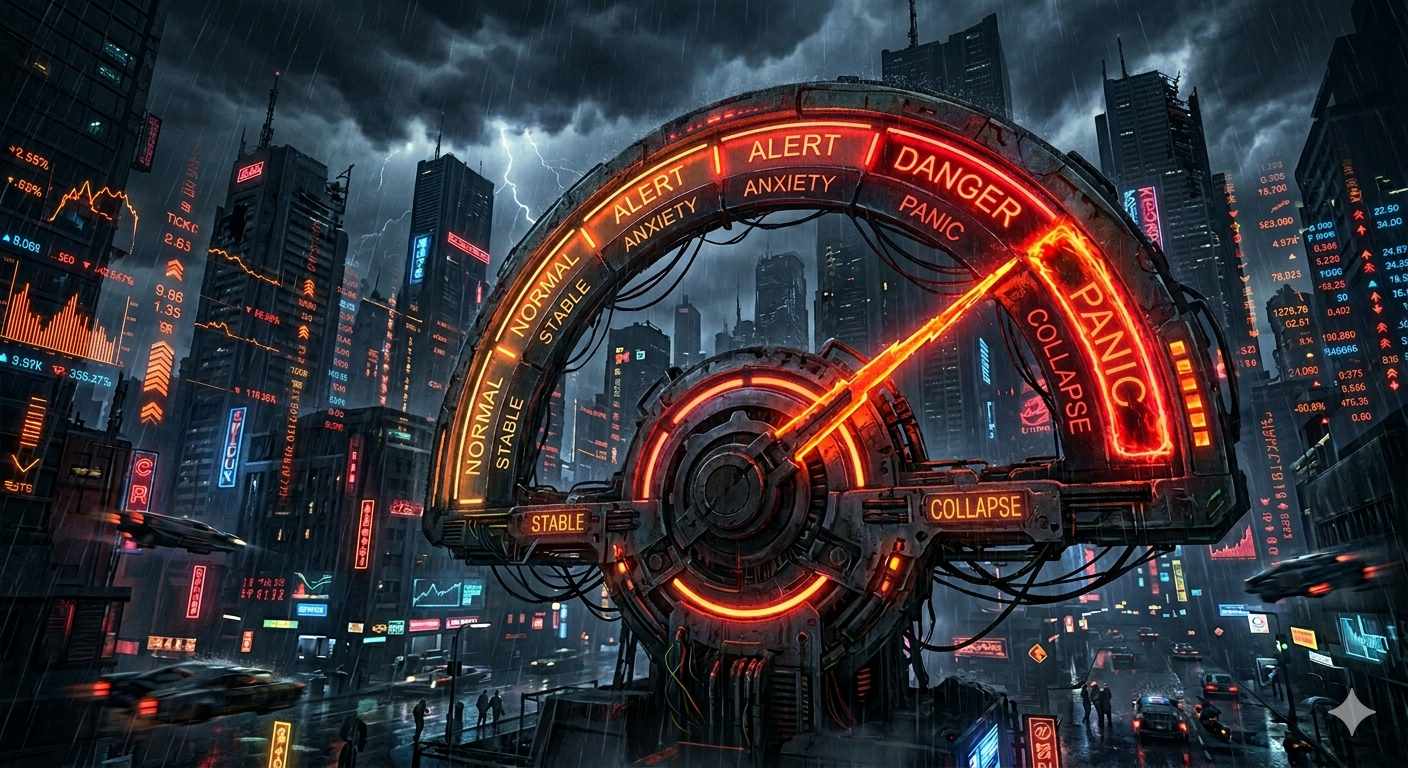
If you’ve spent any time watching financial news, you’ve heard it: “The VIX is spiking.” “Markets are calm the VIX is at historic lows.” “Fear is back, the VIX just hit 40.”
But what is it, actually? And more importantly: can understanding it help you become a better investor?
This is your complete, no-jargon guide to the VIX, what it measures, why Wall Street watches it obsessively, and how everyday investors can actually use it.
Table of Contents
What Is the VIX?
The VIX is the Volatility Index, created by the Chicago Board Options Exchange (CBOE) in 1993.
In simple terms: the VIX measures how nervous the market is.
More specifically, it measures the market’s expectation of how much the S&P 500 could swing up or down over the next 30 days, based on options pricing.
If the VIX is at 20, the market is implying annualized volatility of roughly 20% which translates to around ±5.8% expected movement over the next month.
Think of it like a weather forecast.
The stock market’s current price is today’s temperature.
The VIX is the probability of a storm.
Where Does the VIX Number Come From?
The VIX is not based on past market performance.
It is derived from the options market specifically from the prices of S&P 500 put and call options.
The intuition is straightforward:
When investors become fearful, they buy protection. In markets, that protection usually comes through put options, which gain value if the market falls.
As demand for downside protection rises, option prices increase.
The VIX converts that rising demand for insurance into a single volatility reading.
- High VIX = expensive protection = fear
- Low VIX = cheap protection = calm
That is why the VIX is commonly called the “fear gauge” or “fear index.”
For official methodology and live data, investors can consult the CBOE VIX documentation.
How to Read the VIX: Key Levels
Historically, the VIX has ranged from below 10 during periods of extreme calm to above 80 during full-scale market panic.
Here’s a simplified framework investors often use:
Below 15 — Complacency Zone
Markets are calm and confidence is high. Risk appetite tends to expand. But extremely low VIX levels can also signal excessive complacency the financial equivalent of blue skies before a storm.
15 to 25 Normal Conditions
This is roughly the historical average range. Markets are functioning normally with standard levels of uncertainty.
25 to 35 Elevated Anxiety
Investors are becoming nervous. This often appears during geopolitical stress, recession fears, inflation shocks, or major central bank events.
Above 35 Panic Zone
These readings historically coincide with severe crises and disorderly markets.
During the 2008 financial crisis, the VIX reached 89.5.
During the COVID crash of March 2020, it briefly surged above 85.
At these levels, fear dominates decision-making.
Why the VIX Usually Moves Opposite Stocks
One of the most important things to understand about the VIX is this:
It usually moves in the opposite direction of the stock market.
When equities fall sharply, the VIX typically spikes.
When markets rally steadily, the VIX usually drifts lower.
This inverse relationship exists because falling markets increase demand for downside protection through put options.
The relationship is not perfect, but it holds most of the time.
Occasionally, both stocks and the VIX rise together. Those moments are less common and often signal unusual market stress beneath the surface.
How Investors Use the VIX
The VIX as a market thermometer
The simplest use of the VIX is context.
Before making a major investment decision, check the volatility environment.
Are you buying into a euphoric market or a fearful one?
Are you panic-selling when fear is already elevated?
Sentiment tends to be mean-reverting. Extreme fear is often followed by stabilization or recovery. Extreme calm often precedes disruption.
The VIX helps investors understand where markets currently sit on that emotional spectrum.
The contrarian signal
Warren Buffett’s famous line: “be fearful when others are greedy, and greedy when others are fearful” aligns surprisingly well with VIX behavior.
Historically, some of the strongest long-term returns came from periods when the VIX was elevated and fear dominated headlines.
The clearest recent example remains the COVID-19 crash of March 2020.
As markets collapsed and the VIX exploded above 80, investors willing to gradually accumulate quality equities during the panic were rewarded by a historic recovery.
This is not a guarantee.
Buying during crashes carries real risk.
But broadly speaking, periods of elevated fear have often provided stronger long-term entry opportunities than periods of extreme complacency.
Some investors use rough thresholds like:
- VIX above 30: begin gradually accumulating quality assets
- VIX above 40: consider more aggressive positioning
- VIX below 15: become more cautious about risk
The important word is gradually.
The complacency warning
The VIX is useful not only during panic, but also during unusually calm markets.
Late 2017 became a textbook example. The VIX remained near historic lows below 10 for months.
Then came February 2018’s “Volmageddon” event, when short-volatility products imploded and the VIX surged toward 50 within days.
Low volatility does not automatically mean a crash is imminent.
But it often means investors have become comfortable and that market insurance is relatively cheap.
That can be a reasonable moment to reduce leverage, rebalance risk, or add hedges.
Position sizing and portfolio management
More sophisticated investors often use the VIX within volatility-targeting strategies.
The concept is simple:
- When volatility rises, reduce position sizes
- When volatility falls, allow risk exposure to increase
The goal is to keep portfolio risk relatively stable across different market environments.
Institutional investors frequently use quantitative models for this.
Retail investors can apply simplified versions:
- VIX above 25: trim equity exposure and increase defensive positioning
- VIX below 15: allow equities to move closer toward target allocation
This approach is less about prediction and more about risk discipline.
VIX derivatives: proceed with extreme caution
Investors can trade volatility directly through futures, options, or exchange-traded products such as VXX and UVXY.
Retail investors should be extremely careful here.
These are among the most complex instruments available in public markets.
One major issue is contango decay. Because VIX futures curves are often upward-sloping, products that continuously roll futures contracts forward tend to lose value structurally over time.
As a result, many long-volatility ETPs have suffered catastrophic long-term declines despite periodic volatility spikes.
These products are designed primarily for short-term tactical hedging — not long-term investing.
The VIX itself is incredibly useful as an indicator.
Trading volatility directly is an entirely different game.
What the VIX Can and Cannot Tell You
What the VIX does well:
- Measures real-time market sentiment
- Highlights periods of fear or complacency
- Provides historical context for volatility conditions
- Acts as a useful contrarian signal when combined with broader analysis
What the VIX cannot do:
- Predict market direction
- Tell you exactly when a correction will happen
- Measure volatility in crypto or individual stocks
- Replace a coherent investment strategy
A high VIX means markets expect turbulence.
It does not tell you whether prices will ultimately go up or down.
The VIX and Crypto Markets
As crypto exposure becomes more common in retail portfolios, investors increasingly ask whether the VIX still matters in a multi-asset world.
The answer is: yes, but less directly.
Crypto markets have their own volatility benchmarks, including DVOL, the Deribit Volatility Index for Bitcoin options.
These indexes behave similarly to the VIX but often operate at dramatically higher volatility levels.
There is some correlation between equity volatility and crypto volatility during macro stress events, but the relationship is far from perfect.
If your portfolio contains meaningful crypto exposure, the VIX remains useful context — just not the full picture.
A Practical Weekly VIX Checklist
Here is a simple investor routine:
- Check the current VIX reading
- Compare it to the one-year average
- Look at the VIX term structure relative to indexes like VIX3M
- Review whether your portfolio risk matches current conditions
- Avoid impulsive decisions based solely on volatility spikes
The VIX works best as a contextual tool — not as an automatic buy-or-sell trigger.
Why the VIX Still Matters
The VIX remains one of the most useful free indicators available to investors and one of the most misunderstood.
It will not predict the future.
But it will tell you how nervous investors are about it.
That changes how you think about risk, opportunity, and position sizing.
When the VIX is calm, enjoy the ride but stay aware of complacency.
When the VIX spikes, avoid emotional reactions.
And when fear becomes extreme, remember that some of the best long-term opportunities in market history appeared during moments when panic felt overwhelming.
Fear is information. The VIX helps investors read it.
VIX FAQ
What is the VIX in simple terms?
The VIX is an index that measures expected volatility in the S&P 500 based on options pricing. It is commonly known as the market’s fear gauge.
What is considered a high VIX reading?
Many investors consider readings above 30 elevated and readings above 40 extreme.
Does a high VIX mean the market will crash?
No. A high VIX signals expected volatility, not guaranteed market direction.
Can beginners trade VIX products safely?
VIX derivatives and leveraged volatility ETPs are highly complex and risky. Beginners should approach them with extreme caution.
Does the VIX apply to crypto markets?
Only indirectly. Crypto markets use separate volatility indicators such as DVOL.
Is this financial advice?
No. This article is for educational and informational purposes only and should not be considered investment advice.