Gold has always occupied a strange place in the global financial system.
It is not a currency in the traditional sense. It does not generate earnings like a stock. It does not pay coupons like a bond. Yet during periods of inflation, geopolitical chaos, banking stress, or monetary uncertainty, investors around the world instinctively run back to it.
In trading platforms, gold is usually represented by one of the most watched symbols in global macro markets: XAUUSD.
For retail traders, XAUUSD often looks simple “gold versus the dollar.” In reality, it is one of the most complex macro instruments in finance because it reacts simultaneously to inflation expectations, interest rates, central bank policy, bond yields, geopolitical risk, liquidity conditions, and global confidence in fiat currencies.
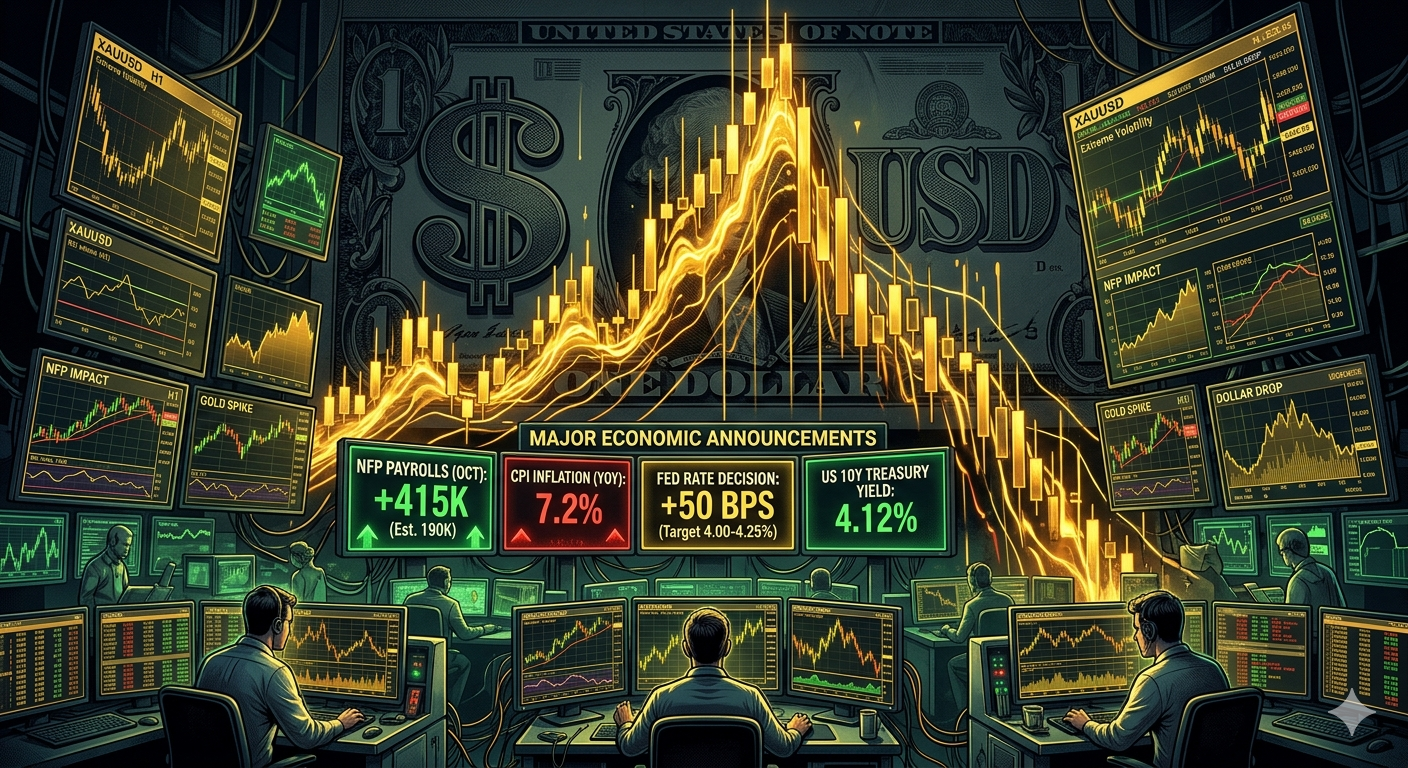
That is why major economic announcements like Non-Farm Payrolls (NFP), CPI inflation data, Federal Reserve decisions, and interest rate expectations can send XAUUSD moving violently within seconds.
Understanding how XAUUSD actually behaves requires understanding both markets and macroeconomics.
Here is Geek’n’Destroy’s complete guide to what XAUUSD is, how it works, why it correlates with the US dollar, and how economic announcements influence gold prices in the real world.
Table of Contents
- What Is XAUUSD?
- Why Gold Is Traded Against the US Dollar
- The Real Correlation Between Gold and the Dollar
- Interest Rates, Bond Yields and Gold
- How NFP Data Influences XAUUSD
- How CPI Inflation Data Moves Gold
- The Federal Reserve and XAUUSD
- The Real Macro-Economic Forces Behind Gold
- Why Gold Is Considered a Safe-Haven Asset
- How Traders Approach XAUUSD
- Why XAUUSD Is Extremely Volatile
- The Bottom Line on XAUUSD
- XAUUSD FAQ
What Is XAUUSD?
XAUUSD is the financial market symbol representing the price of gold quoted against the US dollar.
In trading terminology:
- XAU = one troy ounce of gold
- USD = the US dollar
So if XAUUSD trades at 2,400, it means one ounce of gold is worth 2,400 US dollars.
XAUUSD is one of the most traded instruments in global macro markets because gold sits at the intersection of commodities, currencies, central banking, inflation expectations, and investor psychology.
Unlike industrial commodities such as oil or copper, gold behaves primarily as a monetary and financial asset.
That distinction matters.
Gold is not traded only because of physical demand. It is also traded because investors use it as:
- A hedge against inflation
- A hedge against currency debasement
- A safe-haven asset during crises
- A diversification tool
- A speculative macro asset
This is why XAUUSD reacts strongly to macroeconomic announcements.
Why Gold Is Traded Against the US Dollar
Gold is globally priced in US dollars because the dollar remains the dominant reserve currency in international finance.
Most commodities — including oil, silver, copper and gold — are priced internationally in dollars.
That creates a direct relationship between gold and the dollar itself.
When the dollar strengthens significantly, gold often weakens.
When the dollar weakens, gold often strengthens.
But the relationship is not perfectly mechanical.
Gold is not simply “the opposite of the dollar.”
It is more accurate to think of XAUUSD as a reflection of global confidence in monetary conditions, real interest rates, inflation expectations and financial stability.
The US dollar remains central because the Federal Reserve still influences global liquidity more than any other central bank.
That means US macroeconomic data matters enormously for XAUUSD.
The Real Correlation Between Gold and the Dollar
Gold and the US dollar usually show an inverse correlation.
That means:
- Strong dollar = pressure on gold
- Weak dollar = support for gold
The logic is straightforward.
If the dollar becomes stronger, gold becomes more expensive for buyers using other currencies, which can reduce demand.
At the same time, investors may prefer holding interest-bearing dollar assets rather than non-yielding gold.
However, the correlation is not perfect.
There are periods where both gold and the dollar rise together.
This usually happens during severe global stress.
For example:
- Banking crises
- Geopolitical conflicts
- Liquidity shocks
- Systemic risk events
In those situations, investors may simultaneously seek safety in both US Treasury assets and gold.
This is why traders who oversimplify gold as merely “inverse dollar” often get trapped.
Gold reacts to a wider macro system.
Interest Rates, Bond Yields and Gold
One of the most important drivers of XAUUSD is real interest rates.
Gold does not generate yield.
That means when interest rates rise sharply, holding gold becomes less attractive relative to assets like Treasury bonds that suddenly offer meaningful returns.
This is why rising US bond yields often pressure gold lower.
But traders focus especially on real yields — nominal yields adjusted for inflation expectations.
If inflation rises faster than rates, real yields may remain low or negative, which can support gold.
Gold tends to perform best when:
- Real yields are low
- Inflation fears rise
- Confidence in fiat currencies weakens
- Central banks become more dovish
Gold often struggles when:
- Real yields rise aggressively
- The Federal Reserve becomes hawkish
- The dollar strengthens sharply
- Risk appetite returns strongly
Understanding this relationship is critical for interpreting economic news.
How NFP Data Influences XAUUSD
The US Non-Farm Payrolls report — commonly called NFP — is one of the most important monthly economic releases for XAUUSD traders.
Published by the US Bureau of Labor Statistics, the report measures job creation in the American economy outside the farming sector.
Markets watch NFP because strong employment data can influence Federal Reserve policy expectations.
A stronger-than-expected NFP report often means:
- The economy remains strong
- The Fed may keep rates higher for longer
- Bond yields may rise
- The dollar may strengthen
That combination frequently pressures gold lower.
Conversely, weak NFP data can support gold because traders may expect future rate cuts or looser monetary policy.
However, markets do not react only to the headline number.
Traders also analyze:
- Unemployment rate
- Wage growth
- Labor force participation
- Revisions to previous reports
Sometimes a “strong” NFP report can still help gold if wage growth weakens or unemployment rises unexpectedly.
That is why XAUUSD reactions around NFP can become extremely volatile.
The official NFP release calendar is available from the US Bureau of Labor Statistics.
How CPI Inflation Data Moves Gold
CPI — the Consumer Price Index — measures inflation.
For gold traders, inflation data is critical because gold is historically viewed as an inflation hedge.
The relationship is complicated, though.
If CPI inflation comes in higher than expected, gold may initially rise because inflation fears increase.
But if traders believe the Federal Reserve will react aggressively with higher interest rates, gold may then fall because higher rates strengthen the dollar and increase bond yields.
This creates a constant balancing act inside XAUUSD:
- Inflation supports gold
- Rate hikes often pressure gold
The market is always trying to determine which force dominates.
This is why traders obsess over CPI releases.
Not because inflation alone matters, but because inflation changes central bank expectations.
The Federal Reserve and XAUUSD
No institution influences XAUUSD more than the Federal Reserve.
Every Fed meeting, interest rate decision, economic projection and Jerome Powell press conference can move gold aggressively.
Gold traders constantly ask:
- Will the Fed raise rates?
- Will rates stay higher for longer?
- Will liquidity tighten?
- Will recession risks force future cuts?
Hawkish Fed policy generally pressures gold.
Dovish Fed policy generally supports gold.
But context matters.
Sometimes gold rises even during rate hikes because investors fear deeper systemic instability.
Gold is not just reacting to policy itself.
It reacts to what policy means for confidence.
The Real Macro-Economic Forces Behind Gold
Gold sits at the center of several macroeconomic narratives simultaneously.
That is why XAUUSD often looks chaotic to beginners.
Gold can react to:
- Inflation fears
- Currency debasement concerns
- Banking instability
- Wars and geopolitical crises
- Debt sustainability fears
- Central bank buying
- Interest rate expectations
- Dollar strength
- Recession fears
- Liquidity shocks
Sometimes these forces align.
Sometimes they conflict.
For example:
- Inflation may support gold
- But aggressive rate hikes to fight inflation may pressure gold
This tension is what makes XAUUSD one of the purest macro instruments in the world.
Gold is not merely a commodity.
It is a global confidence barometer.
Why Gold Is Considered a Safe-Haven Asset
Gold has historically been viewed as a safe-haven asset because it is perceived as independent from governments and central banks.
Unlike fiat currencies, gold cannot be printed.
Unlike corporate assets, it does not depend on earnings.
During periods of extreme uncertainty, investors often rotate toward gold because it represents perceived monetary stability.
Examples include:
- Financial crises
- Wars
- Banking collapses
- Debt fears
- Currency crises
Central banks themselves hold large gold reserves for similar reasons.
That institutional behavior reinforces gold’s role in the financial system.
How Traders Approach XAUUSD
XAUUSD attracts many different types of traders.
Day traders focus on intraday volatility around economic announcements and technical levels.
Swing traders attempt to capture medium-term macro trends driven by rates, inflation and Fed expectations.
Long-term investors may hold gold exposure as a hedge against inflation, geopolitical instability or systemic financial risk.
Technical analysis is widely used in XAUUSD trading because gold respects liquidity zones, psychological levels and volatility structures strongly.
However, macro context usually dominates over pure chart patterns during major economic events.
A perfect technical setup can collapse instantly if NFP or CPI surprises markets.
Why XAUUSD Is Extremely Volatile
Many beginners underestimate how violent XAUUSD can become.
Gold can move sharply because it reacts simultaneously to:
- Dollar moves
- Bond yields
- Interest rates
- Inflation expectations
- Risk sentiment
- Geopolitical news
Leverage magnifies this volatility further.
A highly leveraged XAUUSD position during NFP or CPI releases can experience enormous price swings within seconds.
This is why risk management matters heavily in gold trading.
The market can remain irrational longer than traders remain solvent.
The Bottom Line on XAUUSD
XAUUSD is far more than “gold versus the dollar.”
It is one of the purest expressions of global macroeconomics available in financial markets.
Gold reacts to inflation, interest rates, real yields, Federal Reserve policy, bond markets, geopolitical crises, banking stress and confidence in fiat currencies simultaneously.
That complexity is exactly why traders and investors watch it so closely.
The inverse relationship between gold and the dollar is real — but incomplete. Sometimes both rise together during moments of systemic fear. Sometimes inflation supports gold while rate hikes pressure it lower.
There is no single-variable explanation for XAUUSD.
The smart way to approach gold is to stop viewing it as merely a commodity and start understanding it as a global macro asset connected to the entire financial system.
Gold is not just a metal. In markets, it is a real-time measure of fear, trust, inflation, liquidity and confidence in money itself.
XAUUSD FAQ
What does XAUUSD mean?
XAUUSD represents the price of one troy ounce of gold quoted in US dollars.
Why does gold usually move opposite to the dollar?
Because a stronger dollar often pressures gold demand and increases the attractiveness of dollar-denominated assets like bonds.
Does NFP affect gold prices?
Yes. Strong employment data can strengthen the dollar and bond yields, which often pressures gold lower.
Why is CPI inflation data important for XAUUSD?
Because inflation influences Federal Reserve policy expectations and gold is often viewed as an inflation hedge.
Is gold a safe-haven asset?
Historically, yes. Investors often move toward gold during crises, wars, banking instability and periods of monetary uncertainty.
Why is XAUUSD so volatile?
Gold reacts simultaneously to interest rates, bond yields, inflation, dollar strength, geopolitical events and market sentiment.
Can gold and the dollar rise together?
Yes. During severe global stress, investors may seek safety in both gold and US dollar assets simultaneously.
Is this financial advice?
No. This article is for informational and educational purposes only and should not be considered financial or investment advice.