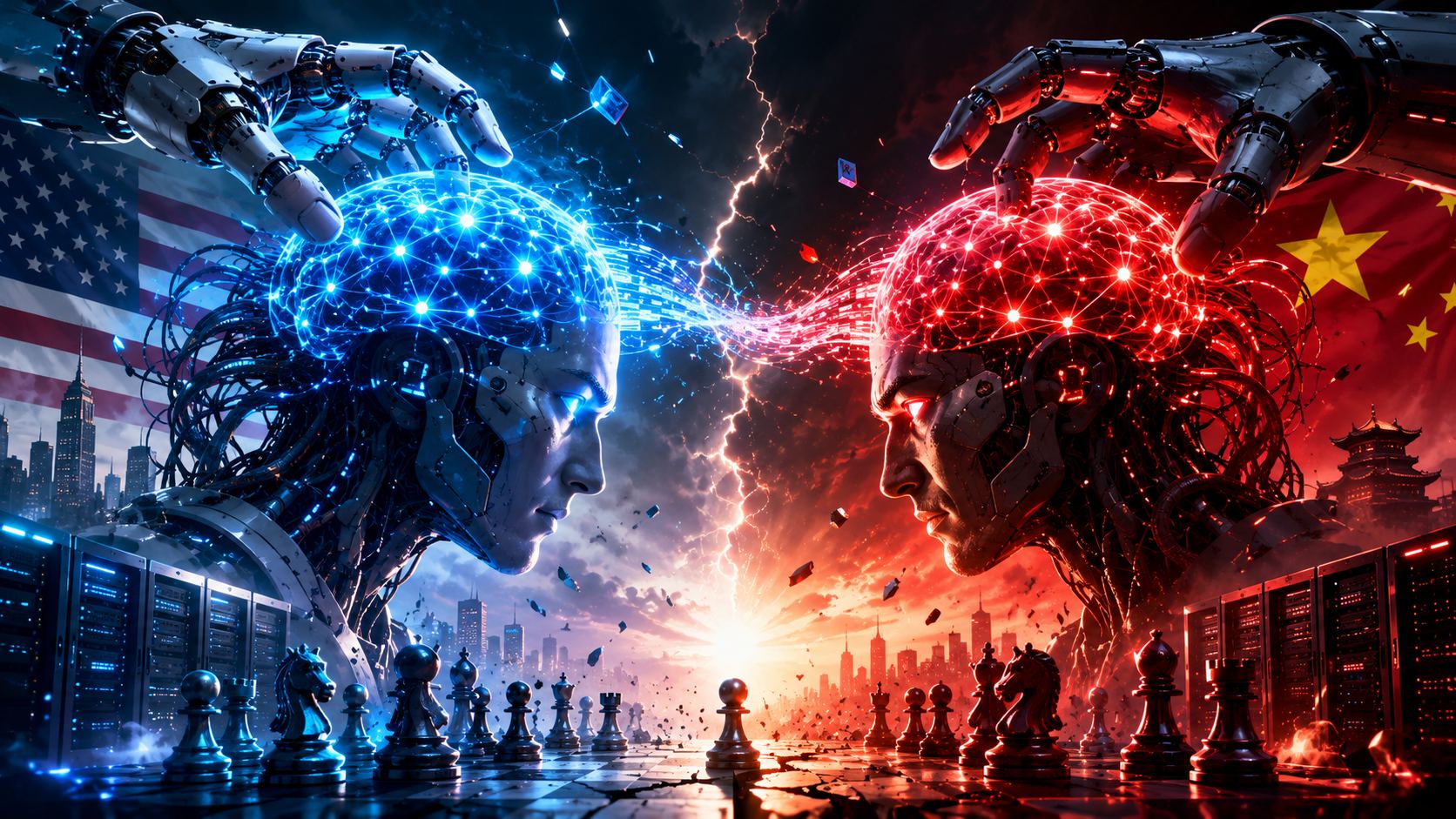
AI labs keep throwing the same accusation across the Pacific: Chinese rivals are “copying” their models. Behind the loaded word is a more technical one: distillation.
The practice is not new, and it is not automatically illegal. But in the AI race, it has become one of the most politically explosive shortcuts in the business: use a powerful model as a teacher, harvest its answers at scale, and train a cheaper model to behave in similar ways.
That is why Anthropic and OpenAI are increasingly framing distillation not just as a terms-of-service problem, but as a strategic threat.
- What AI distillation actually means
- Why every AI lab has a reason to use it
- What Anthropic is alleging
- Why China makes the debate more sensitive
- The legal grey zone
- AI distillation: key questions
What AI distillation actually means
Distillation is a model-compression technique popularized by Geoffrey Hinton, Oriol Vinyals, and Jeff Dean in the 2010s. The basic idea is simple: a larger, more capable “teacher” model generates outputs, and a smaller “student” model is trained to imitate them.
In practical terms, that can mean asking a frontier model hundreds of thousands or millions of questions, saving the answers, and using those responses as training data for a lighter system. OpenAI itself describes model distillation as a way to use outputs from larger models to fine-tune smaller, cheaper models for similar task performance.
OpenAI’s own documentation frames distillation as a legitimate developer tool when done inside the rules. The problem starts when a company allegedly uses another lab’s proprietary model without authorization.
Why every AI lab has a reason to use it
Training a frontier AI model from scratch can be brutally expensive. It requires chips, data, researchers, infrastructure, and repeated failed experiments. Distillation offers a shortcut: instead of rediscovering every behavior independently, a smaller model learns from a stronger one’s outputs.
That makes distilled models cheaper to run, faster to deploy, and potentially good enough for many commercial tasks. In court testimony reported by WIRED, Elon Musk said that “generally” AI companies distill other AI companies, and acknowledged xAI had done so “partly” with OpenAI.
That line matters because it exposes the industry’s awkward reality: distillation is both a standard optimization method and, when applied to a rival’s closed model at scale, a possible act of extraction.
What Anthropic is alleging
Anthropic has been one of the most aggressive companies in calling out alleged distillation campaigns.
In February 2026, the company said it had identified “industrial-scale” campaigns by DeepSeek, Moonshot, and MiniMax. According to Anthropic, those labs generated more than 16 million exchanges with Claude through around 24,000 fraudulent accounts.
The allegations escalated again in June. Reports say Anthropic accused Alibaba of using roughly 25,000 fake accounts to generate 28.8 million Claude exchanges between April and June 2026. Reuters has reported on the wider tension between Anthropic and Chinese AI firms as Chinese models become increasingly competitive.
Anthropic’s argument is clear: if a rival can extract frontier capabilities through mass querying, then the cost and time advantage of building the original model shrink dramatically.
Why China makes the debate more sensitive
This is not only a business dispute. It sits inside the larger U.S.-China AI race.
Chinese labs have already shown they can build highly capable systems with aggressive efficiency gains. Z.ai’s GLM-5.2, for example, has drawn attention for strong open-weight performance, long-context capabilities, and competitive coding results. Security researchers have also tested it in vulnerability-analysis workflows, adding to concerns that advanced cyber capabilities are becoming cheaper and more accessible.
That does not prove Chinese labs are only catching up through distillation. The stronger reading is more complicated: distillation may accelerate progress, but it does not replace engineering, architecture, data work, or deployment skill.
The danger for U.S. labs is that the gap narrows faster. The danger for everyone else is that the debate turns into a simplistic “copying” narrative that ignores genuine technical progress outside Silicon Valley.
The legal grey zone
The law has not fully caught up. Unauthorized distillation can clearly violate platform terms of service. Whether it also counts as intellectual property theft, trade-secret misappropriation, or something else is a harder question.
Model outputs are not source code. They are not model weights. They are behavior. That makes enforcement messy.
AI companies want stronger technical defenses, tighter account verification, and export-control arguments that treat model capability as a strategic asset. Researchers are more divided. Some see distillation attacks as a real threat; others argue that blocking them too aggressively could slow legitimate research, benchmarking, and interoperability.
The uncomfortable truth is that AI’s most valuable product is increasingly not just the model file. It is the pattern of answers the model gives. And that pattern can be probed.
AI distillation: key questions
What is AI distillation?
AI distillation is a technique where a smaller model is trained using outputs from a larger, more capable model.
Is AI distillation illegal?
Not by default. It is widely used in AI development, but using a rival’s proprietary model without permission can violate terms of service and may raise legal issues.
Why are Anthropic and OpenAI worried?
They worry that competitors can extract valuable capabilities from expensive frontier models without paying the full cost of developing them.
Did Anthropic accuse Chinese AI companies of distilling Claude?
Yes. Anthropic has accused DeepSeek, Moonshot, MiniMax, and reportedly Alibaba of large-scale unauthorized extraction campaigns involving millions of Claude interactions.
Does distillation explain China’s AI progress?
Only partly, if at all. Distillation can accelerate model development, but Chinese AI labs have also made real advances in efficiency, cost control, model architecture, and open-weight deployment.