AI is often sold as pure software: models, prompts, agents, apps, interfaces, APIs. Clean, weightless, almost magical.
That is only half the story. The real AI boom has a body, and it is heavy. It is made of GPUs, memory, servers, cooling systems, power substations, fiber, copper, switches, cables, wafers, racks, and brutally complex supply chains.
The next phase of the AI race may not be decided by who writes the cleverest chatbot wrapper. It may be decided by who controls the machines, electricity, networking, and materials that make the whole thing run. In other words: the geek war is moving back into hardware.
AI is not just software
The mainstream AI narrative is obsessed with models. GPT, Claude, Gemini, Llama, agents, reasoning, multimodal tools — the software layer gets the spotlight because it is what users touch.
But every prompt has a physical cost. Somewhere, a GPU cluster wakes up. Memory moves data. Switches route traffic. Cooling systems fight heat. Electricity flows through copper. A data center burns through megawatts so a model can generate a paragraph, analyze an image, write code, or simulate a molecule.
That is the part of AI most people do not see. And it is becoming the most important part.
The International Energy Agency has estimated that data centers consumed roughly 415 terawatt-hours of electricity in 2024, around 1.5% of global electricity consumption, with demand growing quickly as AI workloads expand. The IEA has also warned that electricity demand from AI-focused data centers has been rising much faster than the broader data center market. Source: International Energy Agency
That makes AI less like a cloud fantasy and more like an industrial revolution. Not just code. Infrastructure.
Nvidia and the return of the chip empire
Nvidia is the obvious symbol of this hardware comeback. The company did not become one of the defining firms of the AI era because it built the prettiest app. It became essential because its GPUs are the engines behind modern AI training and inference.
In its fiscal 2026 fourth quarter, Nvidia reported record quarterly revenue of $68.1 billion, with data center revenue alone reaching $62.3 billion. For the full fiscal year, the company reported $215.9 billion in revenue. Source: Nvidia
That tells the story better than any keynote. The center of gravity has moved from consumer graphics cards to industrial-scale compute.
Nvidia’s advantage is not only the chip. It is the stack: GPUs, networking, systems, software libraries, developer lock-in, and a supply chain tuned for hyperscale AI. In a world where everyone wants more compute, selling the shovels is a very good business.
But the bigger lesson is not “Nvidia wins forever.” It is that AI has made silicon strategic again. AMD, Intel, Broadcom, Marvell, TSMC, Samsung, SK hynix, Micron, and a growing list of AI chip startups are all part of the same battle: turning physics into intelligence at scale.
The software boom is real. But the hardware toll booth is very real too.
Data centers are the new tech cathedrals
The data center used to be boring infrastructure. A warehouse full of servers. Something only cloud engineers, sysadmins, and CFOs cared about.
Not anymore.
AI data centers are becoming the new cathedrals of technology: massive, expensive, power-hungry buildings designed around compute density. The most valuable digital products in the world increasingly depend on physical campuses that need land, water, grid connections, transformers, backup power, cooling systems, and network access.
This is why the AI race is also a real estate race, an energy race, and a permitting race.
Cloud giants and “neocloud” players are fighting to secure capacity because AI demand has moved faster than infrastructure can be built. Training frontier models requires huge clusters. Running AI products for millions of users requires even more distributed inference capacity. The result is a buildout that looks less like a normal software cycle and more like telecom, energy, and heavy industry.
The cloud is not actually a cloud. It is someone else’s building, plugged into someone else’s grid, filled with very expensive machines.
Why copper suddenly matters again
One of the strangest side effects of the AI boom is that an ancient metal is suddenly part of the future-tech conversation.
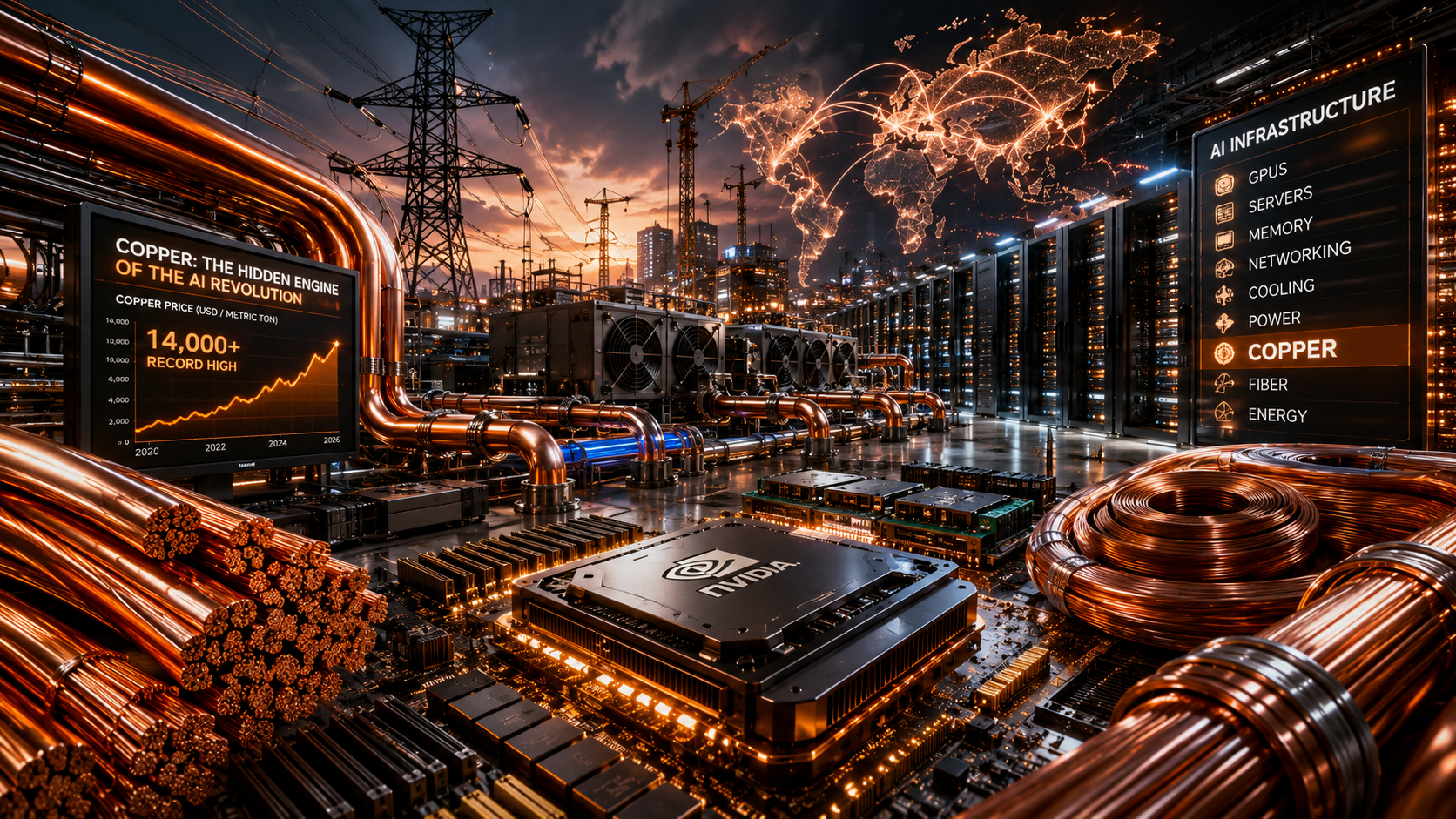
Copper matters because electrification matters. Data centers need power cables, transformers, cooling infrastructure, grid upgrades, and internal electrical systems. AI is not the only driver of copper demand — electric vehicles, renewable energy, defense, and grid modernization all matter — but AI has added another powerful source of pressure.
Reuters reported in January 2026 that copper prices had surged to record levels above $13,000 per metric ton, helped by supply concerns and expectations of strong demand from AI data centers and electric vehicles. Later that month, Reuters reported another spike above $14,000 per metric ton. Source: Reuters
That is the kind of detail that makes the AI story feel less abstract. A new model may be announced on a livestream. But behind it, miners, smelters, utilities, grid operators, and cable suppliers are suddenly part of the plot.
The AI economy is not only about tokens. It is about tons.
Networking, memory, and cooling are now strategic
GPUs get the glory, but AI infrastructure is a team sport.
Memory is critical because AI models move and store huge amounts of data. High-bandwidth memory has become one of the most important components in AI accelerators. Without enough memory bandwidth, even powerful chips become bottlenecked.
Networking is just as important. Large AI clusters depend on thousands of chips acting together. If the network cannot move data fast enough between GPUs, the whole system loses efficiency. This is why companies like Cisco, Broadcom, Arista, Marvell, and Nvidia’s own networking business are suddenly central to the AI conversation.
Cisco, for example, has been pushing deeper into AI infrastructure networking as hyperscalers and cloud providers expand their clusters. In its February 2026 quarterly results, the company highlighted AI infrastructure momentum and raised its fiscal 2026 revenue guidance. Source: Cisco investor relations
Then there is cooling. AI servers generate serious heat. Traditional air cooling is under pressure as rack densities climb. Liquid cooling, immersion cooling, advanced heat exchangers, and smarter data center design are moving from niche engineering topics to boardroom-level priorities.
This is the geeky truth: the future of AI may depend as much on thermodynamics as on algorithms.
The hidden risk: supply chains and power bottlenecks
The hardware comeback also brings hardware problems.
Software scales fast. Physical infrastructure does not. A model can go viral overnight. A data center cannot be built overnight. A power grid cannot be upgraded with a software patch. Semiconductor capacity cannot magically appear because demand increased last quarter.
That creates bottlenecks everywhere.
Advanced chips depend on leading-edge foundries. Packaging capacity matters. High-bandwidth memory supply matters. Transformers and power equipment can face long lead times. Grid interconnection queues can slow projects. Local communities may resist new data centers because of water use, power demand, noise, or land use.
There is also geopolitical risk. Semiconductor manufacturing is deeply globalized. Critical minerals are politically sensitive. Export controls, tariffs, national security rules, and industrial policy can all reshape who gets access to the best hardware.
This is why AI infrastructure is becoming a national strategy issue, not just a Silicon Valley procurement problem.
What this means for the next decade
The first wave of the modern AI boom was about models. The next wave is about capacity.
Who has the chips? Who has the power? Who has the data centers? Who has the networking gear? Who has the cooling technology? Who can finance the buildout? Who can secure supply chains before rivals do?
That does not mean software stops mattering. Better models, smarter architectures, efficient inference, open-source systems, and optimized applications will still define the user experience. But the companies that control the physical layer may have the strongest leverage.
This is the grand return of hardware. Not in the nostalgic “build your own PC” sense, though that spirit is definitely in the room. This is hardware as geopolitical power, financial engine, and competitive moat.
AI has a body. It is made of silicon, copper, steel, glass fiber, water, electricity, and heat.
And the next decade of tech may belong to whoever can build that body fastest.
AI hardware boom: key questions
Why is hardware becoming so important in AI?
Because AI models require massive physical infrastructure to train and run: GPUs, servers, memory, networking equipment, cooling systems, data centers, and electricity.
Why is Nvidia so central to the AI boom?
Nvidia’s GPUs and data center systems are widely used for AI training and inference, making the company a key supplier for hyperscalers, cloud providers, startups, and enterprises building AI products.
Why are data centers called the new tech cathedrals?
Because they are large, expensive, power-intensive facilities that now support some of the most important digital services in the world, including AI platforms.
What does copper have to do with artificial intelligence?
Copper is used in power cables, electrical systems, grid upgrades, transformers, cooling infrastructure, and data center construction. AI adds demand to an already tight market driven by electrification.
Could power demand slow down the AI boom?
Yes. Grid capacity, energy costs, permitting delays, and local opposition could become major constraints for AI data center expansion.
Is this article financial advice?
No. This article discusses technology and market trends for informational purposes only. It is not investment advice, and readers should do their own research before making financial decisions.