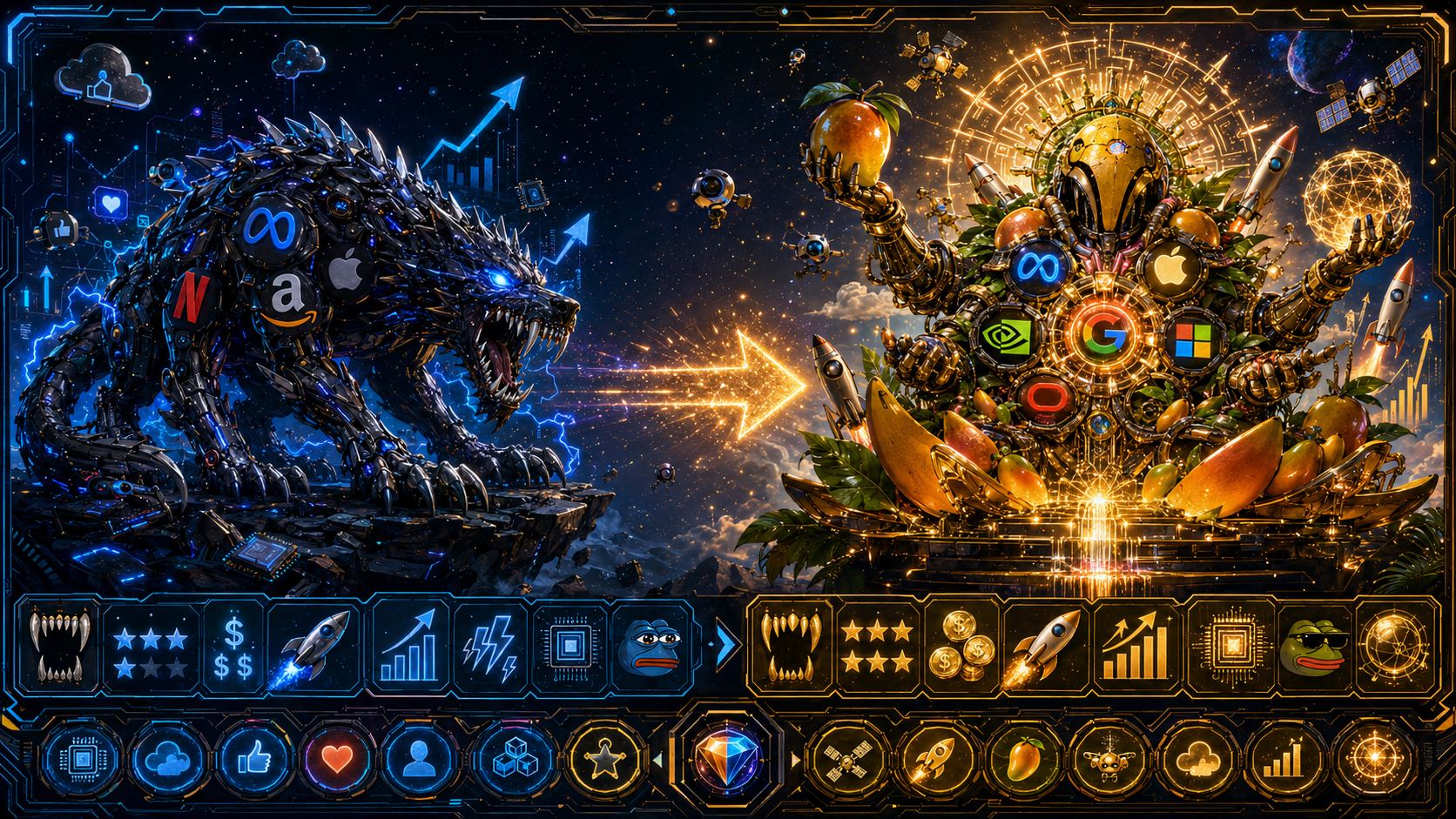
Some market acronyms are useful. Others are just Wall Street cosplay with a Bloomberg terminal.
FAANG started as a clean way to talk about the internet giants that ate advertising, e-commerce, mobile, streaming, and attention. Then came GAFAM, because Europe loves regulatory symmetry. Then the Magnificent Seven rode into town like the Avengers after a very expensive costume upgrade: Apple, Microsoft, Alphabet, Amazon, Nvidia, Meta, and Tesla.
Now the market has a new shiny object: MANGOS — Meta, Anthropic, Nvidia, Google, OpenAI, and SpaceX.
It sounds like a smoothie. It behaves like a thesis. And that is exactly why investors should pay attention without switching their brains to autopilot.
The pitch is simple: FAANG was the web platform era, the Magnificent Seven was the mega-cap dominance era, and MANGOS is the AI-and-frontier-tech era. The twist is that half the acronym is not even fully available to public-market investors yet. That makes MANGOS less like a stock basket and more like a market mood board: artificial intelligence, compute, cloud, space infrastructure, private valuations, and the hunt for hidden exposure.
The acronym wars
Wall Street loves acronyms because they turn messy market structure into collectible lore.
FAANG originally bundled Facebook, Amazon, Apple, Netflix, and Google into one easy story: these were the companies reshaping consumer internet behavior and compounding market value while everyone else tried to explain why their valuation multiples were “probably too high.” Investopedia notes that FAANG became shorthand for dominant, high-growth U.S. tech names, evolving from the earlier FANG label popularized around the Jim Cramer/CNBC orbit according to its explainer.
Then the names changed. Facebook became Meta. Google became Alphabet. Netflix lost some of its “unstoppable platform” mystique. Microsoft, once treated like your dad’s enterprise software cabinet, became a cloud and AI superpower. Nvidia evolved from gaming GPU champion into the market’s AI mana crystal.
FAANG did not die. It evolved, Pokémon-style. The problem is that the evolution path got chaotic.
GAFAM tried to clean up the naming problem by swapping Netflix for Microsoft. The Magnificent Seven went bigger and more cinematic, putting Apple, Microsoft, Alphabet, Amazon, Nvidia, Meta, and Tesla into one heroic squad. Fidelity describes the Magnificent Seven as a group of large-cap tech companies whose size and performance made them central to modern market leadership in its investor guide.
The point was never just the list. The point was the story. These acronyms tell investors who the “main characters” are supposed to be.
Enter MANGOS
MANGOS is the new proposed cast: Meta, Anthropic, Nvidia, Google, OpenAI, and SpaceX.
It is not subtle. This is Wall Street’s Avengers: Endgame reshuffle, where some original heroes are still around, some have been benched, and the new boss fight is powered by GPUs, foundation models, satellites, and private-market markups.
Meta represents the AI-in-social-platforms angle: massive distribution, aggressive AI spending, and a core advertising machine that still prints cash when the market is not busy panicking about capex.
Nvidia is the weapons supplier. In the AI cycle, it is not just a chip company; it is the toll booth for accelerated computing. Every model-training arms race, cloud expansion, and sovereign AI project keeps the Nvidia narrative alive.
Google, or more precisely Alphabet, brings search, YouTube, Gemini, Google Cloud, TPUs, Waymo, and a portfolio of strategic bets. It is both incumbent and challenger, which is an awkward but powerful market position.
Anthropic and OpenAI are the model-lab icons. Claude and ChatGPT are not just products; they are symbols of where enterprise software, consumer interfaces, coding, search, and productivity may be heading.
SpaceX adds the frontier-tech wildcard: rockets, Starlink, satellite internet, defense-adjacent infrastructure, and the kind of Elon Musk gravity field that can turn a listing into a global market event. Reuters reported in early June 2026 that SpaceX was preparing a record-setting IPO at $135 per share, aiming to raise $75 billion, based on a source familiar with the matter as reported by Reuters.
MANGOS is not really about “tech” in the old app-store-and-ad-network sense. It is about infrastructure for the next digital stack: compute, models, data, distribution, orbital networks, and capital intensity.
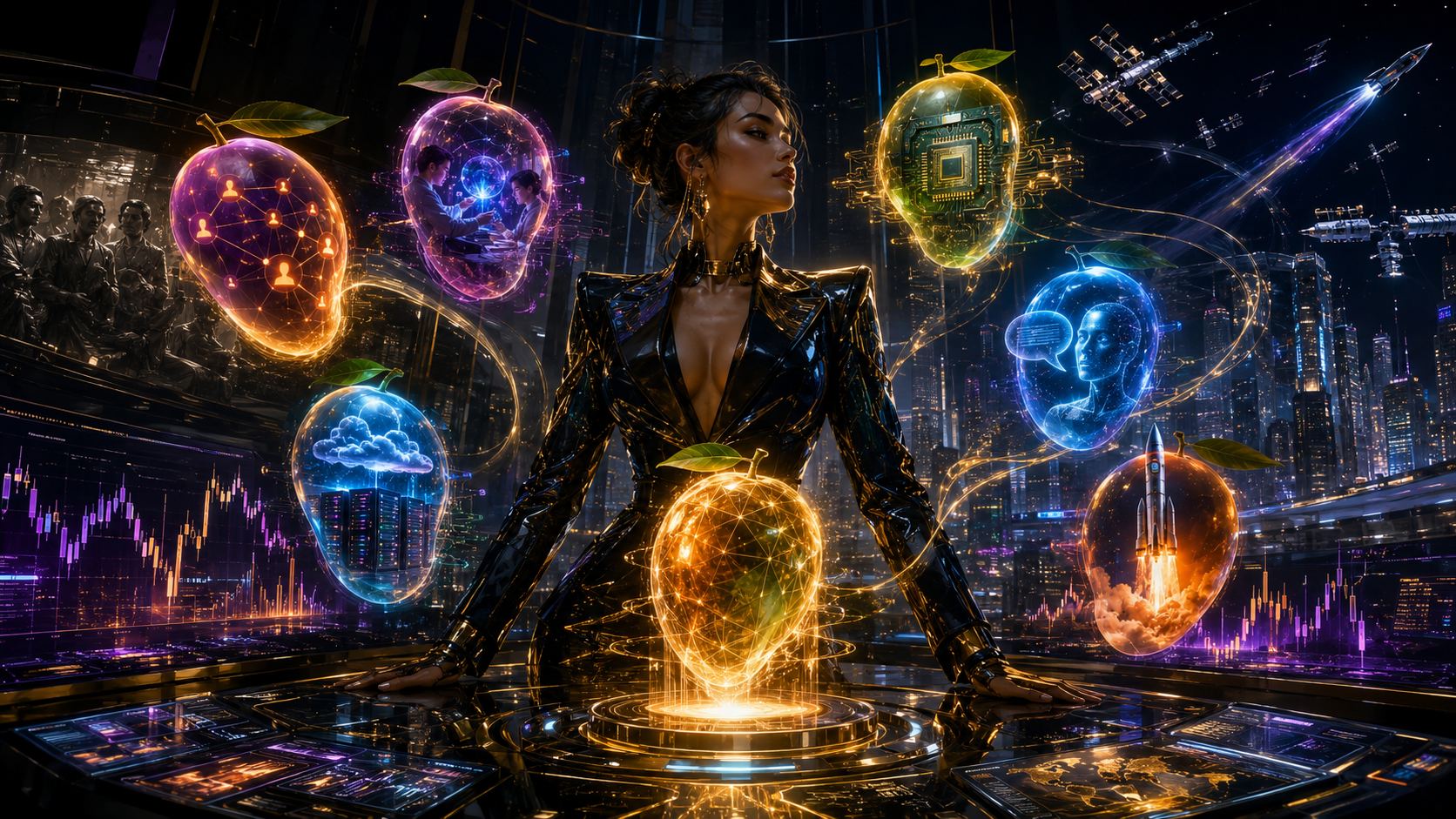
MANGOS stands for Meta, Anthropic, Nvidia, Google, OpenAI, and SpaceX.
The private-market problem
Here is where the acronym gets weird: several MANGOS names are, or recently were, private-market giants.
Meta, Nvidia, and Alphabet are public. Investors can buy them directly. OpenAI, Anthropic, and SpaceX are more complicated. Depending on timing, access, and listing status, many investors either cannot buy them at all, can only access them through secondary markets, or can only get indirect exposure through public companies that own stakes, supply infrastructure, or benefit from demand.
That matters because Wall Street acronyms historically worked best when they described actual stocks. FAANG was a public-market basket. The Magnificent Seven was a public-market basket. MANGOS is partly a public-market basket, partly a pre-IPO watchlist, and partly a fan theory with a discounted cash flow model hiding under it.
Reuters reported that Anthropic confidentially filed for a U.S. IPO in June 2026, a move that could reshape public-market access to foundation-model companies according to Reuters. Reuters also reported that OpenAI confidentially filed for a U.S. IPO after Anthropic, with no confirmed timeline or offering details disclosed in a separate report.
That is the private-market problem in one sentence: the companies shaping public-market valuations are not always public-market securities.
Nvidia trades on AI demand expectations. Alphabet trades partly on whether Gemini, Google Cloud, and its AI infrastructure bets can defend or expand its empire. Meta trades partly on whether AI can make ads, feeds, agents, and wearables more profitable. But OpenAI, Anthropic, and SpaceX influence the market’s imagination before most investors can buy the shares directly.
That creates scarcity value. It also creates narrative distortion.
Alphabet’s hidden side quest
Alphabet may be the most interesting MANGOS character because it is not just “Google search plus YouTube plus cloud.” It has a side quest.
The market already knows Alphabet is an AI incumbent. The less visible angle is its exposure to private names and strategic infrastructure relationships. Alphabet has been tied to SpaceX for years through Google’s 2015 investment alongside Fidelity, which supported SpaceX and its satellite ambitions. It has also been closely linked to Anthropic through cloud and investment relationships, with Google previously committing billions to the AI company.
That does not automatically mean Alphabet should be valued like a stealth venture fund. Public investors should be careful with “sum-of-the-parts” treasure maps. Private stakes can be hard to size, hard to monetize, and easy to over-romanticize. A paper gain is not the same as cash in the treasury. A strategic relationship is not the same as control.
Still, the side quest matters. If SpaceX, Anthropic, OpenAI, or AI coding platforms such as Cursor become major public-market stories, investors will look for indirect beneficiaries. Alphabet sits in that conversation because it has cloud infrastructure, custom AI chips, distribution, and private-market connections that can make its story bigger than search advertising alone.
This is why MANGOS is dangerous and useful at the same time. It pushes investors to look beyond simple ticker symbols. But it can also tempt them into treating every vague private-market association like buried loot.
Hype, indexes, and boss fights
Acronyms are maps. They are not investment theses.
FAANG helped investors understand platform dominance. The Magnificent Seven helped explain market concentration. MANGOS, if it sticks, may help describe the next phase: AI models, compute infrastructure, private-market giants, and space-enabled networks colliding into one giant capital allocation boss fight.
But acronyms also flatten reality. Meta is not Anthropic. Nvidia is not SpaceX. Google is not OpenAI. A profitable ad platform, a chip supplier, a model lab, and a rocket company do not have the same margins, risks, regulatory exposure, capital needs, or valuation logic.
That is where the meme can betray the investor. A catchy basket makes different businesses feel interchangeable. They are not. Some are cash machines. Some are capital furnaces. Some are infrastructure monopolies in the making. Some may become extraordinary companies at prices that still disappoint shareholders.
The practical “so what?” is this: use MANGOS as a starting map, not an autopilot strategy.
A smart investor can use the acronym to ask better questions. Who controls the compute layer? Who owns distribution? Who has pricing power? Who is burning capital to build infrastructure? Who benefits if AI demand keeps compounding? Who gets hurt if the market decides the capex cycle has gone full boss-rage mode?
That is the real value of MANGOS. Not the fruit salad branding. Not the “new FAANG” headline. The value is that it shows where Wall Street is looking next.
FAANG was about the internet economy becoming the economy. The Magnificent Seven was about mega-cap tech becoming the index. MANGOS is about AI, space, and private giants trying to become the next market mythology before the public market has fully absorbed them.
Cool acronym. Interesting map. Dangerous autopilot.
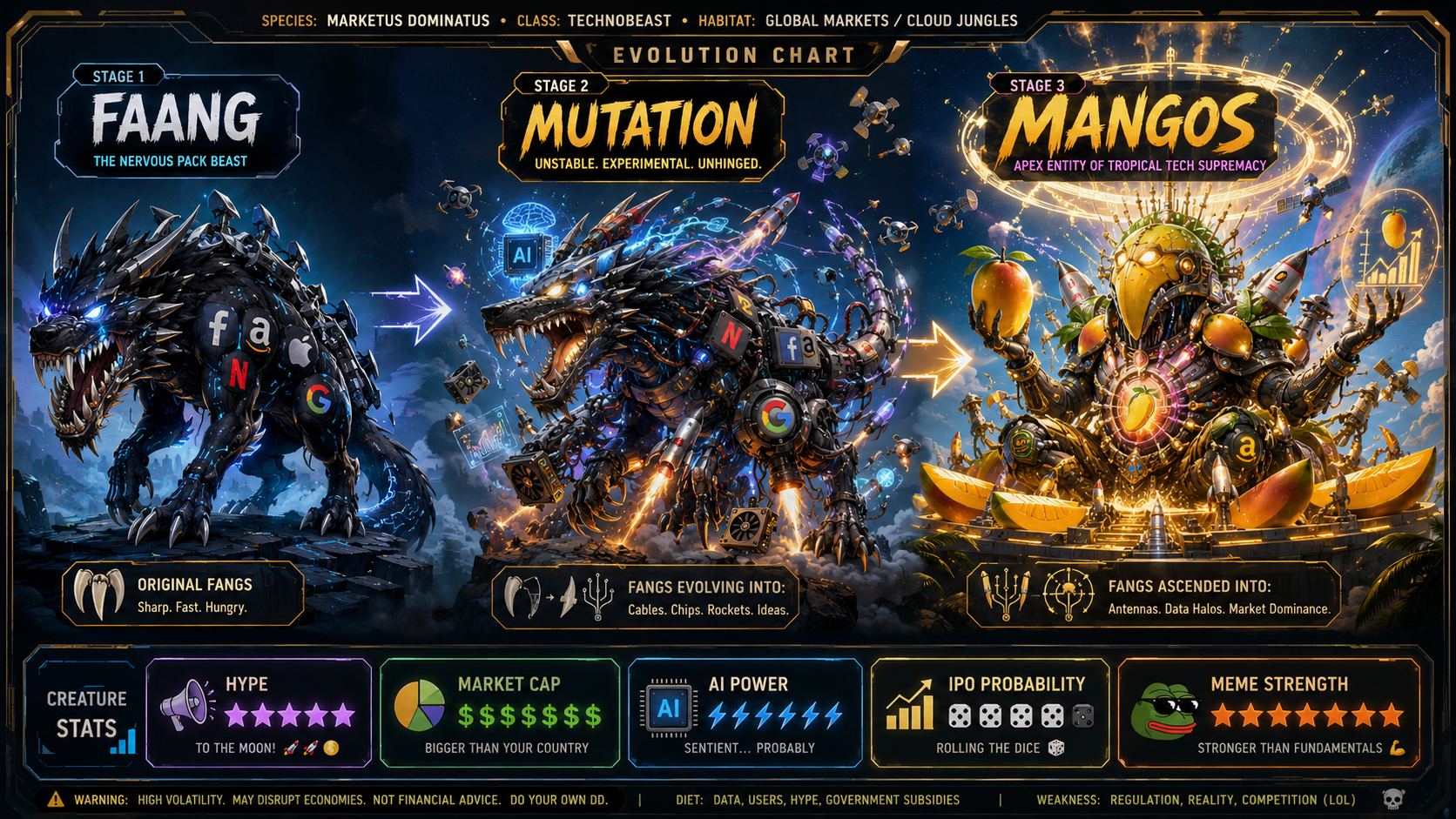
Unlike FAANG, which grouped publicly traded consumer-internet giants, MANGOS mixes public tech leaders with private or pre-IPO AI and space giants, making it more of a market narrative about the next tech cycle than a clean stock basket.
MANGOS stocks: key questions
What does MANGOS stand for?
MANGOS refers to Meta, Anthropic, Nvidia, Google, OpenAI, and SpaceX. It is an emerging market acronym, not an official index.
Is MANGOS replacing FAANG?
Not formally. It is better understood as a new narrative about AI, compute, space, and private-market giants rather than a clean replacement for FAANG.
Can investors buy all MANGOS companies?
Not always. Meta, Nvidia, and Alphabet are publicly traded, while access to Anthropic, OpenAI, and SpaceX depends on their public listing status and investor eligibility.
Why is Alphabet important in the MANGOS story?
Alphabet combines public AI exposure through Google and Google Cloud with strategic links to private companies such as Anthropic and SpaceX, making it a potential indirect beneficiary of the next tech cycle.
Are tech acronyms useful for investors?
They can be useful as a shortcut for understanding market themes, but they should never replace analysis of valuation, cash flow, competition, regulation, and risk.
Is this financial advice?
No. This article is for information and analysis only. It is not financial advice, and investors should do their own research or consult a qualified adviser before making investment decisions.