In the rapidly evolving landscape of digital assets, Kaspa (KAS) has emerged as a Layer-1 project built around a very specific promise: combining proof-of-work security with much faster transaction processing than traditional linear blockchains.
Launched in 2021, Kaspa is not just another blockchain. It is a proof-of-work blockDAG, a directed acyclic graph architecture that allows parallel blocks to be created and ordered instead of discarded. That design gives Kaspa a very different profile in the ongoing debate around security, decentralization, and speed.
Table of contents
The power of GHOSTDAG
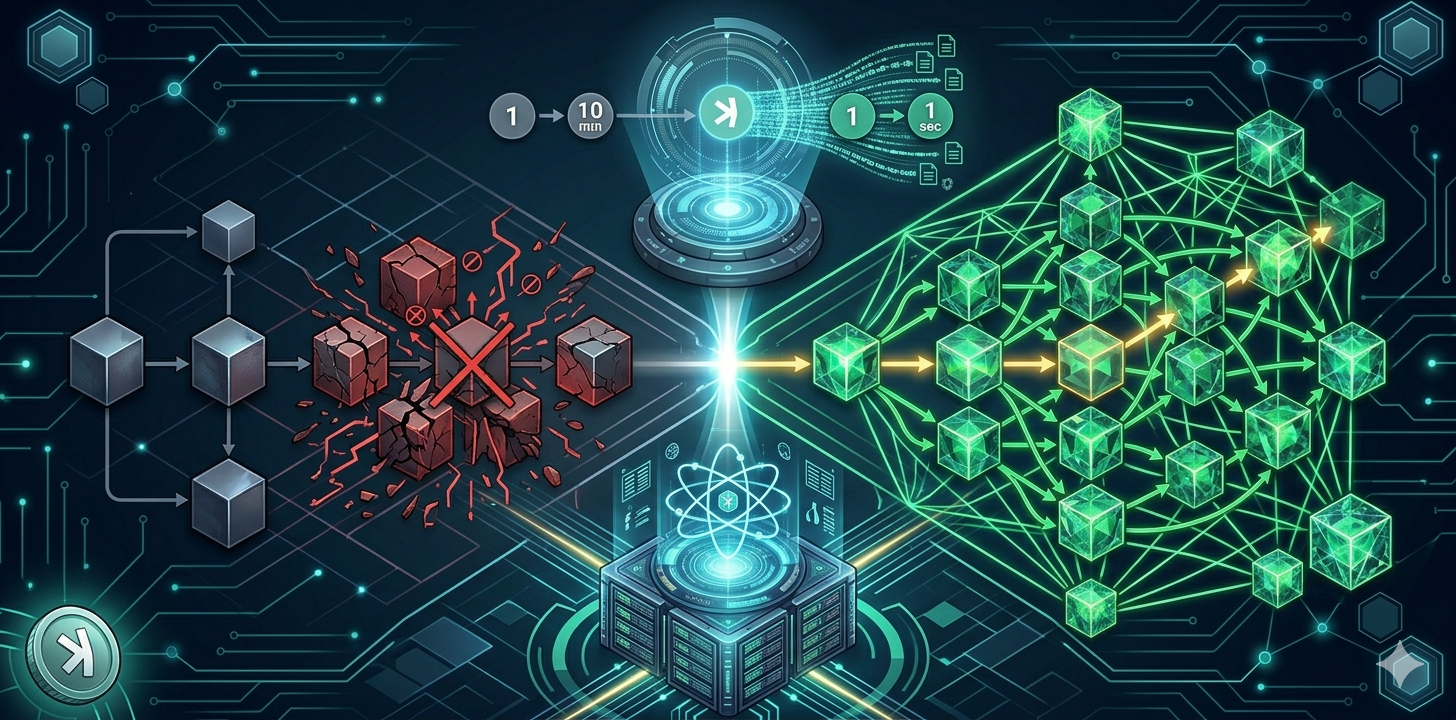
Traditional blockchains, like Bitcoin, function linearly: one block is added at a time, and blocks created simultaneously are usually left aside. Kaspa uses the GHOSTDAG consensus protocol, which allows parallel blocks to coexist.
Instead of choosing one winner and discarding the rest, the network orders blocks into a cohesive ledger. This approach reduces wasted work and helps Kaspa preserve proof-of-work principles while aiming for far higher throughput.
This architecture is Kaspa’s answer to one of crypto’s oldest problems: how to scale without abandoning decentralization or security. Rather than relying on a proof-of-stake model or pushing activity away from the base layer, Kaspa attempts to make proof-of-work itself faster.
Scalability and speed
Kaspa has built much of its reputation on speed. While Bitcoin produces one block roughly every ten minutes, Kaspa operates with a much higher block rate, making transactions visible far more quickly on the network.
This translates into several key advantages:
- Fast transaction visibility: transactions can appear on the network within seconds.
- Rapid confirmation: Kaspa is designed to make settlement feel much closer to real time than older proof-of-work chains.
- Base-layer throughput: its blockDAG structure allows the network to process parallel activity without immediately relying on Layer-2 systems for basic scaling.
The project’s roadmap also points toward even higher block rates in the future. The goal is clear: make proof-of-work usable for faster, more frequent transactions without turning Kaspa into a centralized network.
Native assets and programmability
The next major step for Kaspa is programmability. The Toccata hardfork is designed to introduce covenant-based base-layer programmability, opening the door to features such as native assets, smart wallets, vaults, and more advanced transaction rules.
This does not necessarily mean Kaspa is becoming a general-purpose smart contract platform in the same way as Ethereum. The idea is more specific: to extend what can be done on a proof-of-work UTXO-based network while keeping logic bounded and predictable.
For developers, this could make Kaspa more than a fast payment-oriented chain. Native assets and covenant-based tools could allow new tokens and decentralized applications to emerge directly on its Layer 1, while still relying on the project’s core proof-of-work design.
With its fair-launch origins, no premine, and a monthly emission reduction schedule, Kaspa combines several Bitcoin-like monetary principles with a more aggressive approach to scalability. It is no longer just trying to be a faster proof-of-work chain. It is positioning itself as a possible foundation for a broader decentralized ecosystem.
Source: Kaspa official website
Kaspa: key questions
What is Kaspa?
Kaspa is a Layer-1 proof-of-work cryptocurrency built on a blockDAG architecture. Unlike a traditional linear blockchain, it can order parallel blocks instead of discarding them.
What makes Kaspa different from Bitcoin?
Bitcoin adds one block at a time, roughly every ten minutes. Kaspa uses GHOSTDAG to allow parallel blocks, giving it much faster transaction visibility while preserving a proof-of-work model.
What is GHOSTDAG?
GHOSTDAG is Kaspa’s consensus protocol. It allows blocks created in parallel to coexist and be ordered into the ledger, instead of forcing the network to reject competing blocks.
Does Kaspa support smart contracts?
Kaspa is moving toward covenant-based programmability, which can enable more advanced transaction rules, native assets, smart wallets, and related features. It should not be confused with a full Ethereum-style smart contract environment unless the project’s roadmap evolves further in that direction.
What are native assets on Kaspa?
Native assets would allow tokens to be issued and transferred directly on Kaspa’s Layer 1, rather than depending entirely on external systems or separate smart contract platforms.
Why is Kaspa important?
Kaspa is important because it attempts to solve a major challenge in crypto: making proof-of-work faster and more scalable without abandoning decentralization or security.