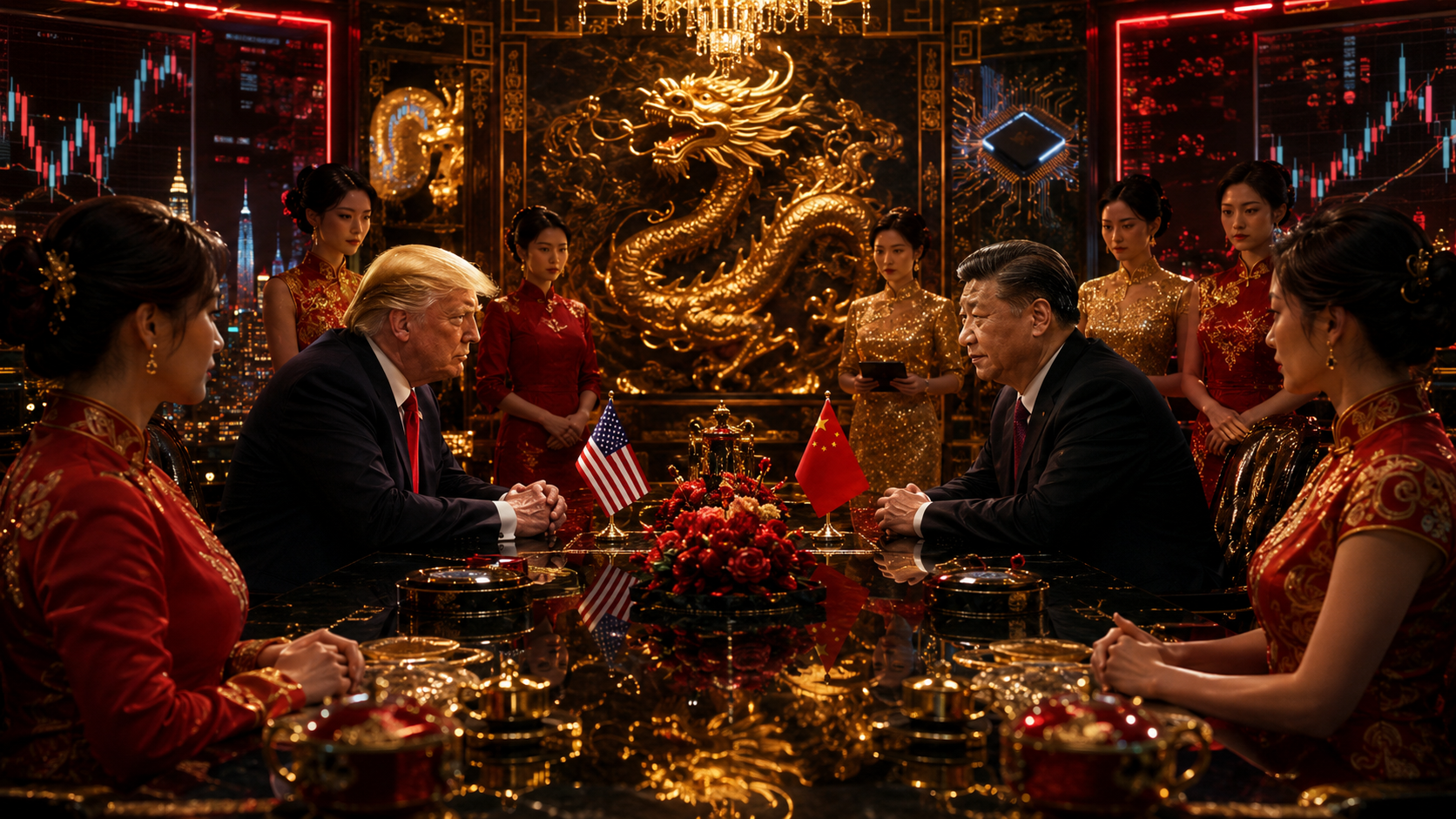

This week’s market tape did not feel like a normal session. It felt like a crossover episode where every faction spawned at once: AI chip kings, crypto bankers, gaming survivors, Chinese consumer IP machines, and Donald Trump landing in Beijing with a corporate raid party big enough to make Wall Street check the loot table twice.
The theme was not subtle. Markets are no longer trading only earnings, guidance, and rate-cut hopium. They are trading access: access to China, access to chips, access to energy, access to payments, access to fandom, and access to the physical infrastructure powering the next decade of AI.
Table of contents
- Trump’s China trip turns into a market access test
- AI is not software. It is infrastructure
- Gaming small caps are still playing survival mode
- Stablecoins are becoming a banking problem
- Bitcoin Depot is not Bitcoin
- Pop Mart shows the financial power of fandom
- The real trade is control of the map
- Market Pulse: key questions
Trump’s China trip turns into a market access test
The biggest geopolitical market story of the week was President Donald Trump’s trip to China. This was not diplomacy reduced to flags, smiles, and ceremonial handshakes. It was business diplomacy at final-boss scale.
The U.S. delegation included some of the biggest names in corporate America, spanning technology, chips, payments, aerospace, finance, agriculture, and industrials. Elon Musk, Tim Cook, Jensen Huang, Kelly Ortberg, Larry Fink, Jane Fraser, Stephen Schwarzman, and other executives were part of a broader corporate push around trade, AI, aviation, supply chains, and market access.
That matters because China is not just another market. For many global companies, it is a revenue engine, a manufacturing node, a regulatory maze, and a geopolitical risk factor all at once. The market read-through is obvious: this trip was not about friendship. It was about who gets access to the next layer of globalization.
Chinese President Xi Jinping reportedly told U.S. business leaders that China’s door would “open wider,” according to reports including the Financial Times. That is the kind of phrase markets want to believe. But investors should stay cold-blooded.
The Boeing example says everything. China agreed to buy 200 Boeing jets, according to President Trump, but that number came in below hopes for a much larger order. Reuters reported that expectations had been closer to 500 aircraft, and Boeing shares fell after the announcement.
In gamer terms: the dragon dropped loot, but not legendary loot.
AI is not software. It is infrastructure
The market still loves to talk about AI as if it lives inside a clean, magical cloud. That is fantasy. AI is physical. It is silicon, memory, networking, power, cooling, real estate, copper, grid capacity, and export licenses.
That is why Nvidia’s China story matters beyond one company’s quarterly revenue line. The U.S. has approved sales of Nvidia H200 chips to a limited group of Chinese firms, including major names such as Alibaba, Tencent, ByteDance, and JD.com, according to Reuters. But the same report noted that shipments had not yet happened, with political, regulatory, and strategic complications on both sides.
That is the real AI trade: not just “who has the best chatbot,” but who controls the supply chain that lets models train, scale, and deploy.
Nvidia chips matter. Micron memory matters. Qualcomm components matter. Cisco networking matters. Data centers matter. Power contracts matter. Export control language matters. The cloud is not floating above the world. It is sweating inside server racks.
For investors, that means AI remains less like a software theme and more like a new industrial stack. The winners may not only be the companies with the best demos. They may be the ones controlling the bottlenecks.
Gaming small caps are still playing survival mode
Gaming also deserves a slot this week, especially through the lens of Pullup Entertainment. The French publisher remains one of those small-cap stories that can either respawn beautifully or get trapped in a brutal difficulty spike.
The thesis is still understandable: a strong back catalogue, AA and indie audiences with real loyalty, and studios with recognizable creative identities. Pullup reported full-year 2025/26 revenue of €281.4 million, with back-catalogue revenue of €189.0 million, according to the company’s own financial release.
But the risk is just as clear. New releases need to land again. A publisher can survive on back-catalogue strength for a while, especially when players keep buying and replaying proven titles. But the market eventually asks the same question every time: where is the next hit?
In gamer language, Pullup has inventory, weapons, and map knowledge. Now it needs the next boss fight to go right.
Stablecoins are becoming a banking problem
Crypto had its own plot twist. Stablecoins were supposed to be the boring corner of the casino: dollar-pegged tokens, payment rails, settlement plumbing, and a little bit of regulatory anxiety.
Then came the fight over yield.
Interest-bearing stablecoins turn the discussion into something more dangerous for traditional banks. If crypto firms can offer yield on stable assets, the product starts to look less like a payment token and more like a bank account with crypto skin.
That is why banks are pushing back. Reuters reported this week that U.S. lawmakers advanced a major crypto market structure bill, while banks opposed provisions that could allow crypto companies to offer stablecoin rewards. The banking concern is simple: yield-bearing stablecoins could compete with deposits, pulling money away from traditional institutions.
European regulators are also watching the sector carefully. ECB President Christine Lagarde recently warned about stablecoin risks, including financial stability concerns and the possibility that private tokens could weaken the singleness of money.
This is no longer just fintech theater. It is regulatory PvP.
Bitcoin Depot is not Bitcoin
Bitcoin Depot sits on the other side of the crypto-adjacent trade. It is not Bitcoin. It is not a pure bet on the price of BTC. It is a cash-to-crypto infrastructure company operating Bitcoin ATMs, and that distinction matters.
When Bitcoin rallies, crypto-adjacent stocks can get pulled into the hype vortex. But Bitcoin Depot’s business has its own problems: regulation, compliance costs, transaction limits, guidance risk, and execution pressure.
That makes the stock a very different kind of beast. Buying after a crash can be smart only when the market has overreacted. It is not smart when the market is correctly diagnosing a broken or shrinking model.
The key question is not whether crypto survives. It is whether Bitcoin Depot can protect volumes, margins, and relevance as regulators tighten the screws around cash-to-crypto ramps.
Pop Mart shows the financial power of fandom
Pop Mart remains one of the cleanest examples of intellectual property turning into financial gravity.
Labubu is not just a toy. It is collectible dopamine, scarcity mechanics, character design, social media velocity, Asian pop culture, and retail theater packaged into one monetizable monster. That is why the company has become such a fascinating case study for investors watching the intersection of fandom and consumer spending.
Reuters reported this week that Pop Mart warned of possible 2026 margin pressure from higher costs, even as it continues to expand its Labubu-driven ecosystem into entertainment and global retail. That is the tension in the story: the IP engine is powerful, but hype cycles, production costs, and the hunt for the next breakout character still matter.
The bigger point is that fandom can now behave like infrastructure. A strong character universe can sell toys, games, content, experiences, cosmetics, collaborations, and social status. Pop Mart did not just sell figures. It built a machine for turning emotional attachment into repeat purchases.

The dragon controls market access.
The real trade is control of the map
This week’s message is simple: markets are no longer just trading earnings. They are trading access.
Access to China. Access to AI chips. Access to energy. Access to payments. Access to regulatory permission. Access to communities. Access to fandom.
That is why the Trump-China trip, Nvidia’s H200 approvals, Boeing’s underwhelming jet order, stablecoin yield debates, Pullup’s back-catalogue strength, Bitcoin Depot’s regulatory risk, and Pop Mart’s IP machine all belong in the same market conversation.
They look like separate stories. They are not.
They are all about who controls the map.
And in this meta, the winners are not always the loudest characters. They are the ones holding the chokepoints.
Market Pulse: key questions
Why did Trump’s China trip matter for markets?
Because the trip focused on trade, AI, aviation, supply chains, and market access, with major U.S. executives joining the delegation. Investors watched it as a signal for which companies could benefit from improved U.S.-China business channels.
Why was the Boeing order seen as disappointing?
China’s reported 200-jet order was positive for Boeing, but it came in below expectations for a much larger deal. That gap between hope and reality weighed on the market reaction.
Why are Nvidia H200 chip sales to China important?
They show how AI has become a geopolitical infrastructure trade. Chips, export licenses, data centers, and national security restrictions now sit at the center of the AI market.
Are yield-bearing stablecoins a threat to banks?
Potentially, yes. If stablecoins can offer yield, they may compete with bank deposits, which is why banking groups and regulators are paying close attention.
Is Bitcoin Depot the same as investing in Bitcoin?
No. Bitcoin Depot is a crypto infrastructure company focused on Bitcoin ATMs. Its performance depends on regulation, transaction volumes, compliance costs, and execution, not just Bitcoin’s price.
Why is Pop Mart important beyond toys?
Pop Mart shows how strong IP can become a scalable consumer business. Labubu combines collectibles, scarcity, social media, and fandom into a powerful monetization model.
Is this article financial advice?
No. This article is for market analysis and editorial information only. It is not financial advice, investment advice, or a recommendation to buy or sell any security, crypto asset, or financial product.