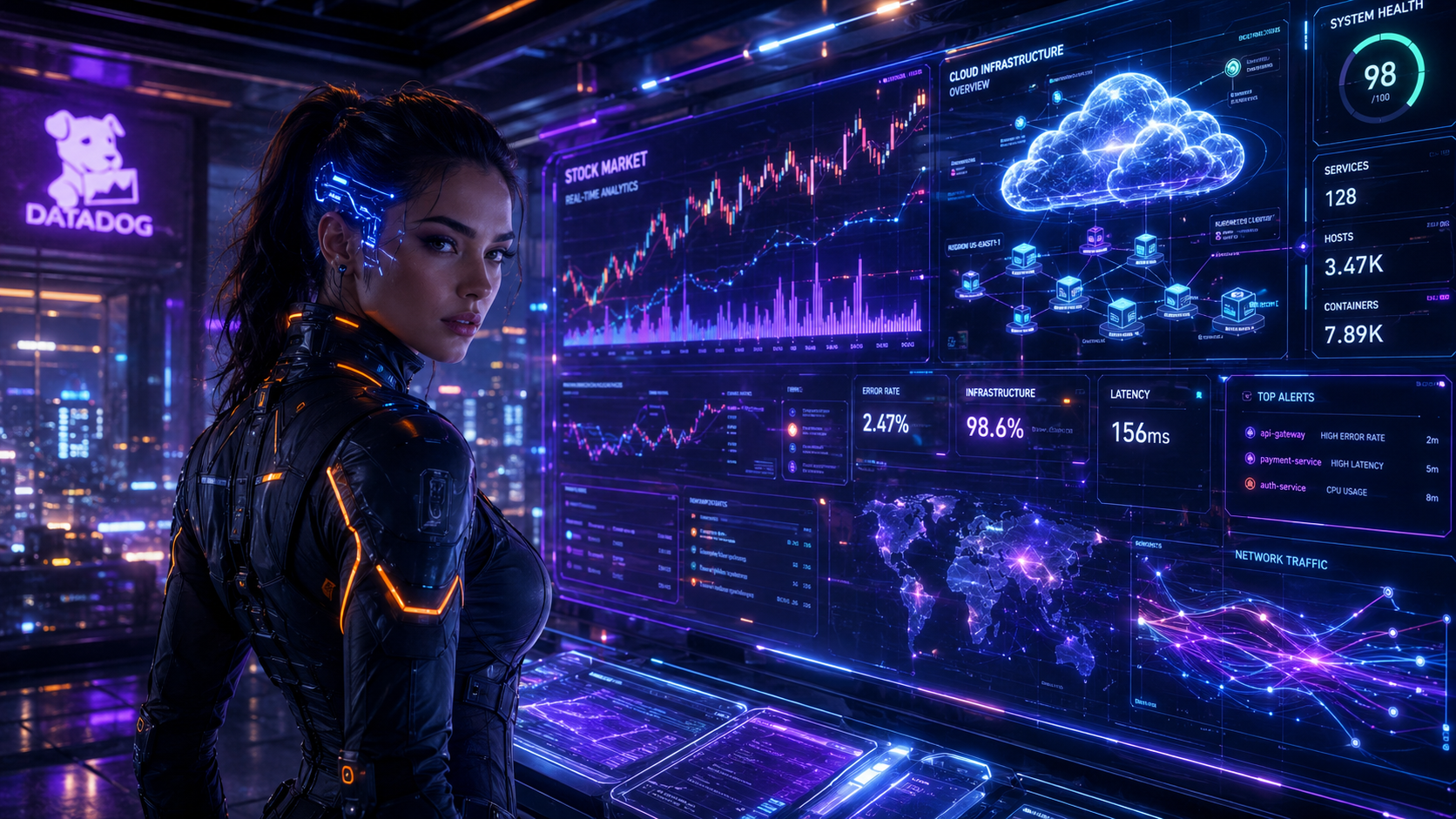

Forget the chatbot wars for a second. While everyone was busy arguing over which LLM has the personality of a toaster, the real money just moved into the engine room. Datadog recently hit hyperdrive, surging 31% after a blowout earnings report that proved one thing: the AI revolution isn’t just about “magic” apps; it’s about the massive, messy cloud infrastructure keeping them alive. Investors are finally waking up to the fact that you can’t run a Skynet-level agent without world-class monitoring.
Table of contents
- The Infrastructure Gold Rush
- Analyzing the Datadog Stock Growth Surge
- Beyond the Buzz: The Future of Cloud Monitoring
- Datadog and AI infrastructure: key questions
The Infrastructure Gold Rush
In the gold rush of 1849, the guys selling shovels made more than the miners. In 2026, Datadog is selling the high-tech sensors that tell you if your shovel is about to melt. As companies transition from “experimenting” with AI to deploying full-scale generative applications, the complexity of their cloud stacks is exploding.
Datadog provides the “observability” needed to ensure these systems don’t crash. When you’re running thousands of GPUs and complex data pipelines, a single second of downtime is a financial catastrophe.
Analyzing the Datadog Stock Growth Surge
The recent Datadog stock growth isn’t just a fluke or a meme-driven pump. It represents a fundamental shift in investor sentiment. Market players are moving away from speculative “buzz” and toward companies with “AI-leveraged revenue.”
Unlike companies that just slap “AI” on their landing page, Datadog is seeing increased spend from existing customers who are scaling their AI integrations. It’s the “invisible plumbing” effect, just like Snowflake and MongoDB, Datadog is a non-negotiable part of the modern tech stack. If you’re building an autonomous agent, you’re likely paying Datadog to watch over it.
Beyond the Buzz: The Future of Cloud Monitoring
We are entering the era of the “AI agent economy.” This means more data, more API calls, and more potential points of failure. The competition is heating up, with firms like CoreWeave providing the raw horsepower, but Datadog remains the brain of the operation.
For the savvy geek investor, the lesson is clear: don’t just look for the flashiest UI. Look for the tools that keep the lights on in the digital neon city.
The AI hype is maturing. We’ve moved past the “wow” phase and into the “how do we scale this?” phase. Datadog has positioned itself as the essential guardian of the cloud, the kind of pick-and-shovel player that can thrive while the AI gold rush keeps pushing companies to build, monitor, and secure ever-larger digital infrastructures.
Datadog and AI infrastructure: key questions
What does Datadog do?
Datadog provides cloud monitoring and observability tools that help companies track the performance, reliability, and security of their digital infrastructure.
Why is Datadog connected to the AI boom?
AI applications depend on complex cloud systems, GPUs, data pipelines, APIs, and infrastructure. Datadog helps companies monitor those systems as they scale.
What is observability?
Observability is the ability to understand what is happening inside a system by analyzing metrics, logs, traces, and other technical signals.
Why does AI infrastructure need monitoring?
AI infrastructure can be expensive, complex, and fragile. Monitoring helps detect failures, performance issues, latency problems, and downtime before they become major incidents.
Why are investors interested in Datadog stock growth?
Investors are watching Datadog because it may benefit from companies spending more on cloud infrastructure, AI deployment, and large-scale monitoring tools.
What does “pick-and-shovel” mean in the AI gold rush?
A “pick-and-shovel” company provides the essential tools and infrastructure needed by others. In this case, Datadog supports the companies building and running AI systems.
How does Datadog compare to flashier AI companies?
Datadog is less visible to consumers, but it plays a critical role behind the scenes by helping companies keep cloud and AI systems running reliably.