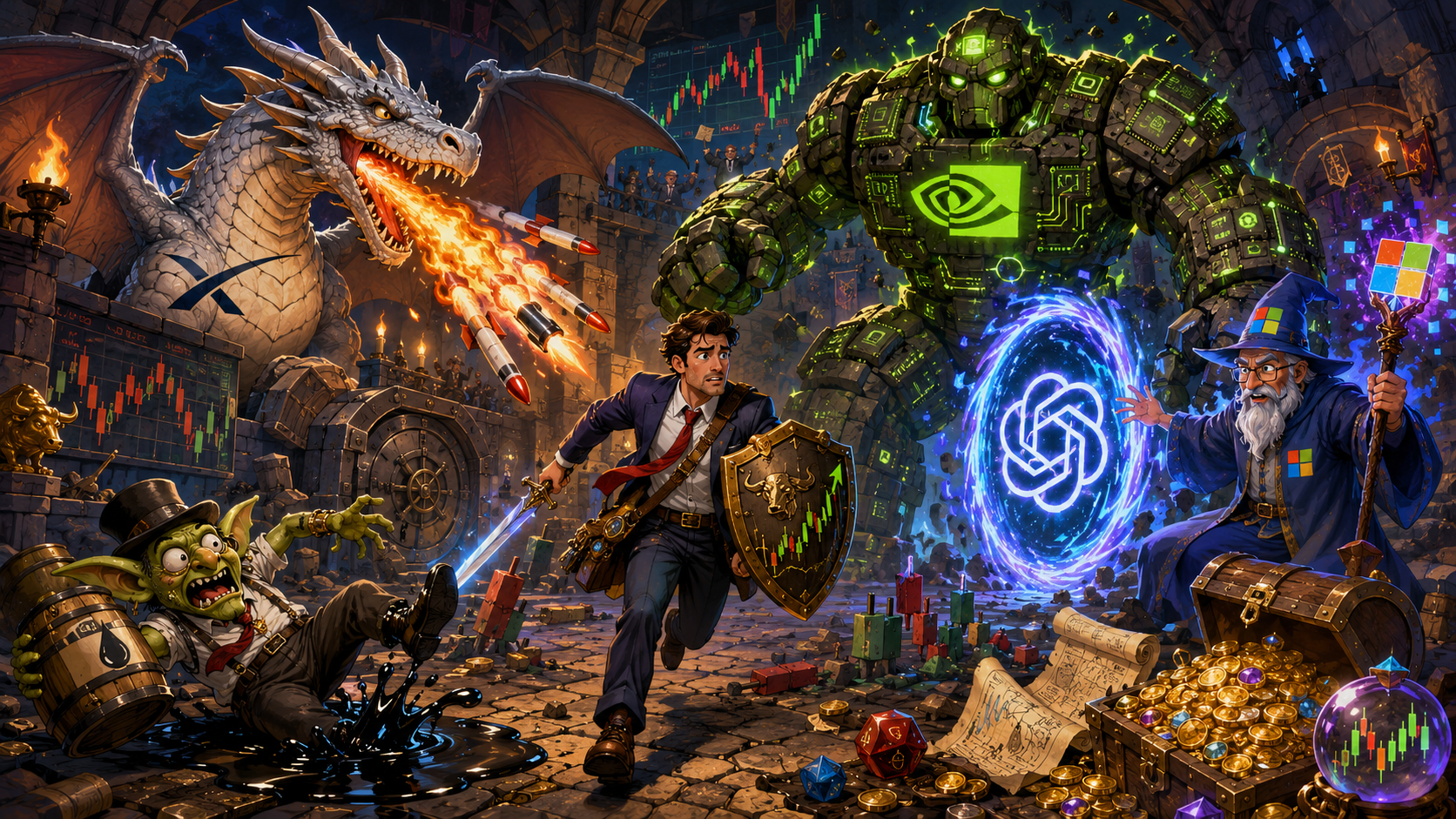

Markets spent the past seven days acting like someone finally found the diplomacy button after weeks of geopolitical stress. Oil cooled, yields eased, US equities bounced, Nvidia reminded everyone that AI infrastructure is still the main quest, and the IPO rumor mill started glowing around SpaceX and OpenAI.
For a geek-focused portfolio, this was not background noise. It shaped the entire setup.
Hasbro’s stock fell despite a strong quarter. Pullup Entertainment stayed below €9, still priced like a damaged gaming story. FDMT remained a high-risk biotech bet with real Phase 3 catalysts. Games Workshop kept defending its premium Warhammer multiple. Meanwhile, Microsoft continued to look like one of the cleanest public-market ways to get indirect exposure to OpenAI before any potential IPO.
This is the strange state of geek finance in mid-May 2026: macro relief, AI euphoria, franchise economics, speculative biotech, and a market that still punishes anything that smells like execution risk.
- Macro mood: oil relief gave stocks breathing room
- AI is still the market’s main character
- SpaceX and OpenAI: the IPO fever is real
- Why Microsoft remains the OpenAI proxy
- Hasbro: strong quarter, ugly sell-off
- Pullup Entertainment: below €9, still a risky recovery bet
- FDMT: biotech risk with a live catalyst path
- Games Workshop: Warhammer still deserves attention
- The portfolio takeaway
- Geek finance: key questions
Macro mood: oil relief gave stocks breathing room
The main market driver this week was not a company earnings report. It was geopolitics.
Investors reacted positively to signs of possible de-escalation around the US-Iran conflict. Reuters reported that Donald Trump said he had paused a planned attack after Tehran sent a peace proposal to Washington, while later updates pointed to Pakistan playing a mediation role in efforts to get talks back on track. That was enough to cool some of the fear premium in oil and give equities room to breathe.
The market reaction was immediate. On Wednesday, US stocks rallied as oil prices and Treasury yields fell. The Dow jumped more than 600 points, while the S&P 500 and Nasdaq also climbed strongly, according to market reports from Anadolu Agency and Yahoo Finance.
That matters because the market had been trapped in a brutal loop: war risk pushes oil higher, higher oil feeds inflation fears, inflation fears keep the Federal Reserve hawkish, and higher yields pressure growth stocks.
This week briefly broke that loop.
Oil was still historically elevated, with Brent around the low $100s, but the direction mattered. A retreat in crude helped cool bond-market stress and supported risk appetite. For tech, AI, small caps and speculative names, that was oxygen.
The macro message was simple: if geopolitical risk cools, markets can still rally. But if oil spikes again, the inflation monster respawns.
AI is still the market’s main character
Even with geopolitics dominating headlines, AI remained the core market narrative.
Nvidia delivered another monster quarter. The company reported revenue of $81.62 billion, up 85% year over year, beating Wall Street expectations, according to the Associated Press. Data center demand remained the center of the story, and Nvidia also guided for another enormous quarter ahead.
Normally, numbers like that would make investors levitate. But Nvidia’s stock reaction was more restrained because expectations were already absurdly high. That is the Nvidia paradox: when Wall Street has already priced in the boss fight, even a huge victory can feel like the tutorial.
Still, the broader message was bullish for the AI ecosystem. The market is not treating AI as a side theme anymore. It is treating AI infrastructure as a new economic layer: chips, cloud, data centers, power, networking, software, agents, enterprise tools, and automation.
That helps explain why tech and AI-linked names kept attracting attention earlier in the week, even with profit-taking along the way. Investors are not just buying companies. They are buying exposure to the next computing stack.
The risk, of course, is valuation. AI can be real and still be overpriced in certain stocks. The internet was real in 1999 too. That did not save every ticker.
SpaceX and OpenAI: the IPO fever is real
The other big market excitement this week came from the IPO pipeline.
SpaceX has been one of the most desired private companies on Earth for years: rockets, Starlink, satellite infrastructure, defense relevance, space logistics, and a near-mythical Elon Musk premium. Bloomberg reported this week that SpaceX had filed publicly for a Nasdaq IPO, intensifying speculation around what could become one of the most important listings of the decade.
Whether the final valuation lives up to the hype is another question. But the investor psychology is obvious. SpaceX is not being viewed as “just” a rocket company. It is being viewed as infrastructure for space, communications, defense, connectivity, and potentially AI-powered satellite networks.
OpenAI is the other name making public-market investors restless.
Reuters previously reported that OpenAI had been laying groundwork for a possible IPO at a valuation that could reach up to $1 trillion, with a filing potentially as soon as the second half of 2026, though plans could change. That is exactly the kind of sentence that makes growth investors start refreshing their brokerage accounts like loot boxes.
The timing also matters. Elon Musk’s legal defeat against OpenAI, Sam Altman, Greg Brockman and Microsoft removed one cloud from the company’s public narrative, even if Musk may continue fighting. Le Monde reported that Musk’s lawsuit was dismissed due to statute-of-limitations issues, giving OpenAI and Microsoft a major legal win.
That does not mean an OpenAI IPO is guaranteed. It means the path looks less blocked than it did before.
The market is now looking at SpaceX and OpenAI as two possible mega-listings that could define the next chapter of tech finance: one for space infrastructure, one for AI infrastructure.
In other words, Wall Street has found its next cinematic universe.
Why Microsoft remains the OpenAI proxy
Until OpenAI becomes public, ordinary investors cannot simply buy OpenAI stock on the open market. That is why Microsoft remains one of the most practical public-market proxies.
This does not mean Microsoft is a pure OpenAI play. It is not. Microsoft is a giant enterprise software, cloud, gaming, cybersecurity, productivity, and AI company. But that is exactly why it works as a cleaner exposure route for many investors: it offers OpenAI-linked upside without the single-company private-market access problem.
Microsoft’s relationship with OpenAI is deep. In its April 2026 partnership update, Microsoft said it remains OpenAI’s primary cloud partner, continues to participate directly in OpenAI’s growth as a major shareholder, and keeps rights to OpenAI IP for models and products through 2032, even though the license is now non-exclusive. Microsoft also said OpenAI revenue-share payments to Microsoft continue through 2030, subject to a cap.
That gives Microsoft several OpenAI-linked benefits.
First, Azure benefits from AI infrastructure demand. OpenAI workloads, AI enterprise adoption, and model deployment all reinforce the cloud story.
Second, Microsoft can integrate OpenAI technology into products such as Copilot, Microsoft 365, GitHub, Azure AI and enterprise software workflows.
Third, Microsoft has economic exposure to OpenAI’s growth through its shareholder position and commercial agreements.
Fourth, Microsoft is not dependent on OpenAI alone. If the AI market broadens, Microsoft can also benefit through Azure, enterprise distribution, internal models, partnerships, and its massive software base.
That is why buying Microsoft can be seen as a reasonable indirect way to gain OpenAI exposure before any IPO. It is not the same as owning OpenAI directly. It is more diversified, less pure, and still exposed to Microsoft’s own execution risks. But for public-market investors, it remains one of the most accessible OpenAI-adjacent routes.
The cleaner sentence is this: Microsoft is not OpenAI, but it is still one of the best public-market bridges to the OpenAI economy.
Hasbro: strong quarter, ugly sell-off
Hasbro was the week’s best example of a stock falling for reasons that had nothing to do with a weak quarter.
The company reported Q1 2026 revenue of $1.0 billion, up 13% year over year, and adjusted diluted EPS of $1.47, according to Hasbro’s official earnings materials. Reuters also noted that Hasbro beat quarterly revenue and profit expectations thanks to strong demand for digital games and Magic: The Gathering.
And yet the stock dropped around 8%.
The problem was guidance. Hasbro kept its full-year outlook unchanged, which disappointed investors who expected management to raise the bar after such a strong start.
The second issue was operational. Hasbro disclosed fallout from a March cybersecurity incident involving unauthorized access to parts of its network. The company expects roughly $40 million to $60 million of Consumer Products revenue to shift from Q2 into the second half of the year, plus about $20 million in one-time related costs.
That gave investors a reason to worry about execution.
But the long-term thesis remains interesting. Hasbro is not just a toy company anymore. It is trying to become a higher-margin entertainment IP platform. Magic: The Gathering is still a growth engine. Dungeons & Dragons remains under-monetized. Monopoly keeps surviving across board games, mobile and licensing like a capitalist cockroach with legendary armor.
The sell-off was not about Hasbro being broken. It was about the market saying: “Great quarter. Now prove the full-year story.”
For a long-term investor, that kind of panic can create opportunity. But only if the core franchise engine keeps working and management cleans up the operational mess.
Pullup Entertainment: below €9, still a risky recovery bet
Pullup Entertainment is not having a Hasbro moment. It is having a credibility moment.
The stock has slipped back below €9, and that tells the story. The market is still skeptical after uneven releases, lowered profitability expectations and debt concerns.
Pullup, formerly Focus Entertainment, is not an empty shell. It owns and operates a real portfolio of studios and labels, including Dotemu, Deck13, Dovetail Games, BlackMill and Focus Entertainment Publishing. Its world is AA and indie-leaning gaming: simulation, tactical games, action titles, licensed universes, community-driven releases and long-tail catalogues.
The strongest point in the thesis is the back catalogue. In its Q4 2025/26 update, Pullup reported full-year back-catalogue revenue of €189.0 million, up 52.9%, with Q4 back-catalogue revenue up 87.2%.
That is not cosmetic. It shows older titles and live operations are becoming a serious recurring engine.
But the risks are just as real. New release revenue disappointed, and Pullup cut its adjusted EBIT guidance to €10 million to €15 million. Net debt was expected between €85 million and €90 million as of March 31, 2026, on a non-audited basis.
So yes, below €9, the upside case becomes more tempting. Analyst targets remain far above the current share price on several platforms. A move back toward the €20-€25 zone is possible if execution improves.
But “possible” is doing heavy lifting.
Pullup needs to deliver stronger releases, stabilize profitability, control spending and prove that its back catalogue can support a more durable business model. Until then, this remains a speculative gaming stock, not a safe recovery story.
FDMT: biotech risk with a live catalyst path
FDMT is the outlier in this geek portfolio because it is not about entertainment IP. It is about biotech asymmetry.
After exiting ultra-risky Bitcoin Depot exposure, reinforcing 4D Molecular Therapeutics makes sense only if the investor understands the danger. FDMT is still risky. Very risky. Clinical-stage biotech is not a comfort zone. It comes with losses, dilution risk, trial risk, regulatory risk and brutal volatility.
But FDMT has something Bitcoin Depot no longer seemed to offer: a live, credible thesis.
The story revolves around 4D-150, its gene therapy candidate for wet age-related macular degeneration, or wet AMD. Wet AMD is a large retinal disease market where patients often need repeated injections. 4D-150 aims to reduce that burden through a one-time intravitreal gene therapy approach.
The program is now in Phase 3. According to 4D Molecular Therapeutics’ investor updates, the 4D-150 Phase 3 program includes 4FRONT-1, with topline data expected in the first half of 2027, and 4FRONT-2, with enrollment completion expected in the second half of 2026 and topline data expected in the second half of 2027.
That gives FDMT a timeline. Not a guarantee. A timeline.
The upside case is clear: strong data could trigger a major re-rating. The downside case is equally clear: disappointing data could wreck the stock.
This is not a safe stock. It is a biotech boss fight with no save point.
Games Workshop: Warhammer still deserves attention
Games Workshop remains one of the most fascinating public companies in geek finance.
It is far smaller than Hasbro, Mattel or Take-Two, but its economics are elite. The company behind Warhammer sells premium miniatures, rules, paint, lore, books and licensed products into a fan base that behaves less like casual consumers and more like a permanent hobby civilization.
That is why the stock often trades at a premium. The market is not just paying for plastic miniatures. It is paying for pricing power, direct retail, community depth, repeat spending, lore, collector behavior and licensing optionality.
Games Workshop’s latest half-year materials showed a record performance for the 26 weeks ended November 30, 2025, with revenue up to £332.1 million and operating profit up to £140.4 million, according to the company’s investor materials and regulatory reporting.
That is the kind of quality investors love.
But quality is not the same as cheap. Games Workshop’s biggest risk is valuation. If growth slows, licensing disappoints, tariffs bite or consumer demand softens, the multiple can compress. Great companies can still become painful investments when bought too expensively.
Still, the strategic appeal is obvious. Warhammer is a rare entertainment ecosystem where fans do not just watch. They buy, paint, play, read, argue, return and recruit others into the cult.
That is not a normal brand. That is a moat with dice.
The portfolio takeaway
The last seven days delivered a useful map for geek finance.
Macro relief helped risk assets. AI remained the central growth narrative. Nvidia proved the infrastructure boom is still alive. SpaceX and OpenAI stirred IPO excitement. Microsoft stayed relevant as the most obvious public OpenAI bridge. Hasbro showed that strong earnings are not enough if guidance disappoints. Pullup proved that back-catalogue strength still needs execution. FDMT offered biotech upside with brutal downside. Games Workshop reminded everyone that premium fandom assets can deserve premium valuations — but not infinite ones.
The common theme is not “buy geek stocks.”
The smarter theme is this: owning culture, infrastructure, or scientific catalysts can create real upside, but only when the market has not already priced perfection.
Hasbro is an IP platform with short-term execution noise. Pullup is a speculative gaming recovery trade. FDMT is a clinical-stage biotech gamble. Games Workshop is a premium fandom compounder. Microsoft is the public-market OpenAI proxy hiding in plain sight. SpaceX and OpenAI are the IPO dragons everyone wants to ride, but nobody should pretend valuation will be gentle.
This is not a low-volatility corner of the market. It is a dungeon full of asymmetric bets.
Some have magic cards. Some have gene therapies. Some have space rockets. Some have Warhammer armies.
All of them require position sizing, discipline, and the ability to tell the difference between conviction and cosplay.
Geek finance: key questions
Why did markets rally this week?
Markets rallied as oil prices and Treasury yields eased on hopes of progress in US-Iran diplomacy. Lower oil reduced some inflation pressure, helping stocks rebound.
Why is Nvidia still important for the market?
Nvidia remains the central infrastructure stock of the AI boom. Its latest quarter showed massive AI chip demand, with revenue up 85% year over year to $81.62 billion.
Is SpaceX going public?
Reports this week said SpaceX filed publicly for a Nasdaq IPO. The final timing, valuation and deal structure still need to be watched carefully.
Is OpenAI going public soon?
OpenAI has been reported to be laying groundwork for a possible IPO, potentially as soon as the second half of 2026, but no public listing is guaranteed yet.
Why is Microsoft a way to get exposure to OpenAI?
Microsoft is a major OpenAI shareholder, remains OpenAI’s primary cloud partner, keeps rights to OpenAI model and product IP through 2032, and benefits from AI demand through Azure and Copilot. It is not a pure OpenAI play, but it is one of the most accessible public-market proxies.
Why did Hasbro stock fall after good earnings?
Hasbro beat Q1 expectations, but investors were disappointed that management kept full-year guidance unchanged. A March cybersecurity incident also created operational disruption and revenue timing concerns.
Why is Pullup Entertainment still risky?
Pullup has strong back-catalogue momentum, but new releases have disappointed, profitability guidance was cut, and debt remains a concern. The stock is a speculative recovery bet.
What is the main risk with FDMT?
FDMT’s main risk is clinical failure. Its lead wet AMD gene therapy program, 4D-150, is in Phase 3, but disappointing data could severely damage the investment thesis.
Why is Games Workshop considered a premium geek stock?
Games Workshop owns Warhammer, a powerful hobby ecosystem with loyal fans, premium pricing, repeat spending and licensing potential. The risk is that the stock already prices in a lot of that quality.
Is this financial advice?
No. This article is for editorial analysis and information only. It is not financial advice, investment advice or a recommendation to buy or sell any stock. The author may hold positions in securities mentioned, and readers should do their own research.