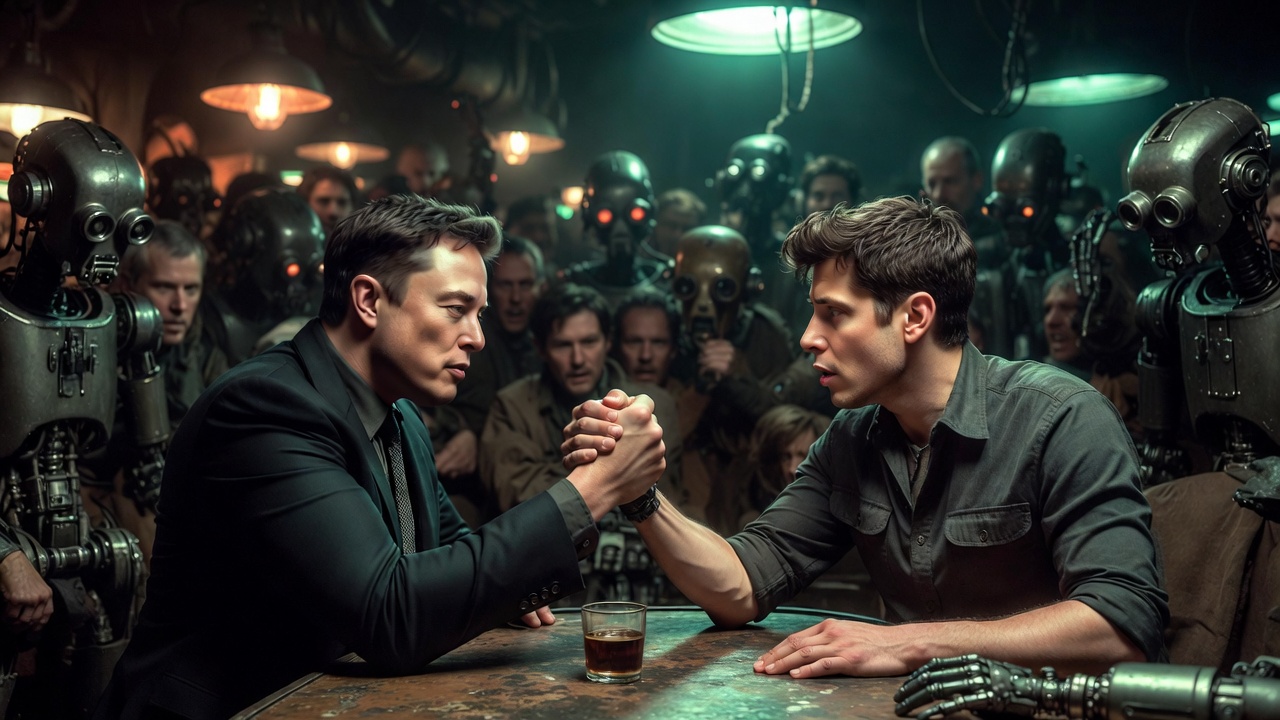
Elon Musk vs. Sam Altman is no longer just a lawsuit. It is the closest thing the AI industry has to a Captain America: Civil War arc: former allies, shared origin story, ideological fracture, corporate superweapons, and a fight over who gets to claim the moral high ground while everyone else watches the collateral damage.
The latest courtroom defeat for Musk does not end the saga. A jury rejected his claims against OpenAI, Altman, Greg Brockman, and Microsoft, finding that Musk had brought the case too late. Tesla also traded lower after the ruling, adding a market-sentiment problem to an already messy legal and strategic fight. But the bigger story is not one verdict. It is the deeper power struggle underneath: who owns the future of artificial intelligence, who controls it, and who gets rich from it.
The founders’ guild breaks apart
OpenAI’s origin story was built for Silicon Valley mythology: brilliant founders, existential stakes, a nonprofit mission, and the promise that artificial general intelligence should benefit humanity rather than become another private empire.
Musk and Altman were both tied to that early story. They were not interchangeable figures, but they represented a certain moment in tech: the idea that the people building the most powerful systems on Earth could also be trusted to contain them. That was always a bold pitch. In hindsight, it may have been the first act of a much darker show.
The split now feels less like a business disagreement and more like the airport battle in Captain America: Civil War. Everyone insists they are fighting for the right reason. Everyone has a version of the founding promise. Everyone believes the other side betrayed it first.
Musk frames OpenAI’s transformation as a betrayal of its nonprofit roots. Altman’s side argues that OpenAI needed a different structure to raise the staggering capital required to compete at frontier scale. Both arguments land because both are attached to real tensions. AI is expensive. AI is powerful. AI was sold to the public as a civilizational project, then rapidly became one of the hottest asset classes in tech.
That is the fracture. Not just Musk versus Altman. Mission versus money. Safety rhetoric versus platform dominance. Founder mythology versus corporate reality.
From mission to machine economy
The core tension in the Musk-Altman fight is simple: OpenAI began as a nonprofit with a sweeping public-interest mission, then became the central actor in a machine economy worth hundreds of billions in implied value.
That transformation did not happen in a vacuum. Training frontier models costs enormous sums. Compute, chips, cloud infrastructure, research talent, data pipelines, safety teams, product distribution, enterprise sales — none of it runs on vibes. The industry’s economics pulled OpenAI toward commercial scale, and once ChatGPT became a global product, the gravitational field changed completely.
OpenAI is still central to the global AI race. It is not just a research lab. It is a platform company, an enterprise vendor, a consumer brand, a developer ecosystem, a Microsoft-linked strategic asset, and a regulatory lightning rod. That makes its governance structure more than an internal corporate matter. It becomes a question of public trust.
This is where the story starts sounding less like superhero cinema and more like Succession. The language is noble: humanity, safety, alignment, public benefit. The mechanics are brutal: cap tables, board power, investor rights, cloud contracts, talent wars, market timing, and control.
The AI industry loves to talk about “alignment” as a technical problem. But the Musk-Altman battle exposes another kind of alignment problem: whether the people, companies, investors, and governments shaping AI are aligned with the public interest, or merely fluent in the language of it.
Courtroom boss fight
Musk’s recent legal defeat matters, but not because it settles the philosophical argument. It does not.
A U.S. jury rejected Musk’s claims tied to OpenAI’s nonprofit status and alleged deviation from its founding mission, finding that the case was filed too late. Judge Yvonne Gonzalez Rogers accepted the advisory verdict, handing OpenAI and Altman a major win in a case that had threatened to keep the company’s governance drama in the spotlight. Reports from AP and Reuters described the verdict as a decisive courtroom setback for Musk.
But a courtroom loss is not the same thing as narrative death. Musk has already signaled plans to appeal, and the broader dispute remains useful to him politically, strategically, and rhetorically. It lets him cast OpenAI as the institution that lost the plot. It lets him position xAI as a counter-model. It keeps the debate over AI governance alive in the public arena.
For OpenAI, the win removes one major obstacle, but not the scrutiny. The trial reinforced the degree to which OpenAI’s structure, leadership, and commercial incentives are now matters of public interest. Even when OpenAI wins, it does not return to being a quiet lab. That version of OpenAI is gone.
For Tesla, the ruling adds another layer of risk. The company’s value is increasingly tied not only to electric vehicles, but to autonomy, robotics, software, and AI. When Musk is fighting a high-profile AI war in court, investors do not simply see a personal grudge. They see potential distraction, reputational volatility, and strategic overlap with xAI.
The boss fight ended. The campaign did not.
Tesla, xAI, OpenAI: the multiverse war
The Musk-Altman conflict becomes more complicated because Musk is not just a former OpenAI backer with a grievance. He is also the force behind xAI, the AI company built to challenge the incumbents, and the CEO of Tesla, a company whose future story leans heavily on artificial intelligence.
Tesla is no longer valued purely as a carmaker. Its bull case depends on self-driving systems, robotaxis, humanoid robots, energy optimization, real-world AI, and the idea that Tesla’s vehicle fleet can become a data and autonomy advantage. That makes AI central to Tesla’s identity, not a side quest.
xAI, meanwhile, gives Musk a direct competitor to OpenAI. That changes the optics of the legal fight. OpenAI has argued that Musk’s lawsuit was driven partly by rivalry. Musk’s side argues that the issue is betrayal of a founding mission. The public does not need to choose one clean explanation. In Silicon Valley, motives often stack like tabs in an overworked browser.
This is the multiverse war: OpenAI pushing deeper into products and enterprise infrastructure; xAI trying to carve out its own model ecosystem and distribution through Musk’s orbit; Tesla pitching AI as the key to its next era; Microsoft leveraging OpenAI as a strategic weapon; regulators trying to understand a market moving faster than policy; investors treating governance drama as both risk and spectacle.
It is personal, but it is not only personal. That is what makes it dangerous. A feud between billionaires is gossip. A feud between billionaires who control AI labs, platforms, public companies, satellites, cloud deals, and political attention is infrastructure drama.
Who gets to control the future?
The real question behind Musk vs. Altman is not whether one founder is right and the other is wrong. That framing is too small. The real question is whether artificial intelligence should be governed by founders, companies, investors, states, courts, users, or some unstable combination of all of them.
Founders bring vision, speed, and obsession. They also bring ego, vendettas, and personal mythology. Companies bring scale and execution. They also bring profit pressure. Investors bring capital. They also expect returns. Governments bring democratic legitimacy, at least in theory. They also move slowly and often understand the technology late. Courts bring process. They also resolve narrow legal questions, not civilizational design problems.
The Musk-Altman saga shows what happens when all of those forces collide around a technology that could reshape labor, media, defense, education, software, finance, and politics.
So what should readers watch next?
First, Musk’s next legal moves. An appeal would keep the OpenAI governance fight alive, even if the current verdict gives Altman and OpenAI breathing room.
Second, xAI’s strategy. If Musk wants to turn the courtroom loss into a product war, xAI needs more than attitude. It needs distribution, performance, developer trust, and a clear reason to exist beyond being the anti-OpenAI.
Third, Tesla’s AI integration. Investors will watch whether Tesla can turn autonomy and robotics promises into measurable business progress, rather than letting the OpenAI fight become another distraction narrative.
Fourth, OpenAI’s governance. The company remains at the center of the global AI race, and its structure will keep attracting scrutiny as its commercial power grows.
Fifth, regulatory signals. If courts cannot answer the broad governance question, lawmakers and agencies may try. The next phase of the AI war may be fought less through founder lawsuits and more through policy, disclosure rules, competition probes, and safety obligations.
This is why Musk vs. Altman matters. It is not just two tech titans relitigating a broken alliance. It is the AI industry looking in the mirror and seeing the thing it usually tries to hide: the future is being built by people who talk like philosophers, negotiate like bankers, and fight like Succession characters with GPU clusters.
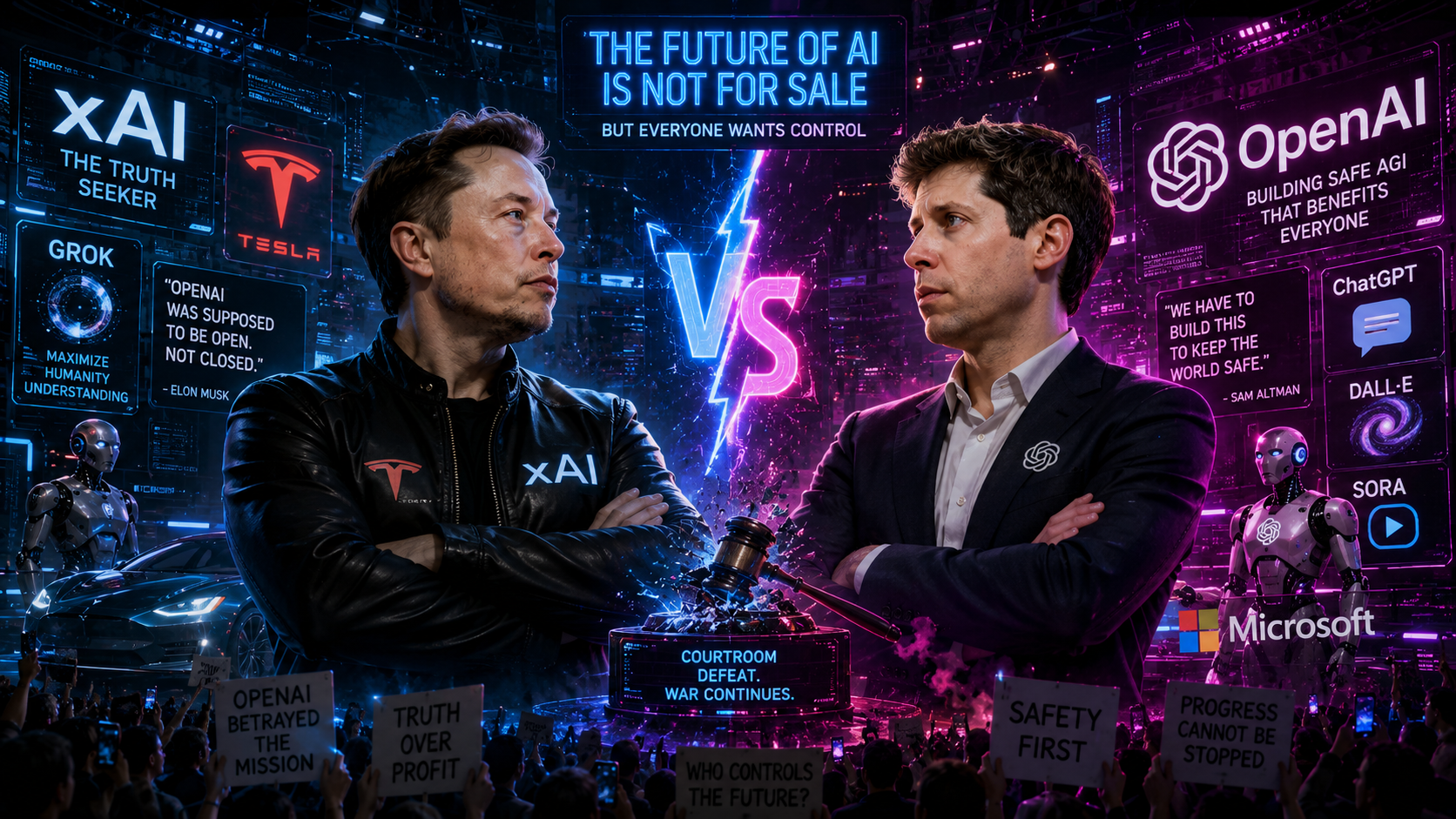
Musk’s OpenAI courtroom loss is only one battle in a bigger AI war over power, profit, Tesla, xAI, governance, and control.
Musk vs Altman: key questions
Why did Elon Musk sue OpenAI and Sam Altman?
Musk argued that OpenAI had departed from its original nonprofit mission and moved toward a profit-driven model. OpenAI denied wrongdoing and argued that Musk brought the case too late.
Did Musk lose the case against OpenAI?
Yes. A U.S. jury rejected Musk’s claims, finding that he had filed too late. The ruling was a major legal win for OpenAI, Altman, Brockman, and Microsoft.
Does the verdict end the Musk vs Altman conflict?
No. Musk has signaled plans to appeal, and the broader strategic fight between OpenAI, xAI, Tesla, Microsoft, and the AI industry is still very much alive.
Why does this matter for Tesla?
Tesla’s future narrative depends heavily on AI, including autonomy and robotics. Musk’s legal and public fight with OpenAI adds media, reputational, and strategic risk around that AI story.
Is this financial advice?
No. This article is for analysis and information only. It is not investment advice, and readers should do their own research before making decisions about Tesla, private AI companies, or related markets.