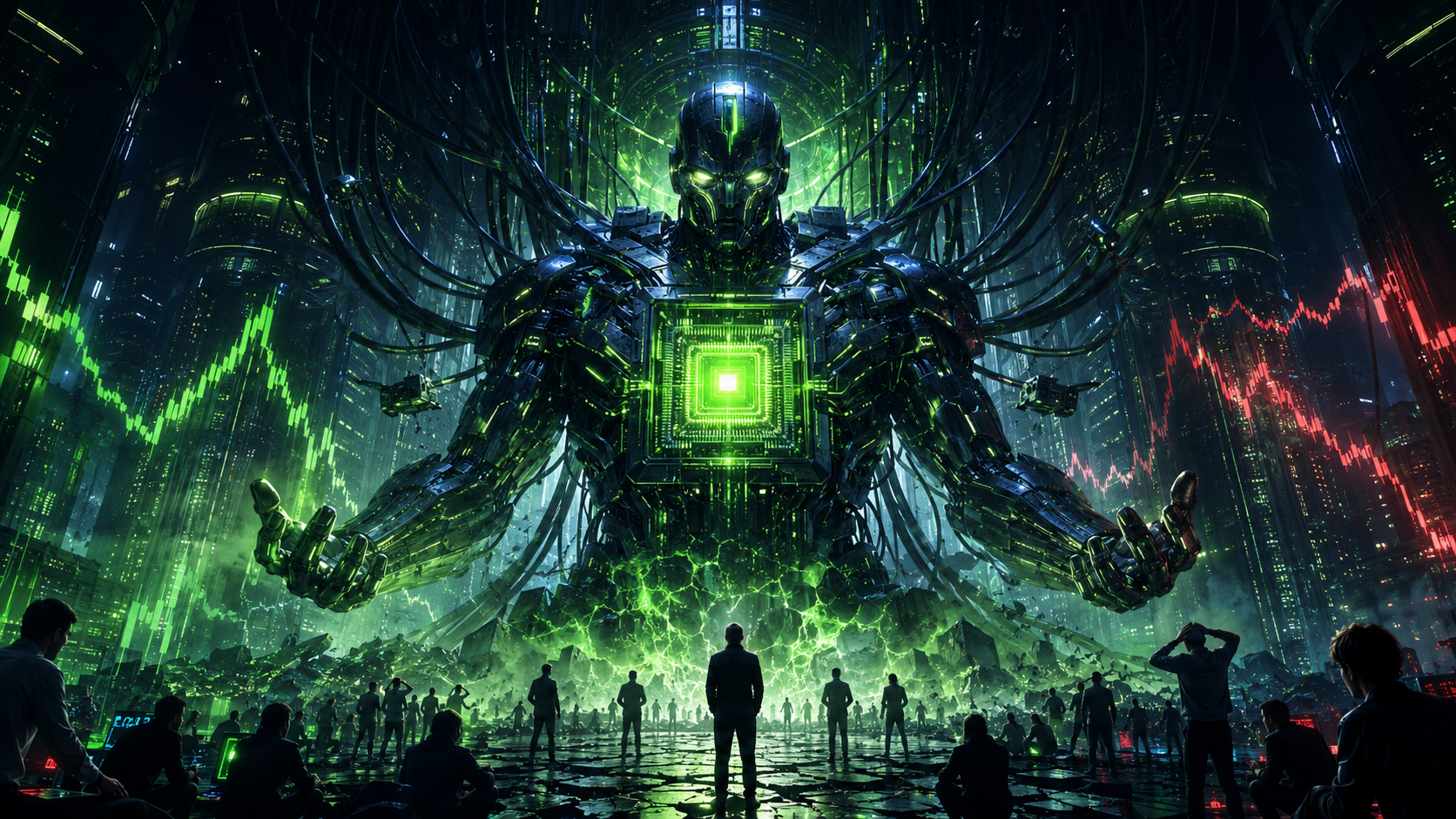
Nvidia walks into earnings week like a final boss with a health bar the size of the screen.
The company reports on Wednesday, and the setup is almost too clean: AI demand is still the dominant market story, data center spending remains the battlefield, Blackwell GPUs are the weapon everyone wants, and Nvidia has become the stock that can either validate the rally or crack the floor under it. The problem? Everyone already knows Nvidia is powerful.
That is what makes this earnings report dangerous.
According to the newsletter figures, Nvidia shares were down 4.18% heading into the event, while analysts are looking for earnings per share near $0.89 and revenue around $43 billion. Those are not small numbers. But this is Nvidia in the AI era, where “strong” is no longer enough. Investors are not just asking whether the company can beat expectations. They are asking whether it can beat the version of Nvidia already priced into the stock.
And that version is basically Avengers: Endgame with better margins.
The final boss of earnings season
Every earnings season has a few boss fights. Banks set the tone. Big Tech moves the indexes. Retail gives a read on the consumer. But Nvidia has become something else entirely: the final boss of the AI trade.
The market does not treat Nvidia like a normal semiconductor company anymore. It treats Nvidia like the scoreboard for artificial intelligence infrastructure. When Microsoft, Amazon, Alphabet, Meta, and other hyperscalers spend billions on data centers, investors eventually trace that money back to GPUs, networking gear, memory, power, cooling, and the companies sitting at the center of the stack.
Nvidia sits closer to the center than almost anyone.
That is why its results matter beyond its own ticker. A good report can reinforce the idea that the AI buildout still has legs. A messy report can raise bigger questions: Are data center customers still buying at the same pace? Is Blackwell supply ramping cleanly? Are margins holding? Are export restrictions starting to bite harder? Is the AI rally running on real demand or on market muscle memory?
This is especially important after a blistering rally from early April. When a stock or sector has already climbed hard, the market becomes less forgiving. A company can deliver great numbers and still get punished if the numbers do not expand the story.
In Dark Souls terms, Nvidia is not dangerous because it is weak. It is dangerous because the arena is small, the attacks are expected, and one badly timed roll can still wipe the player.
Priced for perfection, explained
“Priced for perfection” is one of those market phrases that sounds like Wall Street filler until it hits a stock you actually own.
It means the share price already reflects a near-flawless scenario: strong revenue growth, strong margins, strong demand, clean supply execution, no major regulatory damage, no customer slowdown, and management guidance that keeps the future looking even better than the present.
In other words, the market is not just pricing what Nvidia is today. It is pricing what investors believe Nvidia can become over the next several quarters.
That changes the rules of the game.
For a cheaper, beaten-down stock, “better than expected” can be enough. For Nvidia, expectations are already stacked like a late-game raid boss. If analysts expect revenue around $43 billion and EPS near $0.89, the real question is not only whether Nvidia clears those bars. The question is whether it clears them by enough to justify the premium already embedded in the stock.
This is how an earnings beat can still feel like a disappointment.
A company can report record revenue, strong earnings, and huge demand, but if investors wanted even more aggressive guidance, cleaner China commentary, or stronger margin signals, the stock can fall. It is not always rational in the everyday sense. It is rational in the market sense: prices move on the gap between expectations and reality.
When expectations are low, reality has room to surprise. When expectations are sky-high, reality has to fly.
Blackwell, data centers, and the AI arms race
The heart of the Nvidia story is still data centers.
Gaming made Nvidia famous. Crypto cycles made it volatile. But AI data centers turned the company into one of the defining market stories of the decade. The GPU is no longer just a graphics chip. It is the engine room of model training, inference, cloud AI services, enterprise automation, robotics research, and every ambitious “AI-first” roadmap that Big Tech executives now mention on earnings calls.
Blackwell is the next major test of that story.
Demand for Nvidia’s latest GPU systems is being driven by the arms race among hyperscalers and AI labs. Nobody wants to be compute-poor. In the current AI economy, compute capacity is not just infrastructure; it is strategic territory. The companies with access to the most efficient, scalable AI hardware can train larger models, serve more customers, and move faster.
That is why investors are watching Blackwell supply so closely. Demand is one thing. Delivering at scale is another. The market wants to know whether Nvidia can convert that demand into shipped systems, recognized revenue, and durable margins without hitting supply chain friction.
Margins matter because Nvidia’s valuation depends not just on growth, but on the quality of that growth. If the company sells more but profitability gets squeezed by higher component costs, production complexity, pricing pressure, or export-related disruption, investors may start recalculating the premium.
Export restrictions add another layer of risk. US controls on advanced AI chips have already made China a complicated market for Nvidia, and any commentary from management can move sentiment. Reuters previously reported that investors were watching the impact of US export curbs on China ahead of Nvidia’s results, including the possible hit from restrictions on AI chip sales. Reuters
For Nvidia, this is not just a sales question. It is a strategy question. Can the company keep dominating global AI hardware while navigating Washington, Beijing, hyperscaler capex cycles, and the technical demands of its own product roadmap?
That is a lot of boss phases.
The guidance trap
For high-growth stocks, the past is useful. The future is what moves the price.
That is why guidance can matter more than the quarterly results themselves. Earnings tell investors what just happened. Guidance tells them what management thinks is coming next. For a company like Nvidia, where the market is pricing years of AI infrastructure growth, forward commentary can be more powerful than backward-looking numbers.
A clean beat with cautious guidance can feel like a warning. A modest beat with explosive guidance can send the stock higher. A revenue miss with confident commentary on Blackwell supply could be treated differently from a revenue beat paired with vague language on demand.
This is the trap.
Nvidia is not only reporting a quarter. It is updating the entire AI market’s mood board.
If management says data center demand remains exceptional, Blackwell supply is ramping well, margins are holding, and export restrictions are manageable, that can support broader tech sentiment. If the tone is more cautious, it can pressure not just Nvidia but the Nasdaq, chip stocks, AI infrastructure names, cloud providers, and anything that has been riding the AI multiple expansion.
The reason is simple: Nvidia is now a signal stock.
When Nvidia speaks, investors do not hear only “GPU revenue.” They hear clues about Big Tech capex, enterprise AI adoption, cloud demand, power-hungry data centers, memory supply, networking, and the durability of the AI boom.
That is why the report can move more than one stock. It can either confirm the rally’s logic or force traders to ask whether the market sprinted too far ahead of the fundamentals.
What investors should watch now
For investors, the smartest move is not to reduce the entire event to “beat or miss.” Nvidia’s earnings report needs to be read like a systems dashboard.
Revenue growth is the headline number. If revenue lands around expectations or above them, investors will immediately compare the result with the size of the move already priced into the stock.
Data center demand is the core signal. The market wants evidence that hyperscalers are still spending aggressively and that AI infrastructure demand is not cooling after the recent rally.
Margins will show whether Nvidia’s growth remains as profitable as investors expect. Any pressure here could matter, even if sales are strong.
Blackwell supply may be the most important operational detail. Demand without enough supply can delay revenue. Smooth supply can strengthen the next leg of the story.
Export restriction comments could move the broader market. Investors will listen carefully for any update on China exposure, product limitations, licensing uncertainty, or management’s view of geopolitical risk.
Forward guidance is the real boss phase. Nvidia does not just need to show strength. It needs to show that strength can continue.
None of this means Nvidia has to collapse if it merely does well. It means the margin for surprise is thinner when a company becomes the face of a market narrative.
Nvidia is still the strongest character on the screen. But in markets, even the strongest character can lose if everyone already paid for the perfect ending.
Nvidia earnings: key questions
Why can Nvidia beat earnings and still fall?
Because the stock may already price in exceptional results. If investors expect near-perfect execution, even strong numbers can disappoint if guidance, margins, or management commentary fall short of the market’s hopes.
What does “priced for perfection” mean?
It means a stock reflects not only strong current performance, but also expectations for flawless future growth, execution, demand, margins, and risk management.
Why does Nvidia matter to the Nasdaq?
Nvidia is a bellwether for the AI infrastructure trade. Its results can influence sentiment across semiconductors, cloud stocks, data center suppliers, and broader tech indexes.
Why is Blackwell so important?
Blackwell is central to Nvidia’s next phase of AI hardware growth. Investors want to know whether demand is strong, supply is improving, and revenue from the platform can scale efficiently.
What should investors watch in Nvidia’s guidance?
The key signals are data center demand, Blackwell supply, margin outlook, export restriction commentary, and whether management suggests AI infrastructure spending remains strong.
Is this article financial advice?
No. This article is for information and analysis only. It does not recommend buying, selling, or holding Nvidia stock or any other security.