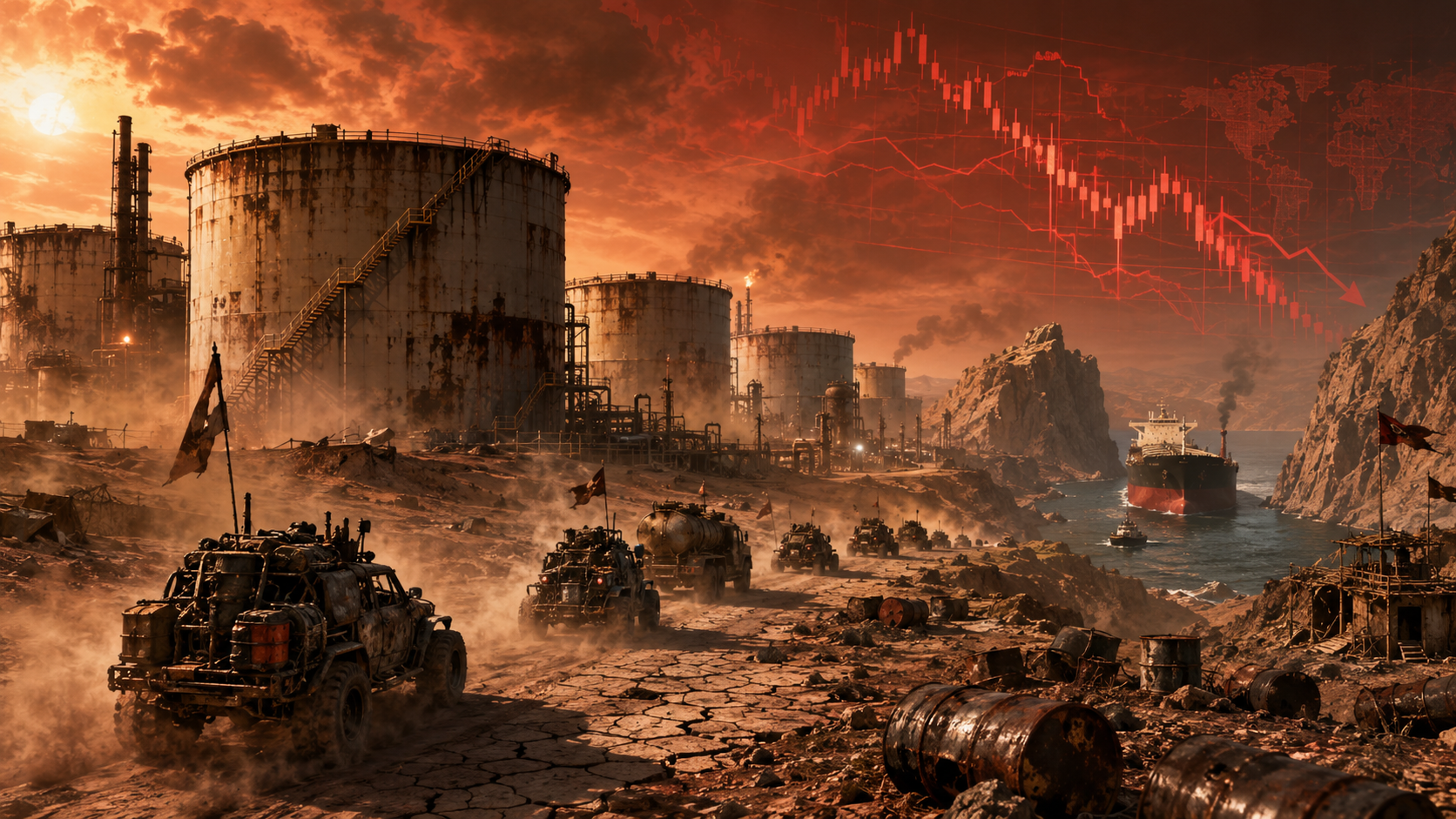
Oil has entered its Mad Max: Fury Road phase.
Not because the world is literally chasing fuel trucks through the desert, but because the logic is suddenly familiar: when a critical resource gets scarce, power shifts fast. The calm language of commodities desks — inventories, futures curves, shipping lanes — starts describing something much more primal. Who has barrels? Who controls routes? Who can absorb the shock? Who gets squeezed first?
The current oil setup is ugly because the signals are contradictory in exactly the way markets hate. Inventories are at record lows. The Strait of Hormuz remains closed or severely restricted, depending on the flow being tracked. The International Energy Agency and energy executives are warning that the buffer is thinning. Brent crude rose above $111 a barrel on Monday as supply fears intensified. And yet U.S. futures were all red, a reminder that financial markets can price fear, recession risk and profit-taking at the same time.
Oil is not just another asset on a screen. It is the bloodstream of transport, logistics, aviation, petrochemicals, inflation and geopolitics. In Dune, spice controls the empire. In the real world, energy is the closest thing we have.
Welcome to the fuel wasteland
The nightmare scenario for oil markets is not simply “high prices.” Markets can handle high prices when the cause is clear, temporary and manageable. The more dangerous setup is when physical supply gets tight, inventories are thin, shipping routes are vulnerable and traders lose confidence in the system’s ability to respond.
That is where the Mad Max analogy becomes useful. The franchise is not really about cars. It is about what happens when fuel becomes power. Scarcity turns infrastructure into leverage. A refinery is no longer just an industrial asset. A tanker route is no longer just a line on a logistics map. A stockpile is not boring inventory; it is breathing room.
That breathing room is now the issue.
According to recent market reporting, Brent crude moved above $111 a barrel on Monday as supply fears deepened, while U.S. equity futures were in the red and bond markets came under pressure from inflation worries. Reuters also reported that IEA chief Fatih Birol warned commercial oil inventories were depleting rapidly amid the closure of the Strait of Hormuz, even after emergency strategic reserve releases added temporary supply. Reuters
That is the paradox: the market is not just reacting to today’s oil price. It is reacting to the shrinking margin for error.
Why inventories matter
Oil inventories are the stored barrels sitting in commercial tanks, refineries, pipelines, ships and strategic reserves. Think of them as the energy system’s shock absorbers.
When supply is interrupted, inventories help keep the machine running. When demand suddenly rises, inventories bridge the gap. When weather, war, sanctions or shipping problems hit, inventories give governments and companies time to respond.
Low inventories do the opposite. They make every shock feel bigger.
For readers who do not follow oil daily, this is the key point: inventories are not just a statistic for traders. They are the cushion between a supply problem and a consumer problem. When tanks are full, the market can absorb some chaos. When tanks are low, chaos travels faster from the Strait of Hormuz to diesel prices, airline costs, freight bills and inflation data.
That matters because oil is embedded everywhere. It fuels trucks that move groceries. It powers aircraft. It influences plastics, chemicals, packaging and industrial production. Even if you never buy crude oil, crude oil keeps showing up in your life through prices.
Record-low inventories also change behavior. Buyers become more aggressive. Governments become more nervous. Refiners worry about feedstock. Traders pay more attention to every shipping headline. A market with a fat buffer can shrug. A market with empty tanks flinches.
Futures are not always fortune-tellers
This is where things get confusing. If the physical oil market is so stressed, why can futures point lower? Why can U.S. futures be red while oil supply fears are exploding?
Because futures are not prophecy. They are prices for delivery at specific future dates, shaped by expectations, hedging, liquidity, interest rates, positioning and risk appetite.
A falling futures market can mean traders expect demand destruction. In plain English: prices rise so much that consumers, companies and economies start using less. Airlines cut capacity. Drivers reduce travel. Factories slow down. Governments push conservation measures. High prices can become the cure for high prices, but the cure is painful.
Lower futures can also reflect recession fears. If investors believe an oil shock will hurt growth, they may sell equities and price weaker future demand even while near-term barrels remain scarce. That is why a market can scream “supply crisis” today and “economic slowdown” tomorrow.
There is also positioning. Funds may take profits after a sharp rally. Producers may hedge future output. Traders may assume emergency reserves, diplomatic pressure or demand cuts will eventually cool the market.
None of that means the risk has disappeared. It means the futures curve is processing multiple fears at once.
This is the part casual observers often miss. A red futures screen does not automatically mean “oil is fine.” It can mean “the market is worried the cure will be a slowdown.”
The Strait of Hormuz problem
The Strait of Hormuz is one of the world’s most important energy chokepoints. It sits between the Persian Gulf and the Gulf of Oman, and it is a critical route for oil and liquefied natural gas flows from major producers in the region.
When Hormuz is open, it is infrastructure. When Hormuz is closed or restricted, it becomes a geopolitical weapon.
That is why this market feels different from a normal supply-demand imbalance. This is not just about one producer pumping less. It is about the route itself. If ships cannot move safely, barrels that technically exist may not reach buyers. Insurance costs rise. Shipping routes stretch. Delivery times become less reliable. Refiners start asking not only “how much oil is available?” but “can it physically get here?”
This is where oil becomes the real-world version of spice. Control the flow, and you influence everything downstream.
The IEA was created in the wake of the 1970s oil crisis to help industrialized countries respond to major oil shocks, and its warnings matter because energy security is its core mission. European Commission When its leadership and industry executives start sounding alarms about inventory depletion, the market listens.
Still, it is important not to overstate certainty. Oil crises are dynamic. Routes can reopen. Emergency reserves can be tapped. Demand can fall. Diplomacy can shift. But the current setup is fragile because there are fewer spare barrels, fewer easy detours and less time to absorb mistakes.
So what for markets?
For markets, oil is both a commodity and a macro signal.
First, inflation. Higher crude prices can feed into gasoline, diesel, jet fuel and freight. That does not always happen instantly or evenly, but the direction matters. If businesses face higher transport and input costs, some of that pressure can reach consumers.
Second, central banks. If oil pushes inflation expectations higher, central banks may find it harder to talk about rate cuts. Even if policymakers know oil shocks can be temporary, they cannot ignore the risk that higher energy prices spread into wages, services and consumer expectations.
Third, consumer spending. Energy costs act like a tax. When households spend more on fuel, heating, transport or goods affected by logistics costs, they have less room for discretionary purchases. That can hit retail, travel, restaurants and consumer tech.
Fourth, transport and aviation. Airlines are especially exposed because jet fuel is a major cost. Shipping, trucking and delivery-heavy business models also feel the squeeze. The question is not only whether they can pass costs on, but whether customers will accept the higher prices.
Fifth, energy equities. Oil producers can benefit from higher crude prices, but the picture is not automatic. Political pressure, windfall-tax talk, operational risks, hedging strategies and broader market selloffs can complicate the trade. Refiners face their own equation, depending on crude availability and product margins.
This is why direct investment calls are dangerous here. Oil shocks create winners and losers, but the map changes quickly. A headline from Hormuz can overpower a balance sheet. A central bank sentence can move equities. A reserve release can change the short-term supply picture.
The practical watchlist
So what should readers actually watch?
Start with Brent crude. It is the global benchmark, and moves above psychologically important levels can reshape inflation and market expectations.
Watch inventory data. Weekly draws or builds matter more when stockpiles are already low. A small draw in a comfortable market is noise. A small draw in a stressed market can be a warning light.
Track shipping routes and tanker flows around Hormuz. In this environment, logistics data can be as important as production data.
Listen to central bank language. If policymakers start sounding more worried about energy-driven inflation, rate expectations can move quickly.
Watch airline stocks and transport names. They are often early signals for how markets are pricing fuel pressure.
Watch energy stocks, but with nuance. Higher oil can help producers, but geopolitics, taxes and broader risk-off moves can blunt the benefit.
Finally, watch consumer inflation signals. Gasoline, diesel, airfares and freight-sensitive goods can tell you whether the oil shock is staying inside commodities or leaking into everyday life.
The oil market is not guaranteed to spiral. But with inventories thin, Hormuz under pressure and futures sending mixed signals, this is not a normal tape. It is a market with less cushion, more politics and a much louder engine.
In Fury Road, everyone understands the value of fuel because the world has run out of softness. That is the lesson for markets too. When the buffer disappears, every barrel becomes a message.
Oil market: key questions
Why do low oil inventories matter?
Low inventories reduce the market’s safety cushion. When supply is disrupted, there are fewer stored barrels available to absorb the shock, which can make prices more volatile.
Why can oil futures fall during a supply crisis?
Futures reflect expectations, not certainty. They can fall if traders expect demand destruction, slower economic growth, reserve releases or future supply relief, even while near-term supply remains tight.
Why is the Strait of Hormuz so important?
The Strait of Hormuz is a critical shipping route for Gulf energy exports. If it is closed or restricted, oil and gas flows can be delayed, rerouted or blocked, increasing global supply risk.
How can high oil prices affect consumers?
High oil prices can raise fuel, transport, airline and logistics costs. Those increases may feed into broader inflation and reduce household spending power.
Could this influence central bank policy?
Yes. If energy prices push inflation expectations higher, central banks may become more cautious about cutting interest rates or may keep policy tighter for longer.
Is this article financial advice?
No. This article is for information and analysis only. It does not recommend buying or selling oil, energy stocks, futures, ETFs or any other financial asset.