A crypto exchange is a platform where people buy, sell and trade cryptocurrencies or other digital assets. For many beginners, it is the front door to crypto: the place where a bank card, bank transfer or stablecoin balance turns into Bitcoin, Ether or another token.
That makes exchanges feel simple. Open an account, search for a coin, click buy, watch the chart do emotional damage. But behind that simple interface sits one of the most important pieces of crypto infrastructure: markets, liquidity, custody, compliance, fees, order books, wallets, withdrawals and sometimes a worrying amount of trust.
A crypto exchange can be centralized, meaning a company runs the platform and often holds customer assets. It can also be decentralized, meaning users trade through smart contracts from their own wallets. Those two models look similar from far away — both let you swap assets — but they work very differently.
Understanding crypto exchanges matters because buying crypto is not just about price. It is also about who controls the assets, how trades are executed, what fees apply, what protections exist, and what happens when something goes wrong. In crypto, the place where you trade can be almost as important as the asset you buy.
This article is part of Crypto Explained, Geek’n’Destroy’s beginner-friendly guide to cryptocurrency, Bitcoin, blockchain, wallets, tokens, stablecoins, DeFi, NFTs and the vocabulary of Web3.
Sommaire
- What is a crypto exchange?
- How a crypto exchange works
- Centralized exchanges explained
- Decentralized exchanges explained
- Order books, liquidity and market makers
- Crypto exchange fees
- Custody: who controls the crypto?
- What crypto exchanges are used for
- The risks beginners should understand
- How to think about choosing an exchange
- What to Remember (FAQ)
What is a crypto exchange?
A crypto exchange is a marketplace for digital assets. It allows users to buy, sell or trade cryptocurrencies such as Bitcoin, crypto tokens, stablecoins and other blockchain-based assets.
The simplest exchange experience is buying crypto with traditional money. A user deposits dollars, euros or another currency, then buys a crypto asset at the available market price. The exchange may also allow crypto-to-crypto trading, such as swapping Bitcoin for a stablecoin, or Ether for another token.
There are two broad categories. A centralized exchange, often called a CEX, is run by a company. A decentralized exchange, or DEX, is built from blockchain-based smart contracts and usually lets users trade directly from their own wallets.
Both are “exchanges,” but the word hides a lot. Some platforms are simple broker-style apps. Some are professional trading venues with order books, APIs and derivatives. Some are on-chain protocols. Some are barely disguised casinos with a login screen. Beginners should not assume every exchange offers the same level of safety, liquidity or transparency.
The job of an exchange is to connect buyers and sellers. The deeper question is how it does that, and who you must trust along the way.
How a crypto exchange works
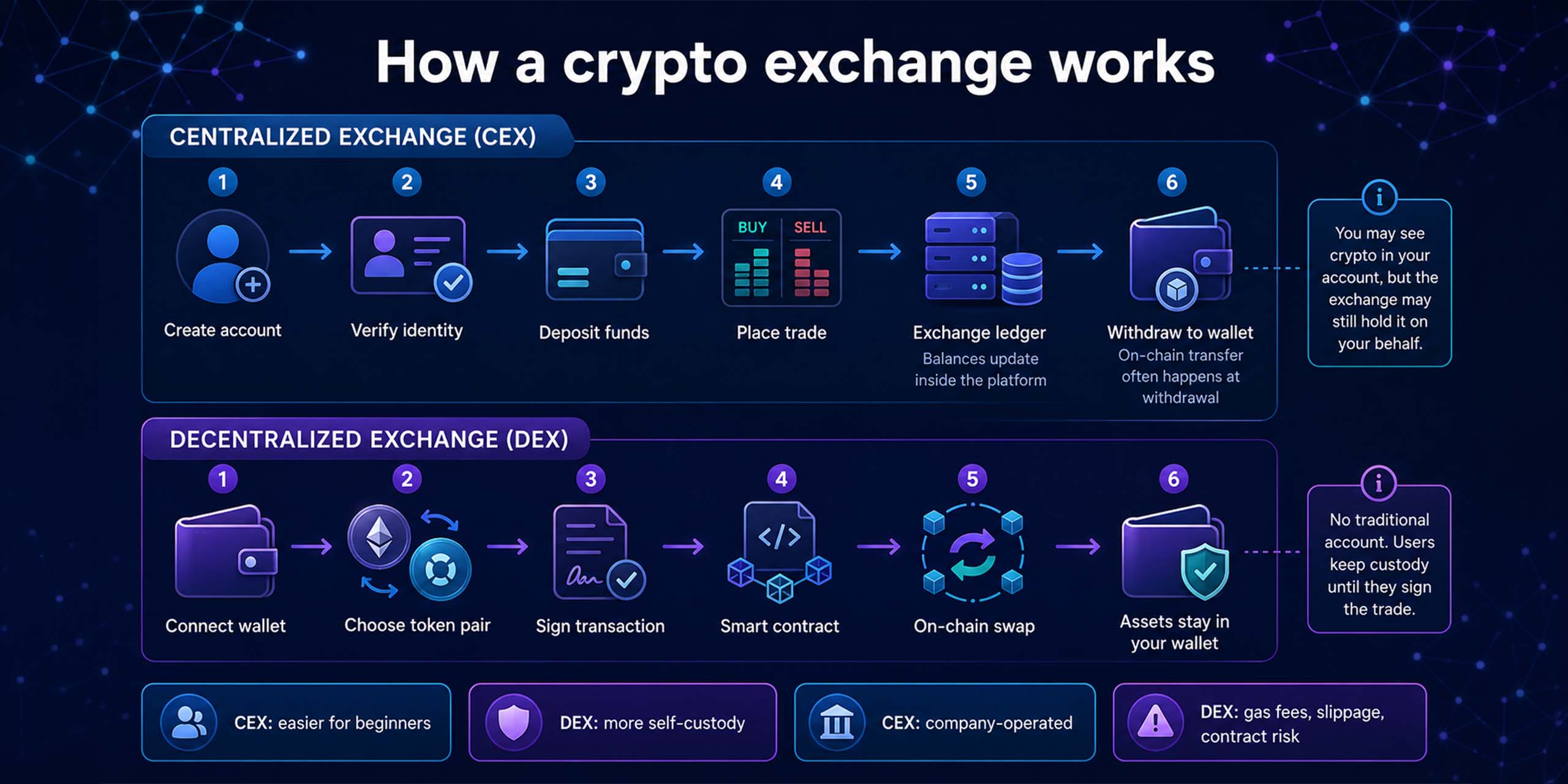
A centralized crypto exchange usually works like a digital marketplace operated by a company. Users create accounts, verify identity when required, deposit funds, place trades and manage balances through the platform.
When a user buys crypto on a centralized exchange, the trade may happen inside the exchange’s internal system. The platform updates user balances in its own database, while the actual blockchain movement may happen only when the user withdraws assets to an external wallet.
That is why exchange balances can be confusing. Seeing Bitcoin in your exchange account does not always mean you personally control Bitcoin on-chain at that moment. It may mean the exchange owes you that amount and holds assets on behalf of customers.
A decentralized exchange works differently. Instead of logging into a company account, users connect a crypto wallet. Trades are executed by smart contracts on a blockchain. The user typically keeps custody of assets until the transaction is signed.
This makes DEXs feel more crypto-native. They are open, on-chain and often available without a traditional account. But they also require users to understand wallets, network fees, token approvals, slippage and smart contract risk. Convenient? Sometimes. Forgiving? Not really.
Centralized exchanges explained
A centralized exchange is the most familiar type of crypto trading platform. It is run by a company that manages the interface, user accounts, trade execution, custody, customer support and compliance obligations.
For beginners, centralized exchanges are often easier to use. They may support bank transfers, card payments, local currencies, password recovery, tax documents, mobile apps and simple buy buttons. That familiar experience is one reason centralized exchanges became the main gateway into crypto.
Centralized exchanges can also offer deep liquidity. Liquidity means there are enough buyers and sellers for trades to happen quickly at prices close to the quoted market price. For popular assets, a large exchange can make buying and selling feel almost instant.
The trade-off is trust. Users rely on the company to secure assets, process withdrawals, manage reserves, prevent fraud, obey regulations and remain solvent. If the exchange fails, freezes withdrawals or suffers a breach, customers can be exposed.
This is the uncomfortable heart of centralized crypto trading. The asset may be decentralized, but the platform may not be. Buying Bitcoin on a centralized exchange is not the same as holding Bitcoin in self-custody.
Decentralized exchanges explained
A decentralized exchange is a protocol that lets users trade crypto assets through smart contracts rather than a traditional company-operated order matching system.
The best-known DEX model is the automated market maker, or AMM. Instead of matching individual buyers and sellers through an order book, an AMM uses liquidity pools and mathematical pricing formulas. Users trade against the pool, while liquidity providers deposit assets and earn a share of fees.
This model became important in DeFi because it made on-chain markets easier to create. A new token could become tradable without waiting for a centralized exchange listing. Anyone could provide liquidity. Anyone with a compatible wallet could trade.
That openness is powerful, but dangerous. A DEX does not necessarily protect users from bad tokens, fake contracts, terrible liquidity or malicious projects. If a scam token is available on a DEX, that does not mean the DEX endorsed it. It may simply mean someone created a market.
DEXs also introduce specific trading risks. Users may face slippage, which is the difference between the expected price and the actual execution price. They may pay blockchain gas fees. They may approve dangerous contracts. They may also suffer from MEV, where bots exploit transaction ordering opportunities on-chain.
A decentralized exchange gives users more direct control. It also gives them fewer cushions.
Order books, liquidity and market makers
Many centralized exchanges use an order book. An order book is a list of buy and sell orders for an asset. Buyers place bids. Sellers place asks. Trades happen when prices match.
If there are many active orders close to the current price, the market is liquid. If the order book is thin, even a modest trade can move the price. This is why liquidity matters. A token may show a price on a screen, but if there are not enough real buyers and sellers, exiting the position can be ugly.
Professional traders and firms known as market makers often provide liquidity by continuously placing buy and sell orders. They help markets function more smoothly, but they are not doing charity. They earn spreads, fees or other incentives.
DEXs can also have liquidity, but it is organized differently. In an AMM, liquidity providers deposit pairs of tokens into pools. Traders swap against those pools. Prices shift according to the pool’s formula and available reserves.
This is why the same asset can trade differently across exchanges. Prices may vary because of liquidity, fees, demand, chain conditions and market structure. Arbitrage traders often help close those gaps by buying where an asset is cheaper and selling where it is more expensive.
For beginners, the main lesson is simple: the “price” of a crypto asset is not just a number. It depends on the market where you trade.
Crypto exchange fees
Crypto exchanges make money through fees. The most visible fee is the trading fee, charged when a user buys or sells an asset.
Centralized exchanges may charge different fees depending on whether a user is placing a market order, a limit order, using a simple buy feature, or trading through an advanced interface. The easy button is often more expensive than it looks.
There may also be deposit and withdrawal fees. Depositing traditional money can involve bank or card costs. Withdrawing crypto can involve network fees and platform fees. A withdrawal fee for Bitcoin is not the same as a gas fee on Ethereum or a transfer fee on another chain.
On decentralized exchanges, users usually pay blockchain transaction fees plus protocol or liquidity provider fees. During busy periods, network fees can become significant. A trade that looks cheap on the chart can become less attractive once gas and slippage are included.
Spreads also matter. The spread is the gap between the buying price and selling price. Some beginner-friendly platforms hide complexity by quoting a convenient all-in price. That may be fine for small purchases, but it can make real costs harder to see.
Good exchange users do not only ask, “What coin should I buy?” They ask, “What will this trade actually cost?”
Custody: who controls the crypto?
Custody is the most important exchange issue most beginners discover too late.
On a centralized exchange, the platform often holds crypto assets for users. The user sees a balance in an account, but the exchange controls the private keys. This is called custodial storage.
Custody can be convenient. Users may get account recovery, customer support, simple trading and easier access to fiat money. For small amounts or beginner learning, that convenience can be useful.
But custody also creates counterparty risk. If the exchange becomes insolvent, is hacked, mismanages assets, freezes withdrawals or faces legal trouble, users may not be able to access their funds. A blockchain cannot rescue assets held inside a failed company’s custody system.
With a decentralized exchange, users typically trade from a self-custody wallet. They keep control of private keys, sign transactions themselves and interact directly with smart contracts. That reduces exchange custody risk, but increases personal responsibility.
This is the core exchange trade-off: centralized platforms reduce friction but require trust; decentralized protocols reduce custody dependence but demand more technical care.
What crypto exchanges are used for
The obvious use case is buying and selling crypto. A user may buy Bitcoin as a long-term investment, purchase Ether to use Ethereum apps, or buy stablecoins for trading and transfers.
Exchanges are also used for price discovery. Markets need places where buyers and sellers meet. Exchange prices become reference points for traders, wallets, media, portfolio trackers and other apps.
For active traders, exchanges offer tools such as limit orders, stop orders, charts, APIs and sometimes margin or derivatives. These tools can be useful, but they can also make it easier to lose money faster. “Advanced trading” is not a synonym for “better idea.”
For crypto users, exchanges often serve as on-ramps and off-ramps. An on-ramp turns traditional money into crypto. An off-ramp turns crypto back into traditional money. Without reliable ramps, crypto becomes much harder to use in the real world.
Exchanges also help users access new assets. Tokens often become easier to buy once listed on major platforms. But a listing is not a blessing from the gods. It may improve liquidity and visibility, but it does not prove the token is safe, fairly valued or useful.
The risks beginners should understand
The first risk is platform failure. Crypto history is full of exchanges that were hacked, collapsed, froze withdrawals or turned out to be less healthy than they looked. A polished interface does not guarantee sound custody.
The second risk is regulatory uncertainty. Exchanges operate under different rules depending on the country, the asset and the services offered. A platform may restrict features, delist tokens, change access or exit a jurisdiction.
The third risk is fake platforms. Scam exchanges can mimic real trading interfaces, show fake profits, block withdrawals and pressure users into depositing more. If a stranger online recommends an exchange that no one reputable has heard of, that is not alpha. That is a trap wearing a referral code.
The fourth risk is bad liquidity. Small tokens on weak exchanges can be hard to sell. The displayed price may collapse when users try to exit. Liquidity is not a cosmetic detail; it is the door.
The fifth risk is user error. Sending assets to the wrong network, withdrawing to the wrong address, ignoring memo requirements or approving malicious contracts can cause permanent losses. Crypto transfers are often irreversible.
There is also the risk of overtrading. Exchanges are designed to make trading easy. Easy trading is not always good for the person doing it. A beginner who came to buy Bitcoin can quickly end up chasing leverage, meme tokens and chart patterns that look scientific until they explode.
How to think about choosing an exchange
Choosing a crypto exchange starts with a practical question: what do you need it for?
If the goal is simply to buy a small amount of Bitcoin or Ether, a regulated, reputable centralized exchange with clear fees, strong security practices and simple withdrawals may be enough. If the goal is DeFi, obscure tokens or on-chain trading, a decentralized exchange may be necessary.
Security should come before novelty. Look for basic protections such as two-factor authentication, withdrawal controls, transparent policies, proof-of-reserves information where available, and a track record that does not read like a crime documentary.
Fees matter, but the cheapest platform is not automatically the best. A low fee is not worth much if liquidity is poor, withdrawals are unreliable, support is nonexistent or the platform operates from a legal fog machine.
Asset support also matters. Some exchanges list hundreds of tokens, while others focus on a smaller set. More listings can mean more opportunity, but also more exposure to weak projects. A serious exchange listing process is not perfect, but total asset chaos is not a feature.
For beginners, the healthiest habit is to separate trading from storage. Use an exchange when you need a market. Use a wallet when you need control. Leaving meaningful long-term holdings on an exchange should be a conscious decision, not the default setting.
A crypto exchange is a tool. It can be useful, fast and necessary. It can also become the place where convenience quietly eats caution. The best users understand both sides before they click buy.
What to Remember (FAQ)
What is a crypto exchange in simple terms?
A crypto exchange is a platform or protocol where users can buy, sell or trade cryptocurrencies and other digital assets.
What is the difference between a centralized exchange and a decentralized exchange?
A centralized exchange is run by a company and often holds user assets. A decentralized exchange uses smart contracts and usually lets users trade directly from their own wallets.
Do crypto exchanges store my coins?
Centralized exchanges often hold crypto on behalf of users, which means the platform controls the private keys. Decentralized exchanges usually let users keep control through self-custody wallets.
What are exchange fees?
Exchange fees are costs charged for trading, deposits, withdrawals or blockchain transactions. Users should also watch spreads, slippage and network fees.
Is a crypto exchange the same as a crypto wallet?
No. An exchange is a marketplace for trading crypto. A wallet is a tool for controlling crypto assets through private keys.
Are crypto exchanges safe?
Some exchanges are more reputable and secure than others, but no exchange is risk-free. Users should consider custody, regulation, liquidity, security, fees and withdrawal reliability.
Sources: FINRA Crypto Assets: Buying and Selling, Investor.gov Crypto Asset Custody Basics, Uniswap Documentation