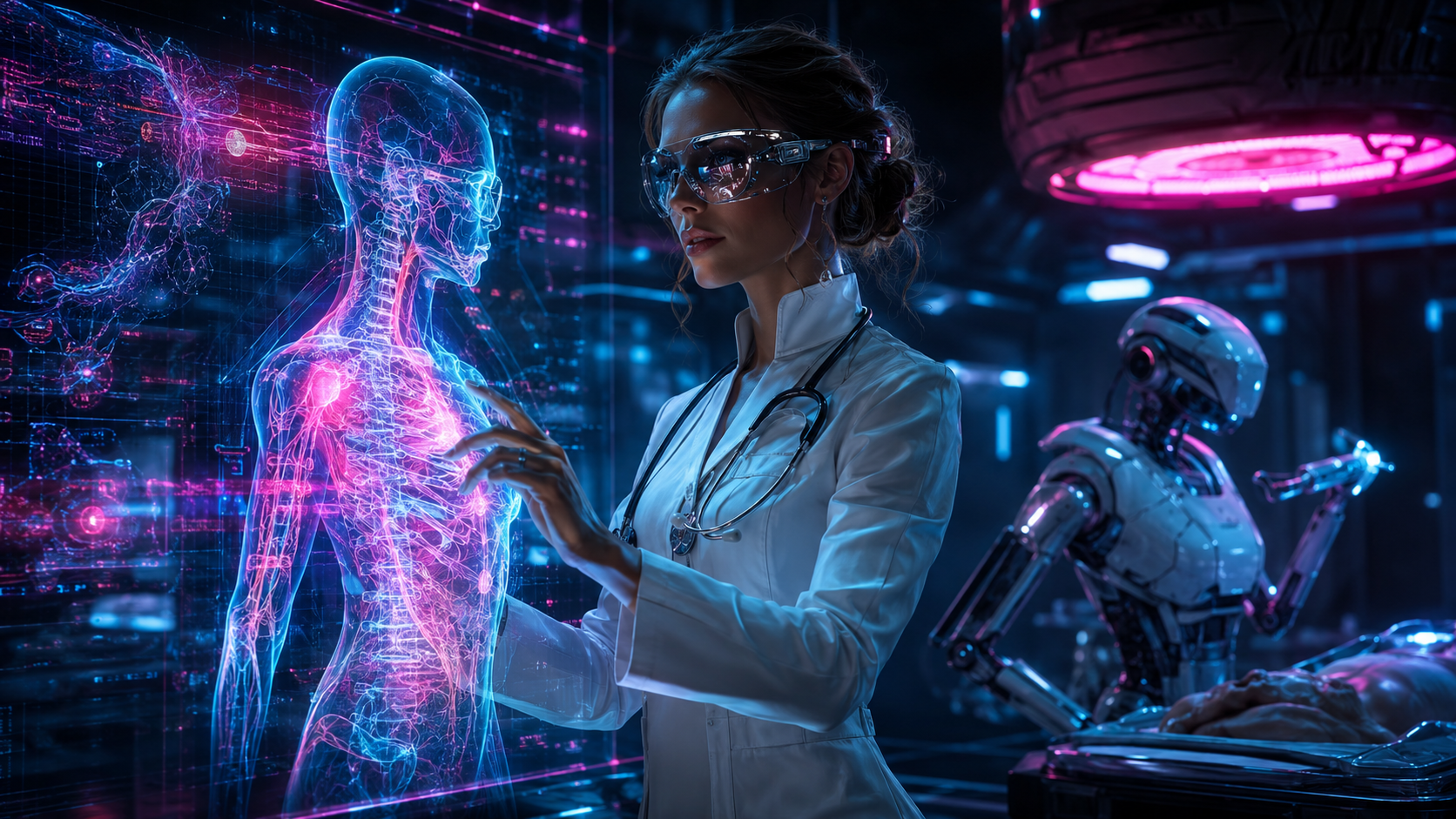
The stethoscope might not be dead, but it’s definitely getting an upgrade. A bombshell new study suggests that AI is now outperforming human doctors in clinical reasoning, and the implications are massive. In a world where medical errors and redundant testing cost billions every year, the debate over AI medical diagnosis has shifted from sci-fi fantasy to a high-stakes reality.
Table of contents
- The High Cost of Human Error
- Performance Review: AI Medical Diagnosis Outshines the Experts
- The “GPS Effect” and the Future of the MD
- AI medical diagnosis: key questions
The High Cost of Human Error
We like to think of medicine as an infallible science, but the reality is more “human” than we’d care to admit. In the US and Europe, diagnostic errors occur in roughly 5% of outpatient visits. Even worse, a recent study in JAMA Internal Medicine found that nearly a quarter of deceased or transferred hospital patients had been subject to a diagnostic misstep.
Beyond the human toll, there is a staggering financial burden. Between avoidable complications and unnecessary tests, the global healthcare system is bleeding money. This isn’t just a lack of resources; it’s a lack of precision. Enter the era of AI medical diagnosis, where algorithms don’t get tired, don’t have “bad days,” and don’t overlook “weak signals” in a patient’s chart.
Performance Review: AI Medical Diagnosis Outshines the Experts
A groundbreaking study recently published in Science put OpenAI’s o1-preview model to the test against seasoned physicians. The researchers didn’t just use academic “textbook” cases; they threw 76 real-world emergency room scenarios at the AI: messy, incomplete data from actual hospital records.
The results were a wake-up call for the medical establishment. At the initial triage stage, where data is scarcest and stakes are highest, the AI correctly identified the diagnosis in 67.1% of cases, compared to just 55.3% for human doctors. By the time patients were admitted, the AI’s accuracy climbed to 81.6%. Whether it’s identifying an atypical heart attack or a subtle pulmonary embolism, the data shows that AI medical diagnosis excels exactly where humans struggle: reasoning quickly with fragmented information.
The “GPS Effect” and the Future of the MD
If the machine is smarter, do we still need the doctor? The danger isn’t just displacement; it’s “cognitive atrophy.” Just as GPS has ruined our natural sense of direction, relying too heavily on algorithms could erode a doctor’s clinical intuition. A randomized trial showed that doctors exposed to incorrect AI suggestions saw their own diagnostic scores drop by 14%.
The goal isn’t a world of cold, automated kiosks. It’s the “Cyborg Physician”: a pairing of human empathy and AI-driven vigilance. The AI should act as a sophisticated “spell-check” for life-and-death decisions, asking, “Have you considered this rare genetic marker?” or “Are you sure that test is necessary?”
We shouldn’t fear the machine; we should fear the doctor who refuses to use it. The future of medicine is a partnership, and it’s time to level up.
AI medical diagnosis: key questions
What is AI medical diagnosis?
AI medical diagnosis refers to the use of artificial intelligence systems to help identify diseases, interpret medical data, and support clinical decision-making.
Why is AI medical diagnosis becoming important?
It is becoming important because healthcare systems face diagnostic errors, rising costs, staff pressure, and increasingly complex patient data.
What did the Science study test?
The study tested OpenAI’s o1-preview model against physicians using 76 real-world emergency room scenarios based on incomplete hospital data.
Did AI outperform human doctors in the study?
According to the study, the AI model performed better than human doctors at several diagnostic stages, especially during initial triage.
Does this mean AI will replace doctors?
Not necessarily. The article argues that AI is more likely to become a support tool for doctors rather than a full replacement.
What is the “GPS effect” in medicine?
The “GPS effect” refers to the risk that doctors could lose some diagnostic sharpness if they rely too heavily on AI systems.
What could the future of medicine look like?
The future could involve “Cyborg Physicians,” combining human empathy and judgment with AI systems that help detect weak signals and reduce errors.