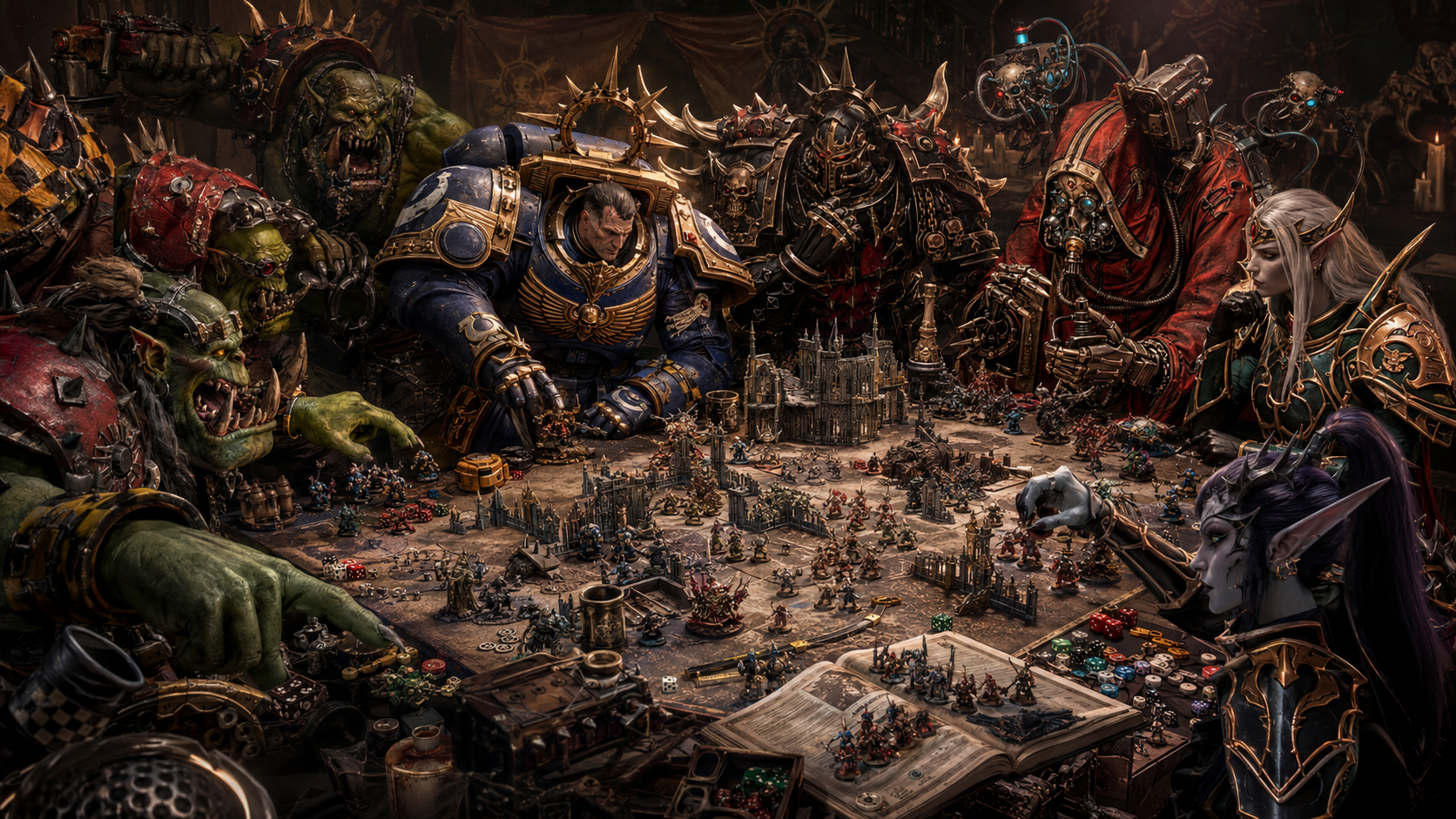
Games Workshop is not a toy giant. It is not a video game publisher. It is not a Disney-scale licensing machine. And yet the company behind Warhammer trades with the confidence of a business that knows exactly what it owns: a niche, obsessive, high-margin universe that fans keep funding one miniature, codex, paint pot, and licensed game at a time.
That is why Games Workshop Group, listed in London under GAW.L, has become one of the strangest premium stories in geek finance. Its revenue base is far smaller than Hasbro, Mattel, or Take-Two, but its profitability looks more like a luxury IP engine than a conventional toy company.
The catch? A lot of that excellence is already priced in.
Warhammer’s small empire
Games Workshop remains a relatively small company by entertainment-sector standards. Recent figures put its annual revenue in the rough zone of £600 million-plus, or around $650 million to $830 million depending on the fiscal period and exchange rate used.
That is tiny next to diversified players. Mattel is still a multi-billion-dollar toy group. Hasbro remains much larger, even after years of restructuring. Take-Two sits in a different league as a video game publisher built around franchises like Grand Theft Auto, NBA 2K, and Borderlands.
But Games Workshop does not need to play the same game. Its power is concentration. Warhammer is the business. The miniatures, books, retail stores, hobby ecosystem, licensing deals, and community all orbit the same core intellectual property.
According to Games Workshop’s own investor updates, the company estimated core revenue of at least £560 million and licensing revenue of around £50 million for the 52 weeks ending June 1, 2025. The group also estimated profit before tax of at least £255 million, underlining just how profitable the Warhammer machine has become. Games Workshop investor relations
How Games Workshop compares
On revenue alone, Games Workshop looks modest.
Mattel reported full-year 2025 results from a much larger global toy platform. Hasbro’s 2025 recovery was powered heavily by Wizards of the Coast, especially Magic: The Gathering, which makes it one of the closest comparisons to Games Workshop’s high-loyalty hobby model. Take-Two is larger again, driven by interactive entertainment rather than tabletop. Funko, meanwhile, is closer in scale but weaker in profitability and more exposed to pop-culture merchandise cycles.
The more useful comparison is not “who sells more?” It is “who keeps more?”
Games Workshop’s appeal comes from its unusually strong margin profile. The company sells premium physical products tied to a proprietary universe, controls much of its own retail and community pipeline, and benefits from licensing upside when video games or screen projects hit. That gives it a cleaner model than traditional toy companies, which often fight retailer pressure, inventory risk, weaker pricing power, and hit-driven demand.
Hasbro’s Wizards of the Coast segment is the closest cousin. Like Warhammer, Magic: The Gathering is not just a product line. It is a rules system, a collector economy, a tournament culture, a digital opportunity, and a licensing asset. That is why investors often view Wizards and Games Workshop as rare examples of geek IP that can generate recurring, high-margin spending.
Why the market pays a premium
Games Workshop’s valuation is not cheap. Recent market data puts the stock around a price-to-earnings ratio in the low 30s, above its longer-term average and above many traditional leisure or toy-sector peers.
That premium is not irrational. It reflects several strengths investors rarely find in one company:
First, Warhammer has a deep moat. The hobby is expensive, time-consuming, social, and lore-heavy. Once players are inside the ecosystem, switching to another tabletop universe is not as simple as buying a different toy.
Second, the business is highly profitable. Games Workshop’s operating margins have often been far above what investors expect from ordinary consumer-products companies.
Third, the company has licensing optionality. Video games such as Warhammer 40,000: Space Marine 2 can create bursts of revenue and brand visibility without Games Workshop taking the same development risk as a full publisher.
Fourth, the fan base is global and unusually loyal. Warhammer customers are not just buying products. They are building armies, following lore, painting collections, and participating in a culture.
That is the core bull case: Games Workshop may be small, but it behaves like a premium IP compounder.
What analysts are saying
Analyst coverage of Games Workshop is limited compared with larger US-listed entertainment stocks, but the tone is generally positive. Recent consensus data points to a Buy-leaning view, with price targets clustered around the high-£190 to low-£200 range per share.
Jefferies has been among the more bullish names, reportedly raising its target to £218.50 while keeping a Buy rating. Other analysts are more cautious, reflecting a simple reality: Games Workshop is excellent, but the share price already knows that.
The market is effectively paying up for quality. Analysts like the company’s margins, cash generation, brand loyalty, and long-term licensing potential. But upside expectations are not huge unless Games Workshop can keep surprising on core growth or turn licensing into a larger, more predictable profit stream.
The big debate is valuation discipline. At a P/E multiple above 30, the stock has less room for disappointment. Slower miniature sales, weaker licensing revenue, production constraints, or a broader market rotation away from expensive quality names could all pressure the shares.
The risks behind the premium
The first risk is growth normalization. Games Workshop has enjoyed powerful momentum, but management has already warned that record licensing performance is not something investors should assume repeats every year.
The second risk is concentration. Warhammer is a strength, but it is also the whole castle. If the brand stumbles creatively, alienates fans, or overextends through licensing, there is no second empire of equal size inside the company.
The third risk is valuation. A premium multiple can be deserved and still become dangerous. When a stock trades like a flawless business, even a merely good update can disappoint.
The fourth risk is the physical nature of the core hobby. Miniatures are not pure software. Manufacturing, logistics, tariffs, retail execution, and pricing all matter. Games Workshop has more pricing power than most toy companies, but it is not immune to cost pressure.
Still, the company’s position remains rare. In a market crowded with entertainment groups chasing fandom, Games Workshop already owns one of the most durable fandom economies in the world.
Games Workshop stock: key questions
Is Games Workshop bigger than Hasbro or Mattel?
No. Games Workshop is much smaller by revenue. Its appeal is not scale, but profitability, pricing power, and control of the Warhammer IP ecosystem.
Why is Games Workshop valued so highly?
Investors pay a premium because the company has strong margins, loyal customers, recurring hobby spending, and licensing upside from video games and future screen projects.
Is Hasbro the closest comparison?
Partly. Hasbro is much larger and more diversified, but its Wizards of the Coast division has similarities with Games Workshop because both rely on deep fan engagement, collectibles, game systems, and high-margin IP.
What do analysts recommend for Games Workshop stock?
Recent analyst consensus appears broadly positive, with Buy-leaning recommendations. However, price targets suggest limited near-term upside unless the company beats expectations.
What is the main risk for Games Workshop investors?
The main risk is valuation. Games Workshop is a high-quality business, but the stock already prices in a lot of that quality. Slower growth or weaker licensing revenue could hit sentiment.
Is this financial advice?
No. This article is for information and analysis only. It is not financial advice, investment advice, or a recommendation to buy or sell any stock.