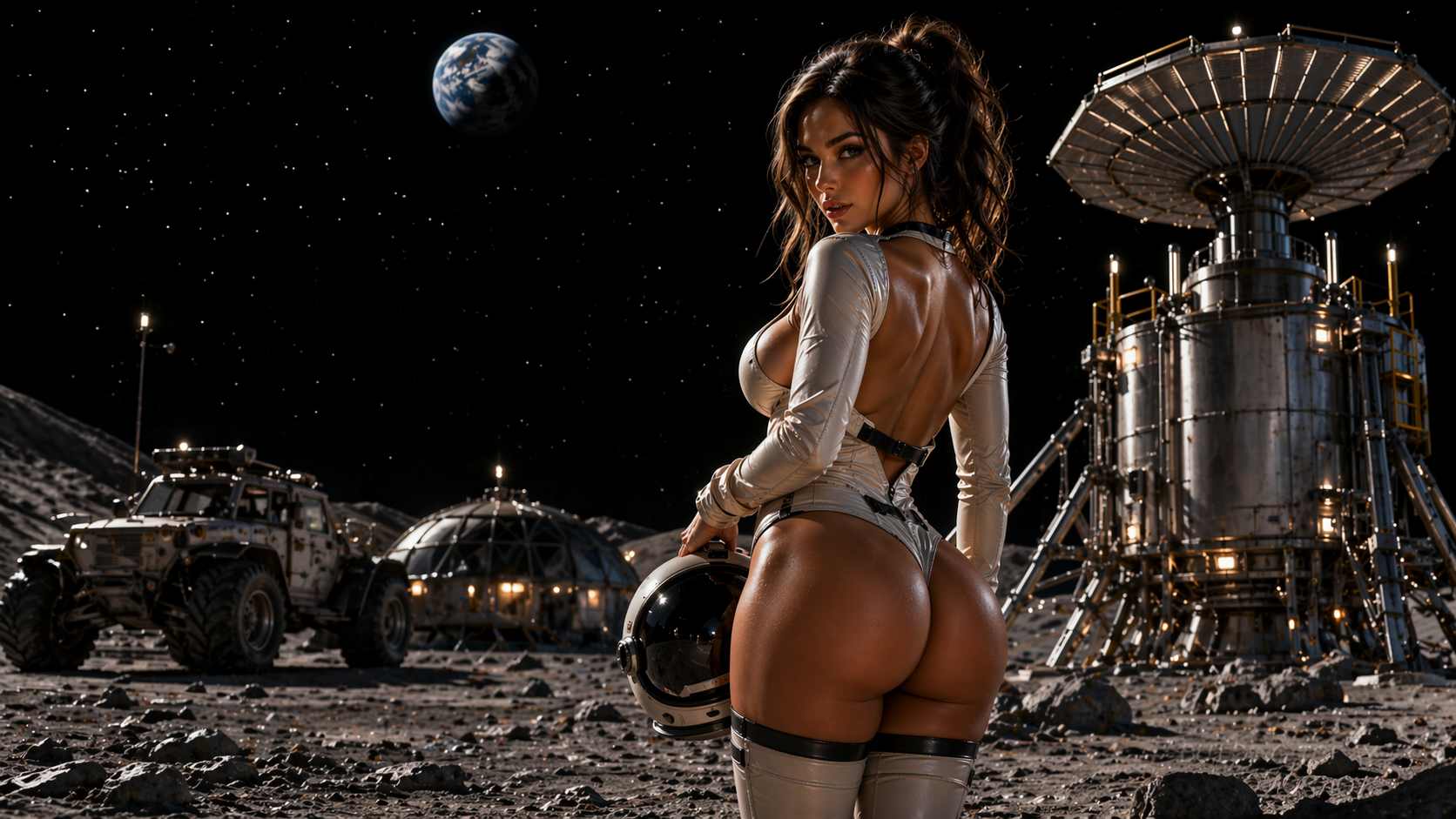
As humanity prepares to return to the Moon through the Artemis program, one challenge now matters as much as getting there: staying there.
The Apollo missions proved that humans could walk on the lunar surface. Artemis is aiming for something harder. A long-term lunar presence requires habitats, rovers, science equipment, communications systems, life support, and a steady source of power that does not disappear when the Sun goes down.
Solar panels will still matter. But on the Moon, they may not be enough. To build a real outpost, space agencies are looking at a more reliable option: nuclear fission.
Table of contents
- The problem of the 14-day lunar night
- Why nuclear power makes sense on the Moon
- How a lunar reactor could work
- Safety beyond Earth
- A stepping stone to Mars
- Moon nuclear power: key questions
The problem of the 14-day lunar night
The Moon is a brutal place for energy systems.
A full lunar day lasts about 29.5 Earth days, with long periods of sunlight followed by around two weeks of darkness. During the lunar night, temperatures can plunge dramatically, creating a major survival problem for machines, batteries, and human habitats.
Solar power alone cannot easily bridge that gap. To keep a base running through the night, astronauts would need enormous energy storage systems capable of covering days of life support, heating, communications, and equipment use. Every kilogram launched from Earth is expensive, so simply adding more batteries is not a clean solution.
That is where Fission Surface Power comes in.
A nuclear reactor does not depend on sunlight. It can provide continuous power through the lunar day, the lunar night, and even in permanently shadowed regions where solar energy is extremely limited.
Why nuclear power makes sense on the Moon
NASA and the U.S. Department of Energy have been working on concepts for a compact fission power system designed for the lunar surface. The goal is not to build a giant Earth-style power plant on the Moon, but a relatively small system capable of delivering reliable electricity for long-duration missions.
According to NASA, early concept awards focused on a 40-kilowatt class fission power system planned to operate for at least 10 years in the lunar environment.
That may sound modest compared with power grids on Earth. But on the Moon, 40 kilowatts could support essential systems such as a small habitat, science equipment, rovers, communications, and backup power infrastructure.
The point is not raw size. It is reliability.
For a permanent base, power cannot be occasional. It has to be predictable, autonomous, and available regardless of sunlight, terrain, or temperature.
How a lunar reactor could work
Forget the massive cooling towers of Earth-based nuclear plants. A lunar reactor would be compact, rugged, and designed to operate with minimal human intervention.
The basic principle remains familiar: uranium fuel undergoes controlled fission, releasing heat. That heat is then converted into electricity through a power conversion system. Some concepts have explored technologies such as Stirling engines or other compact conversion systems designed for space conditions.
The real engineering challenge is not just producing heat. It is managing it.
On Earth, power plants can use water, atmosphere, and large infrastructure to help control temperature. The Moon offers none of that. A lunar reactor would need dedicated heat rejection systems, such as radiators, to release excess heat into space.
It would also need to be transportable, deployable, shielded, and capable of operating for years in dust, radiation, extreme temperatures, and vacuum. In other words: small reactor, enormous engineering problem.
Safety beyond Earth
The idea of launching nuclear material into space naturally raises concerns, and rightly so. But lunar fission systems are designed around strict safety logic.
A surface reactor would not operate during launch. It would be activated only after safe deployment, once it is positioned on the lunar surface. That distinction matters, because an inactive reactor has not yet produced the inventory of fission products associated with an operating nuclear reactor.
Astronaut safety is another major design driver. A reactor would likely be placed at a distance from the habitat, shielded, or partially protected by lunar regolith. The Moon’s soil can act as a natural radiation barrier, making it useful for protecting both people and equipment.
The Moon also changes the environmental equation. There is no breathable atmosphere, no ocean, no biosphere, and no human population nearby. That does not make nuclear safety irrelevant, but it does mean the risk profile is very different from a reactor built on Earth.
A stepping stone to Mars
The Moon is not the final destination. It is the proving ground.
If engineers can operate a reliable nuclear power system on the lunar surface, that knowledge becomes essential for Mars. Unlike the Moon, Mars has an atmosphere, weather, dust, and planet-wide storms that can reduce solar power for long periods. Any serious human settlement on Mars will likely need a dependable power source that does not rely entirely on sunlight.
That is why lunar nuclear power matters. It is not just about lighting up a base. It is about learning how to build energy infrastructure beyond Earth.
The atom, once mostly associated with Cold War anxiety and terrestrial power debates, may become one of the keys to living elsewhere in the solar system.
Not because space exploration needs drama.
Because it needs electricity.
Source: NASA Fission Surface Power
Moon nuclear power: key questions
Why does a Moon base need nuclear power?
A Moon base needs continuous power for life support, heating, communications, science equipment, rovers, and habitat systems. Solar power is useful, but the long lunar night makes storage difficult and heavy.
How long does the lunar night last?
The lunar night lasts roughly two weeks. NASA describes the lunar night as about 14.5 Earth days, which creates a major challenge for solar-powered systems.
What is Fission Surface Power?
Fission Surface Power is a compact nuclear power system designed to generate electricity on the surface of the Moon or Mars by using controlled nuclear fission.
How much power would NASA’s lunar reactor produce?
NASA’s early concepts focused on a 40-kilowatt class fission power system, enough to support demonstration needs and essential lunar surface infrastructure.
Would a lunar nuclear reactor be dangerous during launch?
A lunar reactor would not be operated during launch. It would be activated only after deployment on the lunar surface, reducing the risks associated with an active reactor during transit.
Why is the Moon important for future Mars missions?
The Moon allows space agencies to test habitats, power systems, robotics, construction methods, and survival strategies relatively close to Earth before attempting longer and more difficult missions to Mars.