A crypto wallet is one of the first things people hear about when they enter crypto, and one of the easiest things to misunderstand. The name makes it sound like a digital version of the wallet in your pocket. That is not quite right.
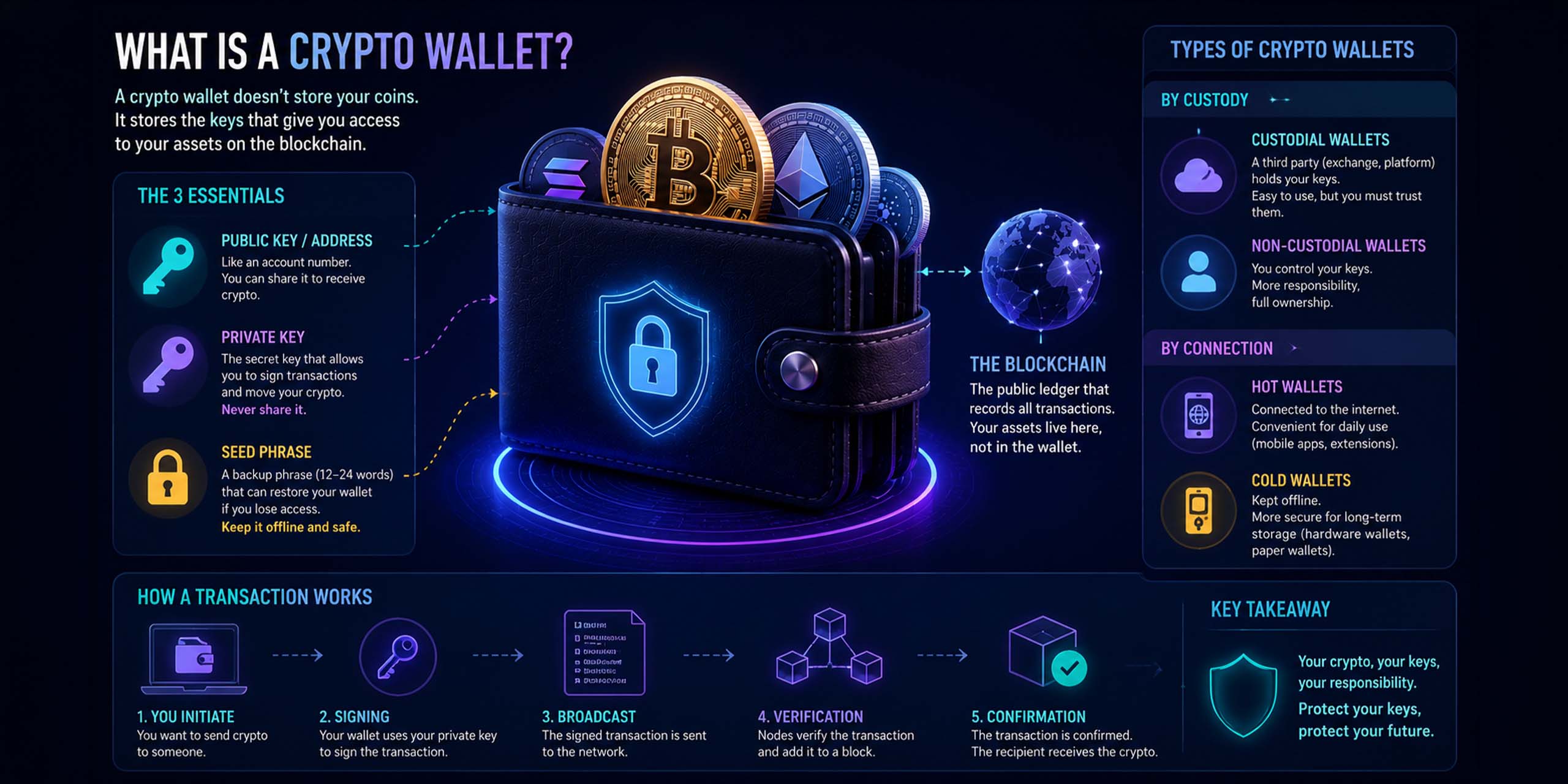
A crypto wallet does not really “store” your coins. Your crypto assets live on a blockchain, recorded as part of a shared public ledger. What the wallet stores, manages or helps you use are the private keys that prove you control those assets.
That distinction matters. In traditional finance, an account is usually controlled by a bank, app or payment company. In crypto, control often comes down to one brutal question: who has the keys? If you control the keys, you control the crypto. If someone else controls them for you, you are trusting that person or platform to give you access when you need it.
This is why wallets sit at the center of crypto. They are not just accessories. They are the interface between a person and a decentralized network: the tool you use to receive assets, send transactions, connect to apps, sign approvals, hold NFTs, interact with DeFi, and make very expensive mistakes if you are not careful.
This article is part of Crypto Explained, Geek’n’Destroy’s beginner-friendly guide to cryptocurrency, Bitcoin, blockchain, tokens, DeFi, NFTs and the vocabulary of Web3.
Sommaire
- What is a crypto wallet?
- How a crypto wallet works
- Private keys, public keys and seed phrases
- The main types of crypto wallets
- Custodial vs self-custody wallets
- Hot wallets vs cold wallets
- What crypto wallets are used for
- The risks beginners should understand
- How to think about choosing a wallet
- What to Remember (FAQ)
What is a crypto wallet?
A crypto wallet is a tool that lets you access and control crypto assets on a blockchain. It can be an app, a browser extension, a hardware device, a piece of software on your computer, or even a carefully stored backup phrase.
The confusing part is that a wallet does not contain crypto in the same way a leather wallet contains cash. When someone says they “have Bitcoin in a wallet,” the Bitcoin is actually recorded on the Bitcoin blockchain. The wallet holds the cryptographic access that lets the owner move it.
Think of the blockchain as the public record and the wallet as the signing tool. The blockchain says which address controls which assets. The wallet proves that you are allowed to act for that address.
This makes a crypto wallet more powerful than a normal login. It is not just a username and password for one website. A wallet can become your identity, payment tool and access pass across different crypto networks and applications.
That power is exciting. It is also unforgiving. In crypto, the wallet is often where the promise of ownership meets the reality of personal responsibility.
How a crypto wallet works
When you create a crypto wallet, it generates or manages cryptographic keys. These keys allow you to receive assets, check balances and sign transactions.
Receiving crypto is relatively simple. Your wallet gives you a public address, which you can share with someone who wants to send you funds. That address is like a destination on the blockchain.
Sending crypto is more sensitive. Your wallet uses a private key to sign a transaction. This signature proves to the network that the transaction was authorized by the person controlling the address. The network can verify the signature without needing to see the private key itself.
That is the clever part. A wallet lets you prove control without exposing the secret that gives control. If the system is working properly, your private key stays private while the blockchain can still confirm that your transaction is valid.
A good wallet hides much of this complexity behind a usable interface. It shows balances, transaction history, network fees, connected apps and approval requests. But under the hood, the wallet’s essential job remains the same: manage keys and sign blockchain actions.
Private keys, public keys and seed phrases
To understand crypto wallets, you need three terms: public key, private key and seed phrase.
A public key, or more commonly an address derived from it, is what you share. It allows others to send crypto to you. It is not usually dangerous to share a public address, although it can reveal transaction history on public blockchains.
A private key is the secret that allows you to spend or move assets. Anyone with access to the private key can control the funds linked to it. This is why serious crypto users treat private keys with the same paranoia a dragon reserves for gold.
A seed phrase, sometimes called a recovery phrase, is a list of words that can restore access to a wallet. In many wallets, the seed phrase is the human-readable backup from which private keys can be derived. Lose it, and you may lose access. Share it, and someone else may take control.
This is the part beginners often underestimate. A seed phrase is not a casual backup code. It is not something to send to customer support. It is not something to paste into a random website. It is the master key.
The main types of crypto wallets
There are several types of crypto wallets, and the differences matter.
A mobile wallet is an app on your phone. It is convenient for everyday use, small payments and quick access. The downside is that phones can be lost, infected, unlocked under pressure or compromised by bad security habits.
A desktop wallet runs on a computer. It can offer more control and features, but it depends heavily on the security of the machine. A computer full of malware is not a great place to protect valuable private keys.
A browser wallet is often used to interact with Web3 apps, NFT marketplaces and DeFi protocols. It is convenient because it sits directly inside the browser experience. It is also a common target for phishing, fake websites and malicious approval requests.
A hardware wallet is a physical device designed to keep private keys offline. It usually signs transactions inside the device, reducing exposure to internet-connected computers. Hardware wallets are popular for long-term storage, though they still require careful backups and safe handling.
A paper wallet is an older method where keys or seed phrases are stored physically on paper. It sounds simple, but it can be fragile, easy to damage, easy to miscopy and awkward to use safely. For most beginners, it is not the clean solution it appears to be.
No wallet type is perfect. Each one is a trade-off between convenience, control, security and user experience.
Custodial vs self-custody wallets
The most important wallet distinction is not mobile versus desktop. It is custodial versus self-custody.
A custodial wallet is controlled by a third party, usually a crypto exchange or financial platform. The user logs in with an account, and the company manages the private keys behind the scenes. This feels familiar because it resembles online banking or a fintech app.
The advantage is convenience. If you forget a password, there may be recovery options. If you are new to crypto, the platform may simplify buying, selling and transferring assets. For many beginners, custodial wallets are the first point of contact with cryptocurrency.
The downside is trust. If the company freezes withdrawals, suffers a hack, goes bankrupt, blocks your account or faces regulatory pressure, you may not have direct control over the assets. The crypto phrase for this is blunt: “not your keys, not your coins.”
A self-custody wallet gives the user control over the private keys. No exchange is holding them on your behalf. That is closer to the original crypto idea: direct ownership without relying on a central intermediary.
But self-custody has a hard edge. If you lose your seed phrase, send funds to the wrong address, fall for a phishing attack or sign a malicious transaction, there may be no one who can reverse the damage. Self-custody is freedom with consequences.
Hot wallets vs cold wallets
Wallets are also often described as hot or cold.
A hot wallet is connected to the internet. Mobile wallets, browser wallets and many desktop wallets are hot wallets. They are useful for frequent transactions, app interactions and smaller balances.
A cold wallet keeps private keys offline. Hardware wallets are the most common modern example. Cold storage is usually preferred for larger holdings or long-term storage because the keys are less exposed to online attacks.
This does not mean cold wallets are invincible. A user can still lose the device, expose the recovery phrase, buy a compromised device from an untrusted source, or sign a dangerous transaction without understanding it. Cold storage lowers certain risks. It does not remove the need to think.
A practical approach is to treat hot wallets like spending wallets and cold wallets like savings storage. You would not carry your life savings in your everyday pocket wallet. The same logic applies here.
What crypto wallets are used for
The basic use of a wallet is sending and receiving crypto. A Bitcoin wallet can receive BTC. An Ethereum wallet can send ETH and interact with Ethereum-based tokens. Multi-chain wallets can support several networks.
Wallets are also used to connect to decentralized applications. In DeFi, a wallet can trade tokens, provide liquidity, borrow assets or approve smart contract interactions. In NFT ecosystems, a wallet can hold collectibles, mint tokens, list items or prove ownership.
In Web3, wallets can work like portable accounts. Instead of creating a separate login for every platform, users can connect a wallet and sign a message to prove control. That does not always mean sending a transaction or paying a fee. Sometimes a signature simply confirms, “yes, this wallet is mine.”
Wallets can also carry identity and reputation signals. A wallet might show participation in a DAO, ownership of a token-gated membership, past on-chain activity or access rights to a digital community.
This is why crypto wallets matter beyond finance. They are one of the building blocks of Web3’s bigger idea: users carrying assets, access and identity across platforms rather than leaving everything inside one company’s database.
The risks beginners should understand
The biggest wallet risk is losing access. If you self-custody and lose your recovery phrase, your funds may be permanently inaccessible. There is no central blockchain support team that can reset the network for you.
The second risk is theft. Scammers often try to trick users into revealing seed phrases, installing fake wallet apps, connecting to fake websites or approving malicious transactions. The attack usually does not need to “hack the blockchain.” It only needs to trick the user.
The third risk is bad transaction hygiene. Crypto addresses are long and unforgiving. Sending funds to the wrong network, wrong address or wrong token contract can be difficult or impossible to fix. Always check addresses, networks and transaction details before signing.
Another risk is blind approvals. Some blockchain apps ask wallets for permission to move certain tokens. If a user approves a malicious or overly broad request, funds can be drained later. This is especially common in DeFi and NFT scams.
There is also the privacy issue. Public blockchain activity can be visible to anyone. A wallet address does not automatically reveal your legal name, but once an address is linked to you, the associated transaction history may become readable.
The harsh truth: most wallet disasters are not caused by elite movie-style hackers. They are caused by phishing, rushed clicks, fake support, poor backups, reused devices and users signing things they did not understand.
How to think about choosing a wallet
Choosing a crypto wallet starts with the question: what are you trying to do?
For small amounts and basic learning, a reputable mobile or exchange wallet may be enough. For frequent Web3 use, a browser wallet may be practical. For long-term storage of meaningful value, many users prefer a hardware wallet and self-custody setup.
Security matters, but usability matters too. A wallet that is theoretically secure but too confusing for the user can become dangerous. People make mistakes when tools feel mysterious.
Network support is another factor. A Bitcoin-only wallet may be great for BTC but useless for Ethereum tokens. An Ethereum wallet may support DeFi and NFTs but not every chain. Multi-chain wallets add convenience, but also more complexity.
The safest mindset is to start small. Learn how addresses, fees, backups and transactions work before moving serious funds. Send a test transaction before sending a large amount. Keep recovery phrases offline. Never share private keys. Be skeptical of urgent messages, surprise rewards and “support agents” who appear in your DMs like raccoons around an open trash can.
A crypto wallet is not just software. It is a responsibility system. The better you understand it, the less crypto feels like magic and the more it feels like what it really is: digital ownership secured by keys, habits and caution.
What to Remember (FAQ)
What is a crypto wallet in simple terms?
A crypto wallet is a tool that lets you access, manage and move crypto assets by using private keys. The assets are recorded on a blockchain, while the wallet controls access to them.
Does a crypto wallet store coins?
Not exactly. A wallet does not store coins like a physical wallet stores cash. It stores or manages the keys that let you control crypto assets recorded on a blockchain.
What is the difference between a custodial and self-custody wallet?
A custodial wallet is managed by a third party, such as an exchange. A self-custody wallet gives you direct control of the private keys, but also makes you responsible for security and recovery.
What is a seed phrase?
A seed phrase is a recovery phrase made of words that can restore access to a wallet. Anyone who has it may be able to control the wallet, so it must be kept secret and offline.
Are hardware wallets safer?
Hardware wallets can reduce online exposure by keeping private keys offline. They are often safer for long-term storage, but they still depend on secure backups and careful transaction signing.
Can a crypto wallet be hacked?
A wallet can be compromised through malware, phishing, fake apps, stolen seed phrases or malicious approvals. Most wallet losses come from user-targeted attacks rather than someone breaking the blockchain itself.
Sources: Bitcoin.org, Ethereum.org, Federal Trade Commission