A neural network is one of the core building blocks behind modern artificial intelligence. It helps AI systems recognize images, understand speech, generate text, detect fraud, recommend content, analyze medical scans, translate languages, and power many of the tools now described as “smart.”
The name is slightly misleading, or at least very easy to overread. A neural network is inspired by the idea of connected neurons in the brain, but it is not a digital brain. It does not think, feel, understand, remember, or reason like a human. It is a mathematical system that processes data through layers of connected units.
The simple version is this: a neural network is an AI model structure made of connected layers that learn patterns from data.
That layered structure is what makes neural networks useful. One layer can detect simple patterns. Deeper layers can combine those patterns into more complex ones. In image recognition, early layers might detect edges and colors, while later layers may detect shapes, faces, objects, or scenes. In language models, layers help process relationships between words, meaning, structure, and context.
Neural networks are not the whole story of AI. They are one family of models. But they are central to deep learning, and deep learning is one of the reasons today’s AI systems became so capable.
Sommaire
- What is a neural network?
- How does a neural network work?
- Why do neural networks matter now?
- Real-world uses of neural networks
- Common mistakes about neural networks
- Neural network vs related concepts
- What beginners should remember
- What to Remember (FAQ)
What is a neural network?
A neural network, also called an artificial neural network, is a machine learning model made of connected units arranged in layers. These units are often called nodes or neurons, although they are not biological neurons. They are mathematical components that receive inputs, process signals, and pass information forward.
A basic neural network usually has three kinds of layers:
- Input layer: receives the data, such as pixels, words, numbers, audio features, or other signals.
- Hidden layers: process the data and learn patterns.
- Output layer: produces the result, such as a label, prediction, score, recommendation, or generated response.
The word “hidden” does not mean mysterious. It simply means those layers sit between the input and the output. They are where much of the pattern detection happens.
Imagine a neural network trained to identify whether a photo contains a cat. The input layer receives the image data. Early hidden layers may detect edges, colors, and textures. Later layers may combine those patterns into ears, eyes, fur, whiskers, and body shapes. The output layer then estimates whether the image likely contains a cat.
The model does not know what a cat is in the human sense. It has learned statistical patterns that tend to appear in cat images. That distinction matters because it explains both the power and the limits of neural networks.
For the broader foundation behind trained systems, read our guide to AI models.
How does a neural network work?
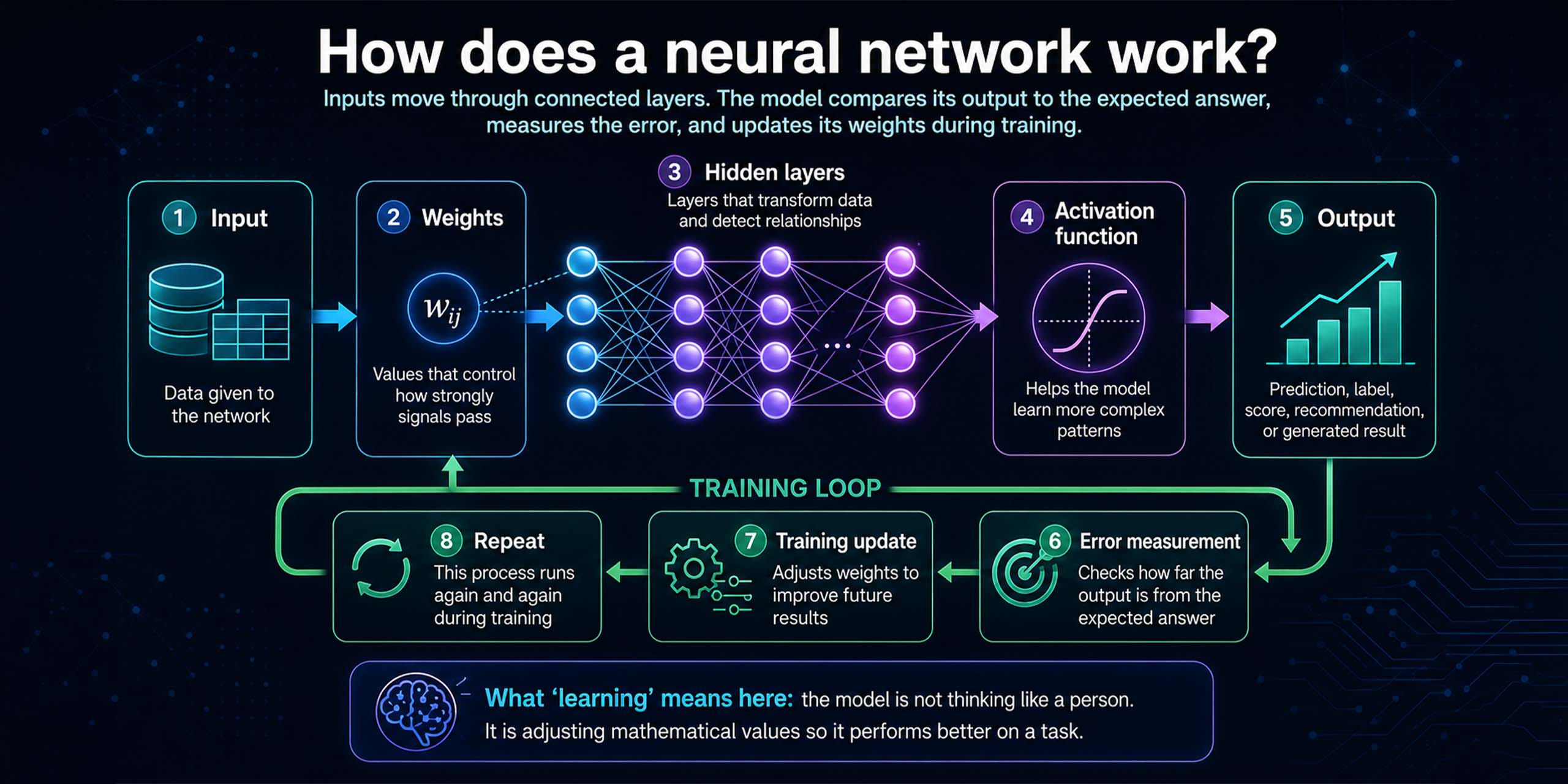
A neural network works by transforming inputs into outputs through layers of connected nodes. Each connection has a value, usually called a weight. During training, the network adjusts those weights so its predictions become more useful.
At first, a neural network usually performs badly. That is normal. It has not learned the patterns yet. During training, it receives examples, makes predictions, compares those predictions with the expected result, and adjusts its internal weights to reduce the error.
A simplified workflow looks like this:
- Input: the data given to the network.
- Weights: internal values that control how strongly signals pass between nodes.
- Activation function: a mathematical step that helps the network model more complex patterns.
- Hidden layers: layers that transform the data and detect relationships.
- Output: the prediction, label, score, recommendation, or generated result.
- Error measurement: the system checks how far the output is from the expected answer.
- Training update: the network adjusts its weights to improve future results.
That training process can repeat millions or billions of times depending on the model, the dataset, and the task. Over time, the network becomes better at producing the right output for similar inputs.
This is where neural networks become powerful. Instead of asking engineers to manually define every feature that matters, the model can learn useful representations from data. In an image system, it can learn visual features. In a speech system, it can learn sound patterns. In a language system, it can learn relationships between tokens, grammar, style, context, and meaning-like structures.
But “learn” still has a technical meaning here. The model is not developing understanding like a person. It is adjusting mathematical values so it performs better on a task.
That is impressive enough. No need to make it mystical.
Why do neural networks matter now?
Neural networks matter because they became the foundation of deep learning, and deep learning helped unlock much of the AI progress people now associate with modern technology.
Older AI systems often relied more heavily on hand-written rules, simpler statistical models, or features designed manually by engineers. Those approaches are still useful. But they can struggle with messy, high-dimensional data such as images, speech, natural language, video, code, and complex user behavior.
Neural networks are good at learning layered patterns from that kind of data. This is why they became so important in computer vision, speech recognition, machine translation, medical imaging, recommendation systems, robotics, and large language models.
The timing also matters. Neural networks have existed as an idea for a long time, but they became far more useful when three things came together: larger datasets, stronger computing power, and better training techniques. The internet produced oceans of data. GPUs made large-scale training more practical. Research progress made deep networks easier to train and scale.
That combination led to systems that could recognize images more accurately, transcribe speech more reliably, translate text more naturally, generate media, and process language in ways that felt far more flexible than earlier software.
For a deeper explanation of this wider field, read our guide to deep learning.
Real-world uses of neural networks
Neural networks are useful when a task involves complex patterns that are difficult to describe with simple rules.
In computer vision, neural networks can classify images, detect objects, recognize faces, analyze medical scans, inspect manufacturing defects, read visual documents, and help autonomous systems interpret the world around them.
In speech and audio, they can power voice assistants, transcription tools, speech recognition, speaker identification, audio cleanup, music generation, and real-time translation.
In natural language processing, neural networks help systems summarize text, translate languages, answer questions, classify documents, detect sentiment, and generate responses. Many large language models are built using neural network architectures. For the language-focused side of AI, read our guide to LLMs.
In recommendation systems, neural networks can help suggest videos, songs, products, articles, games, or posts by learning patterns in user behavior and content similarity.
In cybersecurity, they can detect anomalies, classify malware, identify suspicious behavior, filter alerts, and help analysts prioritize threats.
In healthcare, neural networks can support medical image analysis, research workflows, patient data organization, and administrative automation. These uses require careful validation because a confident model is not the same thing as a safe medical decision.
In finance, neural networks can support fraud detection, risk scoring, document analysis, market modeling, and compliance workflows. Accuracy, transparency, and oversight matter here because the consequences can affect people’s money and access.
In generative AI, neural networks can create text, images, audio, video, synthetic voices, code, and design concepts. This is the most visible version of AI today, but it sits on top of the same broader idea: layered systems learning patterns from data.
Common mistakes about neural networks
The first mistake is thinking a neural network works like a human brain. The brain comparison is useful as a rough metaphor, but it should not be taken too far. Artificial neural networks are mathematical systems, not biological minds.
The second mistake is assuming neural networks understand what they process. A model can recognize a face, generate a sentence, or classify a document without human-style understanding. It detects patterns and produces outputs based on training, not lived experience or common sense.
The third mistake is thinking neural networks are always the best solution. They can be powerful, but they can also be expensive, data-hungry, difficult to interpret, and unnecessary for simple tasks. Sometimes a decision tree, linear model, database query, rule-based system, or human checklist is the smarter tool.
The fourth mistake is ignoring training data. Neural networks learn from examples. If those examples are biased, incomplete, mislabeled, outdated, or poorly matched to the real-world task, the model can learn the wrong patterns.
The fifth mistake is trusting a model because it is complex. Complexity can improve performance, but it can also make a system harder to explain. In areas such as healthcare, finance, hiring, insurance, education, and law, opacity is not a small detail. People need to understand how decisions are made or at least how they are evaluated and controlled.
The sixth mistake is assuming performance stays stable forever. Data changes. User behavior changes. Fraud tactics change. Language changes. A neural network that works well at launch can become less reliable over time without monitoring.
A neural network is not magic. It is a powerful pattern machine, and pattern machines need careful testing.
Neural network vs related concepts
Neural networks sit inside a stack of AI terms that often get mixed together. Separating them makes the whole subject easier.
Artificial intelligence is the broad field of building systems that can perform tasks associated with intelligence, such as learning, perception, language, prediction, planning, and decision support.
Machine learning is one approach inside AI. It trains systems to learn patterns from data instead of relying only on rules written by humans. For more context, read our guide to machine learning.
A neural network is a model structure used in machine learning. It processes information through connected layers of nodes.
Deep learning is a subset of machine learning that uses neural networks with many layers. Put simply, deep learning is what happens when neural networks become layered enough to learn more complex representations.
An AI model is a trained system that produces outputs from inputs. A neural network can be one kind of AI model, but not every AI model is a neural network.
A large language model, or LLM, is a language-focused AI model. Modern LLMs are built using neural network architectures, especially transformer-based systems.
Generative AI creates new content such as text, images, audio, video, music, code, or synthetic data. Many generative AI systems rely on neural networks, but not all neural networks are generative.
Here is the clean version:
- AI: the broad field.
- Machine learning: AI systems that learn patterns from data.
- Neural network: a layered model structure made of connected nodes.
- Deep learning: machine learning using neural networks with many layers.
- AI model: a trained system that produces outputs from inputs.
- LLM: a neural-network-based model focused on language.
- Generative AI: AI that creates new content.
The easiest way to remember it: a neural network is not all of AI. It is one of the structures that made modern AI much more capable.
What beginners should remember
The most important thing to remember is that a neural network is a layered system for learning patterns from data. It receives an input, processes that input through connected layers, and produces an output.
That output can be a prediction, label, score, recommendation, translation, generated sentence, image, warning, or decision-support signal.
Neural networks are especially useful for complex data such as images, speech, language, video, code, and user behavior. They are a key reason modern AI can recognize objects, understand speech, generate text, recommend content, and create media from prompts.
But they are not magic and they are not minds. They are trained mathematical systems. They depend on data quality, evaluation, computing power, design choices, and human oversight.
The useful question is not “Is this a neural network?”
The better question is: what patterns is this network learning, from what data, for what task, and what happens if it gets the answer wrong?
That question cuts through most of the fog. Neural networks are powerful because they can learn patterns humans would struggle to write manually. They are risky when people confuse pattern recognition with understanding.
The network does the calculation. Humans still own the consequences.
What to Remember (FAQ)
What is a neural network in simple terms?
A neural network is an AI model structure made of connected layers that learn patterns from data and produce outputs such as predictions, labels, recommendations, or generated content.
Is a neural network the same as artificial intelligence?
No. Artificial intelligence is the broad field. A neural network is one kind of model structure used in machine learning and deep learning.
Why are neural networks called neural?
They are loosely inspired by networks of neurons in the brain, but artificial neural networks are mathematical systems. They do not work like human brains in a literal sense.
What are neural networks used for?
Neural networks are used for image recognition, speech recognition, language models, recommendations, fraud detection, cybersecurity, medical imaging, generative AI, and many other pattern-heavy tasks.
What is the difference between a neural network and deep learning?
A neural network is the model structure. Deep learning is a type of machine learning that uses neural networks with many layers to learn complex patterns.
Can neural networks make mistakes?
Yes. Neural networks can learn wrong patterns, fail on unfamiliar data, reproduce bias, or produce misleading outputs. They need testing, monitoring, and human oversight.
Sources: AWS, Google Developers, IBM