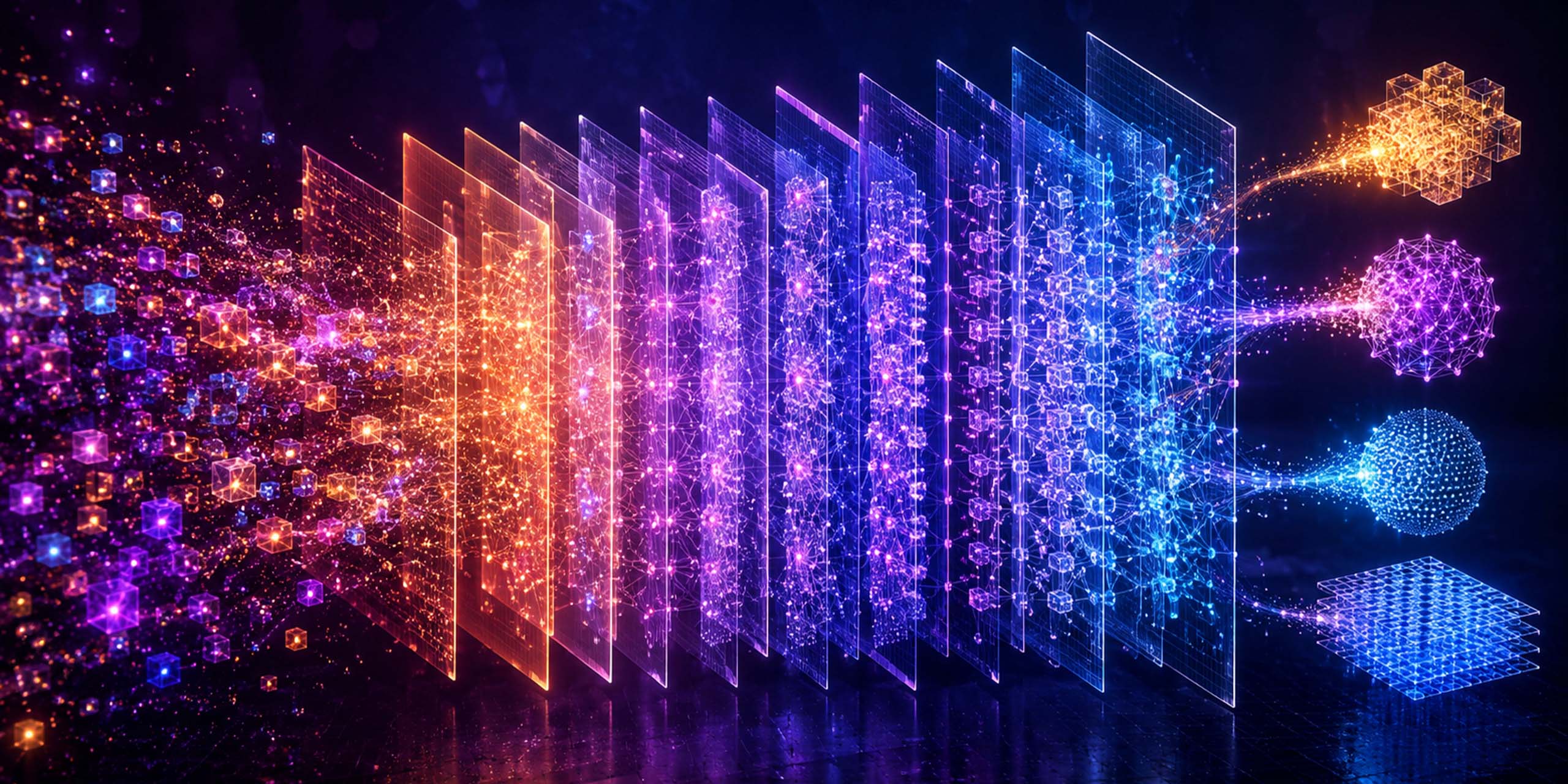
Deep learning is one of the main reasons artificial intelligence has become so powerful over the last decade. It sits behind image recognition, speech recognition, translation tools, recommendation systems, self-driving technology, medical imaging, large language models, and much of today’s generative AI.
The phrase sounds intimidating, mostly because it lives in the same neighborhood as neural networks, parameters, GPUs, training data, backpropagation, and other words that can make a normal person quietly close the tab. But the core idea is not impossible to understand.
The simple version is this: deep learning is a type of machine learning that uses neural networks with multiple layers to find patterns in data.
That “deep” part does not mean the machine has deep thoughts. It means the system has several layers that process information step by step. Each layer can detect different features, patterns, or relationships. Put enough layers together, train them on enough data, and the system can become very good at handling complex information such as images, speech, text, code, video, or sensor data.
Deep learning is not all of AI. It is not even all of machine learning. But it has become one of the most important engines behind modern AI because it is especially strong at learning from large amounts of messy, unstructured data — the kind of data the internet produces by the truckload.
Sommaire
- What is deep learning?
- How does deep learning work?
- Why does deep learning matter now?
- Real-world uses of deep learning
- Common mistakes about deep learning
- Deep learning vs related concepts
- What beginners should remember
- What to Remember (FAQ)
What is deep learning?
Deep learning is a subset of machine learning, which itself is a major approach inside artificial intelligence. Machine learning is about training systems to learn patterns from data. Deep learning does that using a specific kind of structure: artificial neural networks with many layers.
A neural network is inspired, loosely, by the way biological brains process information. That comparison is useful up to a point and then becomes dangerous. A neural network is not a tiny brain trapped in a server. It is a mathematical system made of connected units, often called nodes or neurons, that process signals and pass information through layers.
In a simple image recognition example, early layers might detect basic visual features such as edges, colors, or shapes. Deeper layers may combine those features into more complex patterns: eyes, wheels, textures, faces, animals, road signs, or objects. The model does not “see” like a human. It learns statistical patterns that help it produce the right output.
That layered structure is why deep learning became so useful for complex tasks. Some patterns are too subtle or too messy to describe with hand-written rules. You could spend years trying to manually define every sign of a cat, a spoken word, a suspicious transaction, or a sentence that sounds natural. Deep learning lets the model learn many of those patterns from examples instead.
This is also why deep learning needs data. Lots of it. The more complex the task, the more examples the model usually needs to learn useful patterns. It also needs significant computing power, especially for large models. That is one reason GPUs and cloud infrastructure became so closely tied to the AI boom.
For the broader technical foundation, read our guide to AI models.
How does deep learning work?
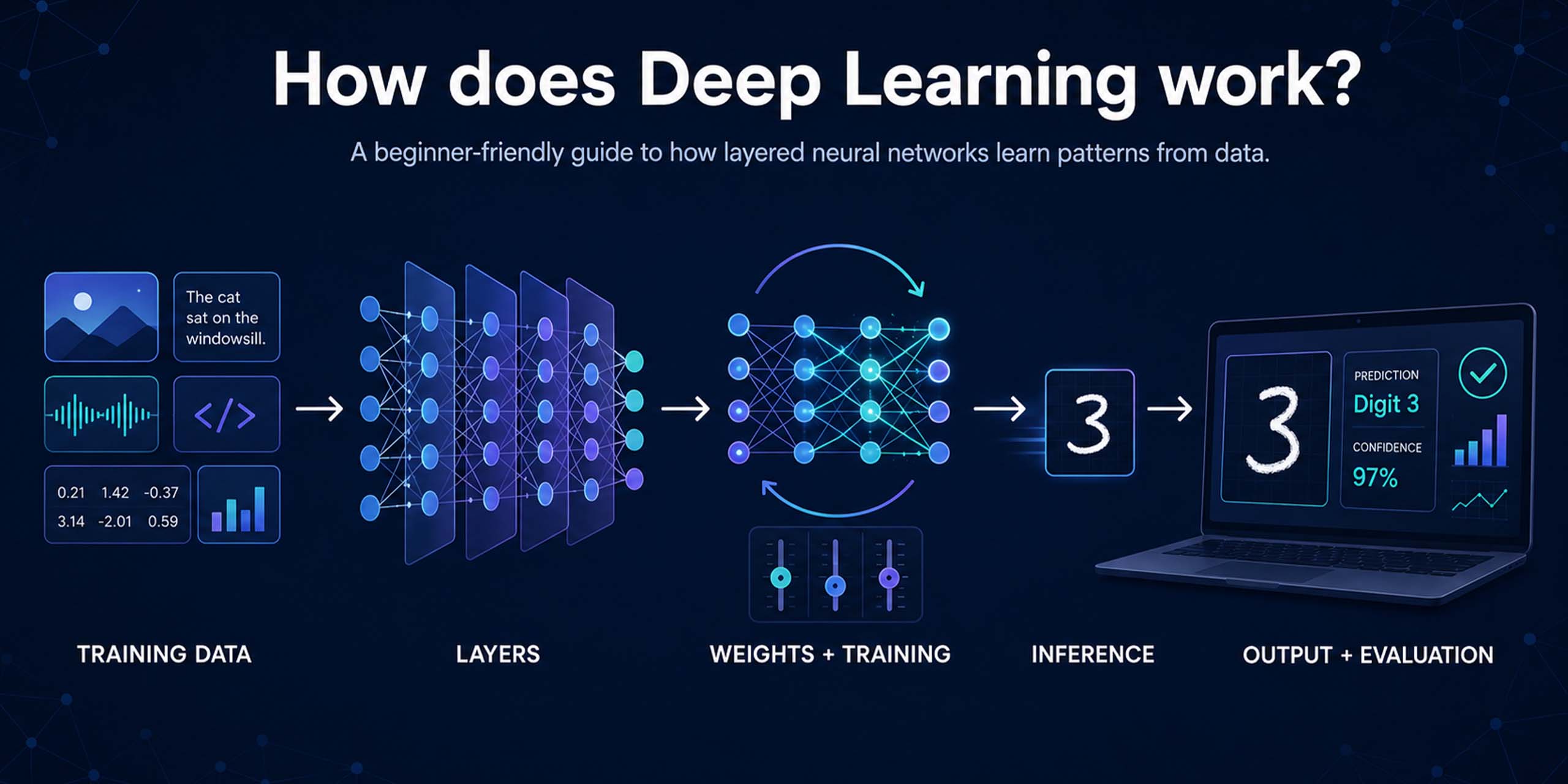
Deep learning works by passing data through layers of a neural network. Each layer transforms the information a little, and the final layer produces an output: a label, prediction, generated response, recommendation, classification, or other result.
Imagine a model trained to recognize handwritten numbers. The input is an image. The first layers may detect simple shapes and strokes. Later layers may learn combinations of lines and curves. The final layer estimates whether the image is a 0, 1, 2, 3, or another digit. The model does not start out knowing the answer. It learns through training.
A simplified deep learning workflow looks like this:
- Training data: examples used to teach the model, such as images, text, audio, code, video, or numerical records.
- Neural network: a layered model that processes the data.
- Layers: stages that transform information and detect patterns.
- Weights: internal values adjusted during training.
- Training: the process where the model improves by comparing its outputs with expected results.
- Inference: the moment when the trained model receives new input and produces an output.
- Evaluation: testing whether the model performs well on data it has not seen before.
During training, the model makes predictions, measures how wrong those predictions are, and adjusts its internal weights to improve. Repeat that process many times across large datasets, and the model can become better at recognizing patterns.
This is where deep learning gets its power. Instead of relying only on manually designed features, deep learning models can learn their own useful representations from raw data. An older image system might require engineers to manually define visual features. A deep learning system can learn many of those features during training.
That does not mean the system is automatically smart. A model can learn the wrong patterns, overfit to its training data, perform badly on unusual examples, or fail when the real world changes. Good deep learning still requires clean data, careful design, strong evaluation, and ongoing monitoring.
The machine may be learning, but humans still need to know what it is learning — and what it might be missing.
Why does deep learning matter now?
Deep learning matters because it unlocked a wave of AI systems that are much better at handling complex data. Images, speech, natural language, video, and code are not neat spreadsheets. They are messy, high-dimensional, and full of context. Deep learning turned out to be very good at finding useful patterns in that mess.
That is why deep learning became central to modern computer vision, speech recognition, machine translation, recommendation systems, robotics, medical image analysis, and large language models. It is also one of the foundations behind generative AI systems that create text, images, audio, code, and video.
The timing matters too. Deep learning needed three things to become practical at scale: large datasets, more computing power, and better model architectures. The internet produced enormous amounts of data. GPUs and cloud platforms made large-scale training more realistic. Research progress gave developers better ways to train deeper and more capable networks.
The result is the AI world we now recognize: models that can describe images, generate text, translate languages, recognize speech, assist with code, detect objects, recommend content, and create new media from prompts.
For businesses, deep learning matters because it can automate tasks that once seemed too complex for software. For creators, it powers tools that generate images, clean audio, edit video, and support writing. For developers, it supports coding assistants and model-based products. For researchers, it helps analyze huge datasets that would be impossible to inspect manually.
But deep learning also brings heavier costs and risks. Large models can be expensive to train, difficult to interpret, energy-intensive, hard to debug, and dependent on huge amounts of data. They can also reproduce bias, make confident mistakes, or behave unpredictably outside their training environment.
Deep learning is powerful because it can learn complex patterns. That is also why it needs serious evaluation.
Real-world uses of deep learning
Deep learning is strongest when the data is complex and the patterns are hard to write manually.
In computer vision, deep learning can classify images, detect objects, recognize faces, analyze medical scans, inspect manufacturing defects, read license plates, and help autonomous systems understand their surroundings. This is one of the areas where deep learning changed the game most visibly.
In speech and audio, deep learning can power voice assistants, transcription tools, speech recognition, audio cleanup, speaker identification, music generation, and real-time translation. The jump in speech tools over the past decade owes a lot to deep neural networks.
In natural language processing, deep learning helps systems summarize text, translate languages, classify documents, detect sentiment, answer questions, and generate responses. Large language models are part of this broader evolution. For more on that specific branch, read our guide to LLMs.
In generative AI, deep learning models can create text, images, audio, video, music, synthetic voices, code, and design concepts. These tools get most of the attention because they produce visible outputs, but they are only one part of the deep learning landscape. For the creative side of the topic, read our guide to generative AI.
In healthcare, deep learning can help detect patterns in medical images, support drug discovery, analyze patient data, and reduce administrative workload. The potential is real, but so is the responsibility. A model used in healthcare needs validation, oversight, and clear human accountability.
In cybersecurity, deep learning can help detect anomalies, classify malware, identify suspicious behavior, and prioritize alerts. Security teams deal with overwhelming volumes of data, which makes pattern detection valuable — as long as false positives and false negatives are taken seriously.
In finance, deep learning can support fraud detection, risk analysis, market modeling, document processing, and compliance workflows. These are high-stakes areas, so accuracy, explainability, and oversight matter more than flashy demos.
In gaming and entertainment, deep learning can support animation, voice synthesis, procedural content, content moderation, recommendation systems, upscaling, localization, and virtual characters.
The common thread is clear: when the data is rich, noisy, and difficult to describe with simple rules, deep learning often becomes useful.
Common mistakes about deep learning
The first mistake is thinking deep learning is the same as AI. It is not. Deep learning is one method inside machine learning, and machine learning is one part of artificial intelligence. AI is the broad field. Deep learning is one powerful branch.
The second mistake is assuming deep learning always beats simpler methods. It does not. If the task is narrow, the data is small, or the rules are clear, a simpler machine learning model — or even a traditional rule-based system — may be cheaper, faster, easier to explain, and more reliable. Not every problem needs a giant neural network doing dramatic GPU yoga in the basement.
The third mistake is thinking deep learning understands like a human. A deep learning model can recognize patterns at impressive scale, but that is not the same as human understanding. It does not have lived experience, intention, common sense, or responsibility.
The fourth mistake is ignoring the data problem. Deep learning systems are hungry. They often need large amounts of training data, and the quality of that data matters. If the dataset is biased, incomplete, mislabeled, outdated, or poorly matched to the real-world task, the model can learn the wrong thing very efficiently.
The fifth mistake is trusting the output because the system is complex. Complexity can make a model powerful, but it can also make it harder to understand. Some deep learning systems are difficult to interpret, which becomes a problem when decisions affect health, money, employment, safety, or legal rights.
The sixth mistake is forgetting that models drift. The world changes. User behavior changes. Fraud tactics change. Language changes. A model that performed well during testing may become less reliable later if it is not monitored.
The seventh mistake is treating deep learning as magic rather than engineering. Good deep learning requires data pipelines, training, evaluation, deployment, monitoring, security, cost control, and human judgment. The impressive demo is usually the easiest part to show and the hardest part to turn into a dependable system.
Deep learning vs related concepts
Deep learning sits inside a stack of related AI concepts. Getting the hierarchy right makes the whole field easier to understand.
Artificial intelligence is the broad field of building systems that can perform tasks associated with intelligence, such as learning, perception, language, prediction, planning, and decision support.
Machine learning is a major approach inside AI. It trains systems to learn patterns from data instead of relying only on hand-written rules.
Deep learning is a subset of machine learning that uses neural networks with multiple layers. It is especially useful for complex data such as images, speech, text, video, and code.
A neural network is the model structure behind deep learning. It is made of connected layers of nodes that process information. Deep learning uses neural networks with enough layers to learn more complex representations.
An AI model is a trained system that produces outputs from inputs. A deep learning model is one kind of AI model.
A large language model, or LLM, is a deep learning model focused on language. Many LLMs use transformer-based architectures to process and generate text.
Generative AI refers to AI systems that create new content. Many generative AI systems rely on deep learning, but not all deep learning is generative. Some deep learning systems classify, detect, predict, or rank instead of creating.
Here is the clean version:
- AI: the broad field.
- Machine learning: AI systems that learn patterns from data.
- Deep learning: machine learning using multi-layer neural networks.
- Neural network: the layered model structure used in deep learning.
- AI model: a trained system that produces outputs from inputs.
- LLM: a deep learning model focused on language.
- Generative AI: AI that creates new content.
The simplest way to remember it: deep learning is not a rival to machine learning. It is one of machine learning’s most powerful forms.
What beginners should remember
The most important thing to remember is that deep learning uses layered neural networks to learn complex patterns from data.
That makes it especially useful for tasks involving images, speech, language, video, code, and other messy forms of information. It is one of the core technologies behind modern AI, including many large language models and generative AI tools.
But deep learning is not automatically better than every other method. It can be expensive, data-hungry, difficult to interpret, and risky when used without proper evaluation. A small, clear model may be better for a simple business problem. A rule-based system may be safer for a fixed workflow. Sometimes the smartest AI decision is not to use the most complicated AI available.
The useful question is not “Can we use deep learning here?”
The better question is: do we have the right data, the right task, the right evaluation, and a good reason to use a model this complex?
Deep learning is powerful because it can find patterns humans would struggle to define manually. Used well, it can make software more perceptive, more adaptive, and more capable. Used carelessly, it can turn a poorly understood dataset into a very confident mistake machine.
The depth is in the layers. The responsibility is still human.
What to Remember (FAQ)
What is deep learning in simple terms?
Deep learning is a type of machine learning that uses neural networks with multiple layers to learn patterns from data and produce outputs such as predictions, labels, recommendations, or generated content.
Is deep learning the same as artificial intelligence?
No. Artificial intelligence is the broad field. Deep learning is a subset of machine learning, which is one major approach inside AI.
What is deep learning used for?
Deep learning is used for image recognition, speech recognition, language models, translation, recommendation systems, medical imaging, cybersecurity, generative AI, robotics, and many other pattern-heavy tasks.
What is the difference between machine learning and deep learning?
Machine learning is the broader approach of training systems on data. Deep learning is a type of machine learning that uses neural networks with many layers to learn more complex patterns.
Does deep learning need a lot of data?
Often, yes. Deep learning systems usually need large amounts of relevant data and significant computing power, especially for complex tasks such as language, images, audio, or video.
Is deep learning always the best choice?
No. Deep learning can be powerful, but it can also be expensive, hard to interpret, and unnecessary for simple tasks. Smaller models or rule-based systems may be better in some cases.
Sources: IBM, Google Cloud, AWS