A Transformer is one of the most important architectures in modern artificial intelligence. It sits behind many large language models, chatbots, translation systems, coding assistants, summarization tools, search assistants, and generative AI products.
The name is confusing if you are not already deep in machine learning. No, this is not about robots turning into trucks. In AI, a Transformer is a type of neural network architecture designed to process relationships inside sequences of data — especially text.
The simple version is this: a Transformer is an AI architecture that uses attention to understand which parts of an input matter most in context.
That idea changed modern AI. Before Transformers became dominant, many language systems processed text more sequentially, step by step, with less ability to handle long-range context efficiently. Transformers made it easier for models to look across a whole passage, weigh the relationships between words or tokens, and process information at massive scale.
This is why Transformers are so closely tied to large language models. When people talk about GPT-style systems, modern chatbots, AI copilots, and many generative text tools, they are often talking about Transformer-based models somewhere under the hood.
The architecture is technical. The impact is simple: Transformers helped turn AI from a narrow pattern tool into something much better at language, context, and generation.
Sommaire
- What is a Transformer in AI?
- How does a Transformer work?
- What is self-attention?
- Why do Transformers matter now?
- Real-world uses of Transformers
- Common mistakes about Transformers
- Transformer vs related concepts
- What beginners should remember
- What to Remember (FAQ)
What is a Transformer in AI?
A Transformer is a type of neural network architecture used in deep learning. It was designed to process sequences of information, such as words in a sentence, tokens in a prompt, lines of code, frames in a video, or other ordered data.
Transformers became famous because they dramatically improved how AI systems handle language. They are especially good at tracking relationships between different parts of a text. In a sentence, the meaning of one word often depends on words that appear much earlier or later. A Transformer can help a model weigh those relationships more effectively.
Take this sentence: “The game studio delayed its trailer because it wanted more time to polish the reveal.”
A human understands that “it” probably refers to the game studio, not the trailer. A language model needs a way to track that relationship. The Transformer architecture helps by letting the model compare tokens with other tokens and decide which ones are most relevant in context.
That is the basic idea behind attention.
Transformers are not limited to text, but language is where they became impossible to ignore. Modern large language models use Transformer-based architectures to generate, summarize, translate, classify, explain, and restructure text. For the broader concept, read our guide to LLMs.
A Transformer is not the same thing as an AI product. It is not ChatGPT, Gemini, Claude, Llama, or any specific chatbot. It is an architecture that can be used to build models. The app is what users see. The model is the trained system. The Transformer is one of the design patterns that can make that model work.
How does a Transformer work?
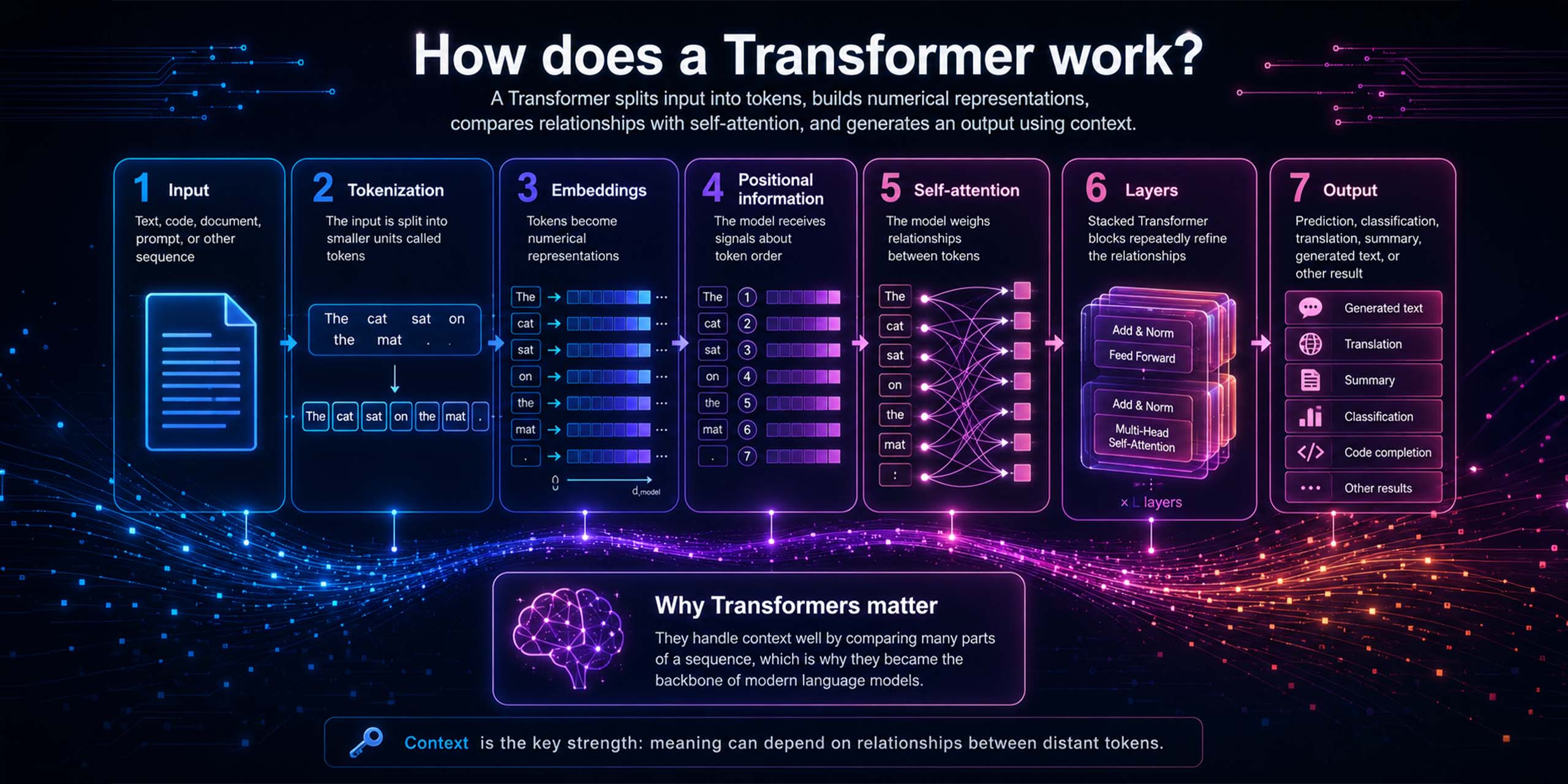
A Transformer works by converting input data into smaller units, processing relationships between those units, and producing an output based on context.
In language models, those units are usually tokens. A token can be a word, part of a word, punctuation, a symbol, or another chunk of text. The model does not read language exactly like humans do. It turns text into tokens, converts those tokens into numerical representations, and processes them through layers of the network.
A simplified Transformer workflow looks like this:
- Input: the text, code, document, prompt, or other sequence given to the model.
- Tokenization: the input is split into smaller units called tokens.
- Embeddings: tokens are converted into numerical representations the model can process.
- Positional information: the model receives signals about token order, because word order matters.
- Self-attention: the model weighs relationships between tokens in the sequence.
- Layers: the model repeatedly refines those relationships through stacked Transformer blocks.
- Output: the model produces a prediction, classification, translation, summary, generated text, or other result.
The Transformer’s strength comes from how it handles context. Instead of reading text only one piece at a time in strict order, it can compare many parts of the sequence with one another. That makes it especially useful for language, where meaning often depends on distant relationships.
The architecture also scales well. Transformers can be trained with enormous datasets and many parameters, which is one reason they became the backbone of large language models. Scale alone is not everything, but Transformers made scaling much more effective for language tasks.
For a broader explanation of trained systems, read our guide to AI models.
What is self-attention?
Self-attention is the core idea that makes Transformers different from many earlier neural network approaches.
In simple terms, self-attention lets the model decide which parts of an input are most relevant to each other. Every token can “look at” other tokens in the sequence and weigh how much they matter for understanding the current context.
Imagine the sentence: “The artist uploaded her portfolio after she finished the cover.”
To understand “she,” the model needs to connect it with “the artist.” To understand “the cover,” it may need to know that this is a creative context, not a physical lid. Self-attention helps the model build those relationships by comparing tokens across the sentence.
The word “attention” sounds almost human, but it is not. The model is not focusing like a person. It is calculating relationships between numerical representations. Some relationships get more weight. Others get less. The result is a richer sense of context.
Modern Transformers often use multi-head attention. That means the model can look at relationships in several different ways at once. One attention head might focus on grammar. Another might track subject-object relationships. Another might capture style, structure, or long-range dependencies. The model does not label them so neatly for our convenience, of course, but the idea is that multiple attention heads allow richer pattern detection.
This is one reason Transformers became so effective for language. Words do not carry meaning alone. They carry meaning through relationships. Self-attention gives models a powerful way to map those relationships at scale.
Why do Transformers matter now?
Transformers matter because they became one of the main foundations of the modern AI boom. They made language models much more capable, scalable, and flexible than many earlier approaches.
Before Transformers, many sequence models relied heavily on recurrent neural networks, which processed information step by step. Those systems could be useful, but they had limits when dealing with long passages and large-scale training. Transformers helped solve part of that problem by making it easier to process relationships across a sequence in parallel.
That parallelism matters. It means Transformer models can train more efficiently on modern hardware and scale to much larger datasets. Bigger datasets, more computing power, and better architecture all reinforced one another. That combination helped produce the large language models and generative AI systems now reshaping software.
This is why Transformers are behind so many tools that feel suddenly more capable: chatbots that maintain context, coding assistants that understand longer files, summarizers that process documents, translation systems that sound more natural, and AI search tools that combine language with retrieval.
Transformers also matter beyond text. They have influenced computer vision, speech recognition, audio processing, time-series forecasting, robotics, multimodal AI, and video systems. The same core idea — weighing relationships inside data — turns out to be useful in many domains.
Still, Transformers are not magic. They can be expensive to train, memory-hungry, difficult to interpret, and prone to producing wrong or misleading outputs when used inside language models. They are powerful architecture, not automatic truth machines.
That distinction is important. Transformers explain why modern AI became more capable. They do not remove the need for good data, evaluation, oversight, safety, and common sense.
Real-world uses of Transformers
Transformers are most famous for language, but their influence now reaches far beyond chatbots.
In large language models, Transformers help generate text, summarize documents, translate languages, classify information, answer questions, explain concepts, and assist with writing. Most modern LLMs are built on Transformer-style architectures.
In coding tools, Transformers can help generate code, explain functions, suggest fixes, write tests, document APIs, and reason across files. Code is not natural language, but it is structured language, which makes it a strong fit for Transformer-based systems.
In search and research tools, Transformers can help understand queries, rank information, summarize sources, extract answers, and connect related concepts. They are especially useful when combined with retrieval systems that provide external documents as context.
In translation, Transformers improved the ability of machine translation systems to handle context, grammar, and long-range relationships between words. That was one of the original areas where the architecture showed its strength.
In computer vision, Transformer-based models can classify images, detect objects, segment scenes, and support multimodal systems that connect images with text. Not every vision system is a Transformer, but the architecture has become important well beyond language.
In audio and speech, Transformers can support transcription, voice recognition, speech translation, speaker analysis, music generation, and audio understanding.
In business software, Transformer-based models can summarize meetings, draft reports, analyze documents, classify tickets, generate emails, extract structured information, and power AI assistants inside productivity tools.
In generative AI, Transformers can help create text, code, images, audio, and multimodal outputs. For the broader creative category, read our guide to generative AI.
The common thread is context. Transformers are useful when a system needs to understand relationships inside complex data: words in a paragraph, functions in code, regions in an image, moments in audio, or elements in a multimodal prompt.
Common mistakes about Transformers
The first mistake is thinking a Transformer is the same thing as a chatbot. A chatbot is an interface. A Transformer is an architecture that can be used to build the model behind the interface. The user types into the product. The model does the prediction. The architecture shapes how the model processes information.
The second mistake is thinking Transformers understand like humans. They are very good at modeling relationships in data, especially language, but that is not the same as lived understanding, common sense, intention, or responsibility. A Transformer-based model can produce fluent nonsense with a straight face, which is rude but very on-brand for modern software.
The third mistake is assuming attention means human attention. Self-attention is a mathematical mechanism. It measures relationships between tokens or data elements. It is not consciousness. It is not focus in the psychological sense. It is pattern weighting.
The fourth mistake is believing Transformers are always the best architecture. They are powerful, but they can be expensive, data-hungry, and inefficient for some tasks. Other architectures can be better for smaller datasets, real-time systems, edge devices, or narrow prediction problems.
The fifth mistake is ignoring the context window. Transformer-based language models can only consider a limited amount of information at once. That limit has grown dramatically in recent years, but it still matters. If important information is outside the context window, the model cannot use it unless the system retrieves or summarizes it.
The sixth mistake is treating scale as intelligence. Larger Transformer models can be more capable, but size alone does not guarantee accuracy, reliability, safety, or usefulness. A smaller well-designed model can be better for a specific task than a huge general model.
The seventh mistake is forgetting the cost. Transformers can require serious computing power, especially during training and large-scale inference. That affects price, energy use, latency, infrastructure, and who can realistically build or deploy the biggest systems.
Transformers changed AI, but they did not cancel engineering trade-offs. They just made the trade-offs more interesting.
Transformer vs related concepts
Transformers sit inside a stack of AI terms that are often used interchangeably. They should not be.
Artificial intelligence is the broad field of building systems that can perform tasks associated with intelligence, such as perception, learning, language, prediction, planning, and decision support.
Machine learning is an approach inside AI where systems learn patterns from data instead of relying only on hand-written rules.
Deep learning is a subset of machine learning that uses neural networks with multiple layers. Transformers are part of the deep learning world. For more context, read our guide to deep learning.
A neural network is a model structure made of connected layers. A Transformer is a specific kind of neural network architecture designed around attention mechanisms. For the foundation, read our guide to neural networks.
An AI model is the trained system that produces outputs from inputs. A Transformer-based model is an AI model built using Transformer architecture.
A large language model, or LLM, is an AI model focused on language. Many modern LLMs are Transformer-based, but the LLM is the trained model, while the Transformer is the architecture.
Generative AI is AI that creates new content. Many generative AI systems use Transformer-based models, but not every Transformer is generative and not every generative system is only a Transformer.
Here is the clean version:
- AI: the broad field.
- Machine learning: AI systems that learn patterns from data.
- Deep learning: machine learning using multi-layer neural networks.
- Neural network: a layered model structure.
- Transformer: a neural network architecture built around attention.
- LLM: a language-focused AI model, often Transformer-based.
- Generative AI: AI that creates new content.
The easiest way to remember it: a Transformer is not the whole AI system. It is one of the architectural breakthroughs that made modern AI systems far more capable.
What beginners should remember
The most important thing to remember is that a Transformer is an AI architecture built around attention. It helps models weigh relationships between different parts of an input, especially in language.
That is why Transformers are so important for LLMs. Language depends on context. A word, sentence, question, or instruction only makes sense because of the other words around it. Transformers gave models a better way to process those relationships at scale.
They also helped AI scale. Transformer models can process sequences more efficiently than many older approaches, which made them a strong fit for huge datasets and modern computing hardware. That combination helped power the rise of chatbots, AI copilots, translation tools, summarizers, code assistants, and generative AI systems.
But Transformers are not magic. They do not understand like humans. They can produce wrong answers. They can be expensive. They can struggle when context is missing, data is weak, or the task requires judgment rather than pattern completion.
The useful question is not “Is this model a Transformer?”
The better question is: what context does this model use, what relationships can it track, and how reliable is its output for the task?
Transformers changed AI because they made context easier to model. The rest — accuracy, safety, usefulness, responsibility — still depends on how the system is trained, deployed, and used.
What to Remember (FAQ)
What is a Transformer in AI in simple terms?
A Transformer is a neural network architecture that uses attention to understand relationships between parts of an input, such as words in a sentence or tokens in a prompt.
Why are Transformers important?
Transformers are important because they made modern language models much more powerful, scalable, and useful for tasks such as writing, translation, summarization, coding, and chatbots.
Is ChatGPT based on a Transformer?
ChatGPT is powered by large language models that use Transformer-based architecture. The app is the interface, while the Transformer architecture helps the underlying model process language.
What is self-attention?
Self-attention is a mechanism that lets a model weigh which parts of an input are most relevant to each other. It helps the model understand context across a sequence.
Is a Transformer the same as an LLM?
No. A Transformer is an architecture. An LLM is a trained language model, often built using Transformer architecture.
Are Transformers only used for text?
No. Transformers became famous through language models, but they are also used in computer vision, speech, audio, multimodal AI, coding tools, time-series analysis, and other fields.
Sources: Attention Is All You Need, Google Developers, IBM